Youth Unrest under Neoliberalism: Causes, Impact, and Remedies
#GS-1 #Indian Society #Social Justice #Vulnerable Sections #Effects of Globalization #GS-2 #Indian Polity & Constitution #Constitution #Governance & Social Justice #Poverty #Current Events #National #International #GS-3 #Economy #Employment #Growth #Infrastructure #Environment #Climate Change #Demographics #Fundamental Rights
Key takeaways
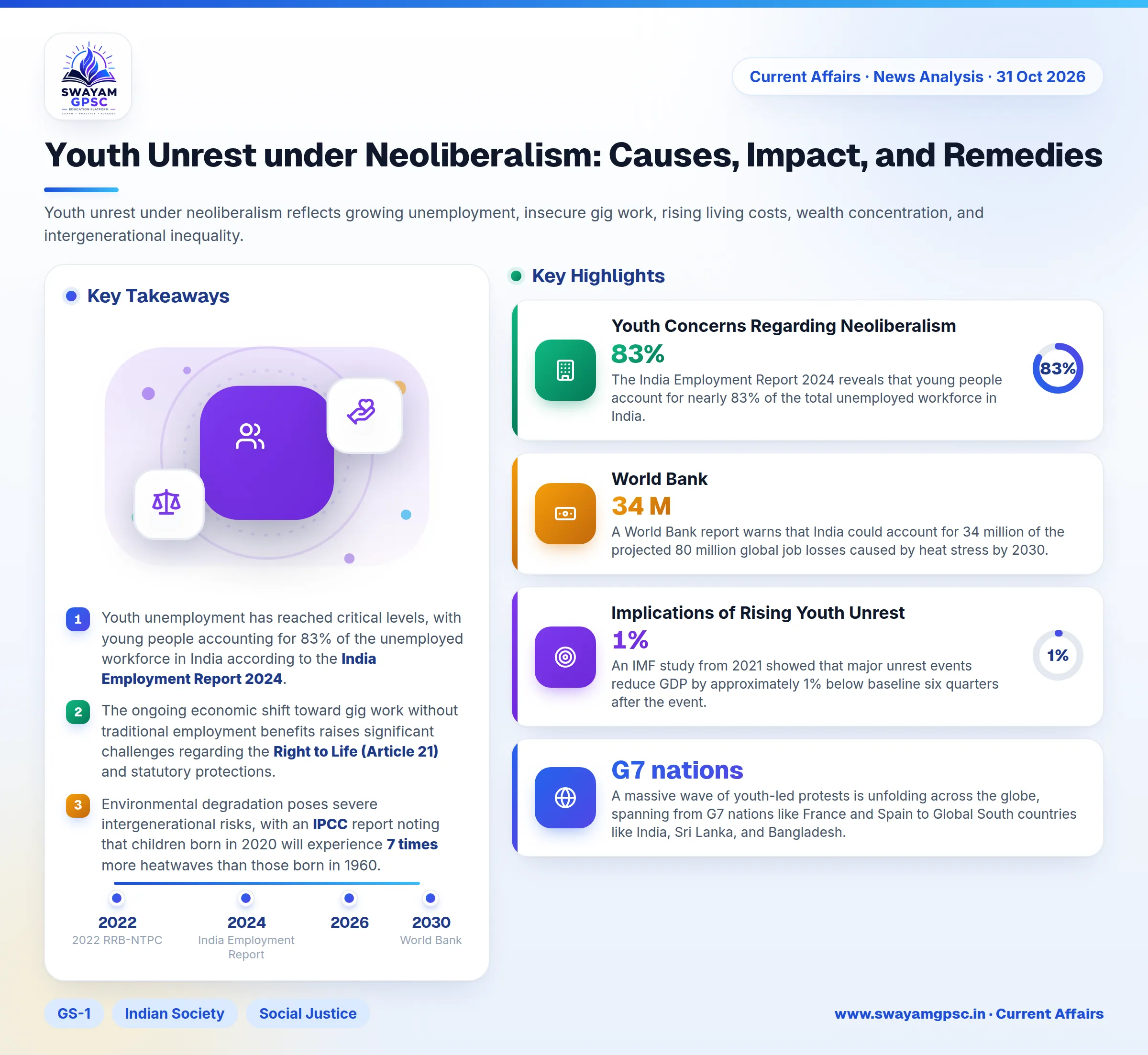
- Youth unemployment has reached critical levels, with young people accounting for 83% of the unemployed workforce in India according to the India Employment Report 2024.
- The ongoing economic shift toward gig work without traditional employment benefits raises significant challenges regarding the Right to Life (Article 21) and statutory protections.
- Environmental degradation poses severe intergenerational risks, with an IPCC report noting that children born in 2020 will experience 7 times more heatwaves than those born in 1960.
- Heat stress caused by climate change threatens severe workforce productivity losses, with the World Bank projecting 34 million job losses in India by 2030.
- Major social unrest events directly impact economic performance, reducing a nation's GDP by approximately 1% over six quarters according to IMF research.
Why in News
- A massive wave of youth-led protests is unfolding across the globe, spanning from G7 nations like France and Spain to Global South countries like India, Sri Lanka, and Bangladesh.
- These widespread mobilizations represent a collective response to the systemic failures of neoliberal capitalism.
- The economic model has systematically weakened public welfare systems while causing the cost of living to skyrocket.
- It has also severely worsened youth unemployment levels worldwide, driving frustration among the younger population.
Summary
- Youth unrest under neoliberalism reflects growing unemployment, insecure gig work, rising living costs, wealth concentration, and intergenerational inequality.
- These compounding socioeconomic issues pose a direct threat to global social cohesion and democratic stability.
- Resolving these challenges requires building stronger welfare systems, establishing robust labor protections, and implementing progressive wealth redistribution policies.
- Governments must also focus on future-oriented skill development and green job creation to ensure inclusive growth and intergenerational justice.
What is Neoliberalism
- Neoliberalism is a political and economic ideology that gained global dominance post-1970s as a counter-revolution to the state-led Golden Age of Capitalism (1945-1973).
- It fundamentally advocates for free-market capitalism, minimal government intervention, and comprehensive economic liberalization.
- The ideology relies on the belief that markets operate most efficiently when completely free from government intervention.
- It promotes an aggressive reduction in public expenditure, government subsidies, and social safety nets.
- It pushes for deregulation and privatization by removing state controls over finance and transferring public utilities to private corporations.
- It enforces labor market flexibility by dismantling labor unions to lower wage costs, using the threat of unemployment to discipline the workforce.
Youth Concerns Regarding Neoliberalism
- Neoliberalism suppressed wages to maximize corporate profits, causing a sharp decline in the purchasing power of the working class.
- Heterodox economic theories on underconsumption explain that when workers cannot afford goods, capitalists stop investing, leading to a severe lack of labor demand.
- Youth unemployment rates in G7 countries have now climbed to nearly twice the rate of overall unemployment.
- The India Employment Report 2024 reveals that young people account for nearly 83% of the total unemployed workforce in India.
- This systemic failure directly contradicts Article 41 of the Constitution, which mandates the State to secure the Right to Work and public assistance during unemployment.
- Under neoliberal policies, higher education shifted from being a public good into a profit-driven private industry.
- Young people face skyrocketing tuition fees and heavy student debt, only to enter a labor market marked by credential inflation and few good jobs.
- Labor market flexibility replaced secure, pensionable, and unionized jobs with contract work, zero-hour contracts, and gig economy roles.
- This shift stripped young workers of job security, medical benefits, and collective bargaining rights.
- This precarity undermines the state obligation to safeguard the Right to Livelihood, which the Supreme Court included under the Right to Life (Article 21) in Olga Tellis vs. Bombay Municipal Corporation (1985).
- The Code on Social Security, 2020 recognizes gig workers and platform workers, but it fails to grant them standard employee status or guaranteed minimum wages.
- Young women face a double burden as state welfare shrinks, forcing them into unpaid care work or the lowest tiers of the gig economy.
- Capital-intensive economic growth alongside advancements in Artificial Intelligence (AI) is eroding entry-level white-collar jobs that previously offered social mobility.
- The pursuit of endless resource-intensive growth has shifted severe environmental costs onto younger generations who contributed the least to global warming.
- A 2021 IPCC study indicates that a child born in 2020 will face 7 times more heatwaves and 2.8 times more floods compared to someone born in 1960.
- A World Bank report warns that India could account for 34 million of the projected 80 million global job losses caused by heat stress by 2030.
- Prolonged pro-capital policies have inflated real estate prices, pricing young people out of homeownership and trapping them in rentier capitalism.
- This extreme concentration of wealth violates Article 38(2) regarding income equality and Article 39(b) & (c) regarding the equitable distribution of material resources.
- The state has systematically transferred economic risks onto individuals, such as moving from state-backed pensions to volatile market-linked retirement funds.
- Perceived political corruption, nepotism, and weak institutional responsiveness erode trust in democratic systems, driving protests across regions like Albania and Europe.
How Current Youth Unrest Differs from Historical Movements
- In 1968, youth operating within strong welfare states protested for social and cultural freedoms, whereas modern youth demand basic economic protections due to state withdrawal.
- Historical movements were led by organized industrial workers, while today unrest is driven by the precariat, consisting of indebted gig workers and unemployed graduates.
- The 2022 RRB-NTPC railway protests in Uttar Pradesh and Bihar illustrated this shift as educated youth demonstrated for a shrinking pool of formal government jobs.
- Past protests were guided by charismatic leaders like Jayaprakash Narayan and structured unions, whereas modern mobilizations are decentralized and organized via social media.
- Unlike the revolutionary optimism of the 1960s and 1970s, modern Gen Z is driven by eco-anxiety and a polycrisis mindset shaped by the 2008 financial crash, Covid-19, and climate change.
Implications of Rising Youth Unrest
- Prolonged social unrest disrupts economic activities, damages business confidence, and deters potential long-term investments.
- An IMF study from 2021 showed that major unrest events reduce GDP by approximately 1% below baseline six quarters after the event.
- Persistent economic grievances exacerbate political polarization and open opportunities for populist or extremist political movements.
- The 2026 protests in France demonstrate how socioeconomic dissatisfaction can become deeply intertwined with electoral politics and public order issues.
- Unaddressed youth grievances and inadequate public services weaken public trust in democratic institutions, damaging social cohesion.
- Constructive and peaceful youth mobilization can promote political accountability, encourage policy reforms, and increase civic participation.
Way Forward
- Governments must enforce the 2020 recommendations of the Parliamentary Standing Committee on Labour to clearly define employer-employee relationships in the gig economy.
- The Code on Social Security, 2020 should be amended to guarantee living wages, algorithmic transparency, and mandatory health insurance for platform workers.
- States should pivot toward Universal Basic Services by offering high-quality public healthcare, education, and affordable social housing to reduce living costs.
- Existing targeted welfare schemes like Ayushman Bharat (PM-JAY) and Pradhan Mantri Awas Yojana (PMAY) should be progressively expanded toward universal access.
- Implementing the World Inequality Lab recommendations on progressive taxation can generate public funds needed for youth welfare and green energy investments.
- The education framework must shift away from degree-centric models by integrating aggressive vocational training under the National Education Policy (NEP) 2020.
- National programs like FutureSkills Prime and PM Kaushal Vikas Yojana (PMKVY 4.0) should be scaled up to train youth in Industry 4.0 technologies.
- Economic planning must embrace a Just Transition by funding the Skill Council for Green Jobs (SCGJ) to support initiatives like the National Green Hydrogen Mission and International Solar Alliance (ISA).
- Governments must balance spending between elderly pensions and youth-focused investments in education and jobs to maintain intergenerational equity.
Conclusion
- Global youth unrest highlights deep structural inequalities inherent in neoliberal capitalism.
- Addressing this global issue requires a deliberate shift toward inclusive growth, equitable wealth distribution, secure employment, and intergenerational justice.