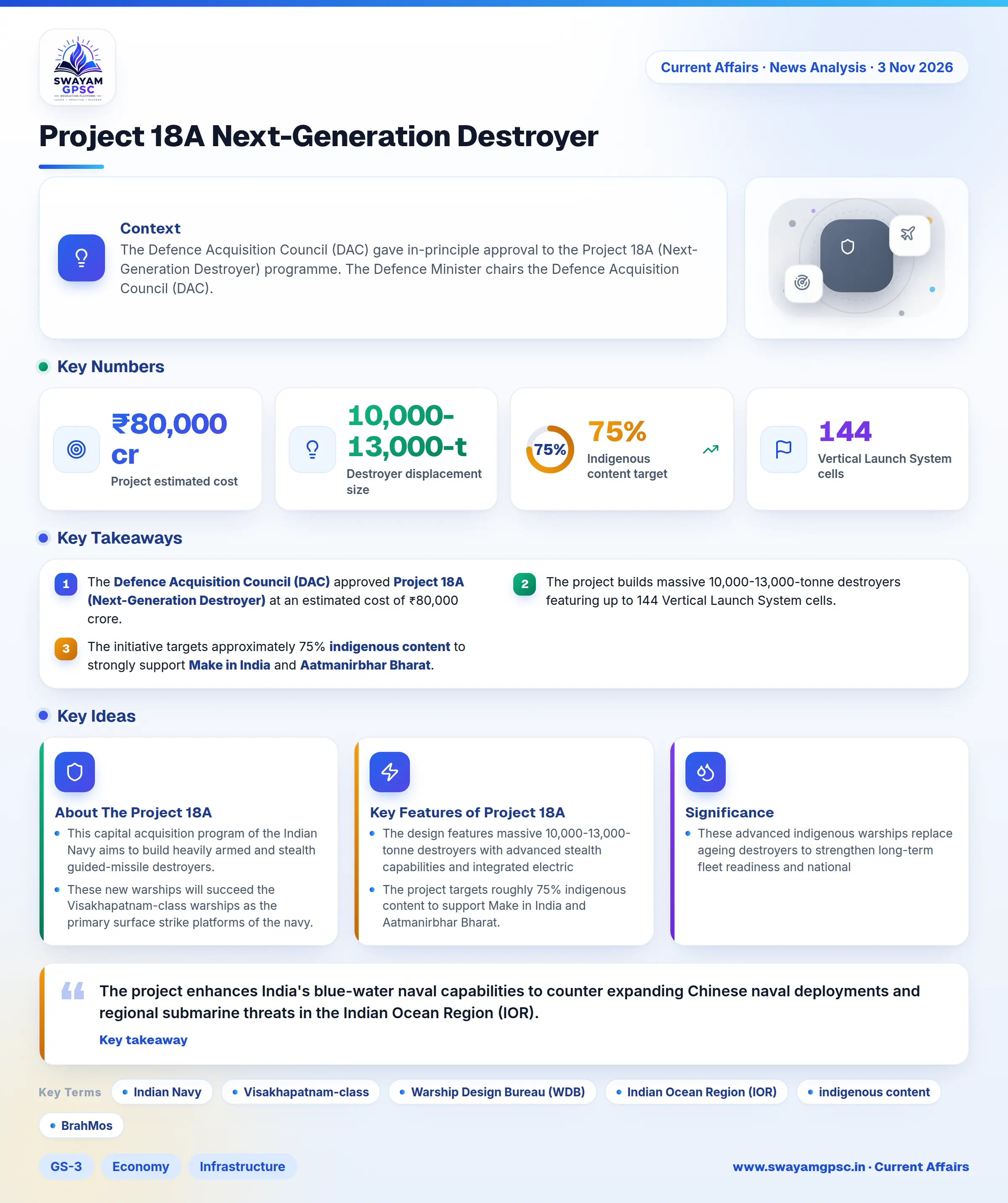
Project 18A Next-Generation Destroyer
#GS-3 #Economy #Infrastructure #Science & Technology #Defence #Current Events #National
Key takeaways
- The Defence Acquisition Council (DAC) approved Project 18A (Next-Generation Destroyer) at an estimated cost of ₹80,000 crore.
- The project builds massive 10,000-13,000-tonne destroyers featuring up to 144 Vertical Launch System cells.
- The initiative targets approximately 75% indigenous content to strongly support Make in India and Aatmanirbhar Bharat.
Context
- The Defence Acquisition Council (DAC) gave in-principle approval to the Project 18A (Next-Generation Destroyer) programme.
- The Defence Minister chairs the Defence Acquisition Council (DAC).
- The entire Project 18A (Next-Generation Destroyer) programme carries an estimated cost of approximately ₹80,000 crore.
About The Project 18A
- This capital acquisition program of the Indian Navy aims to build heavily armed and stealth guided-missile destroyers.
- These new warships will succeed the Visakhapatnam-class warships as the primary surface strike platforms of the navy.
- The Warship Design Bureau (WDB) under the Ministry of Defence conceptualized and designed these vessels entirely in-house.
- The project aims to build multi-role warships with deep-strike land attack, integrated air defense, and anti-submarine warfare capabilities.
- These capabilities help preserve naval dominance and fleet strength across the Indian Ocean Region (IOR).
Key Features of Project 18A
- The design features massive 10,000-13,000-tonne destroyers with advanced stealth capabilities and integrated electric propulsion systems.
- The project targets roughly 75% indigenous content to support Make in India and Aatmanirbhar Bharat.
- The warships will house up to 144 Vertical Launch System cells for BrahMos missiles, long-range land-attack missiles, and air defence interceptors.
- Advanced indigenous AESA radars and integrated combat management systems will track aerial, surface, and missile threats.
- Advanced sonar systems, SMART missiles, and Varunastra torpedoes will strengthen anti-submarine warfare capabilities.
Significance
- The project enhances India's blue-water naval capabilities to counter expanding Chinese naval deployments and regional submarine threats in the Indian Ocean Region (IOR).
- These advanced indigenous warships replace ageing destroyers to strengthen long-term fleet readiness and national maritime security.