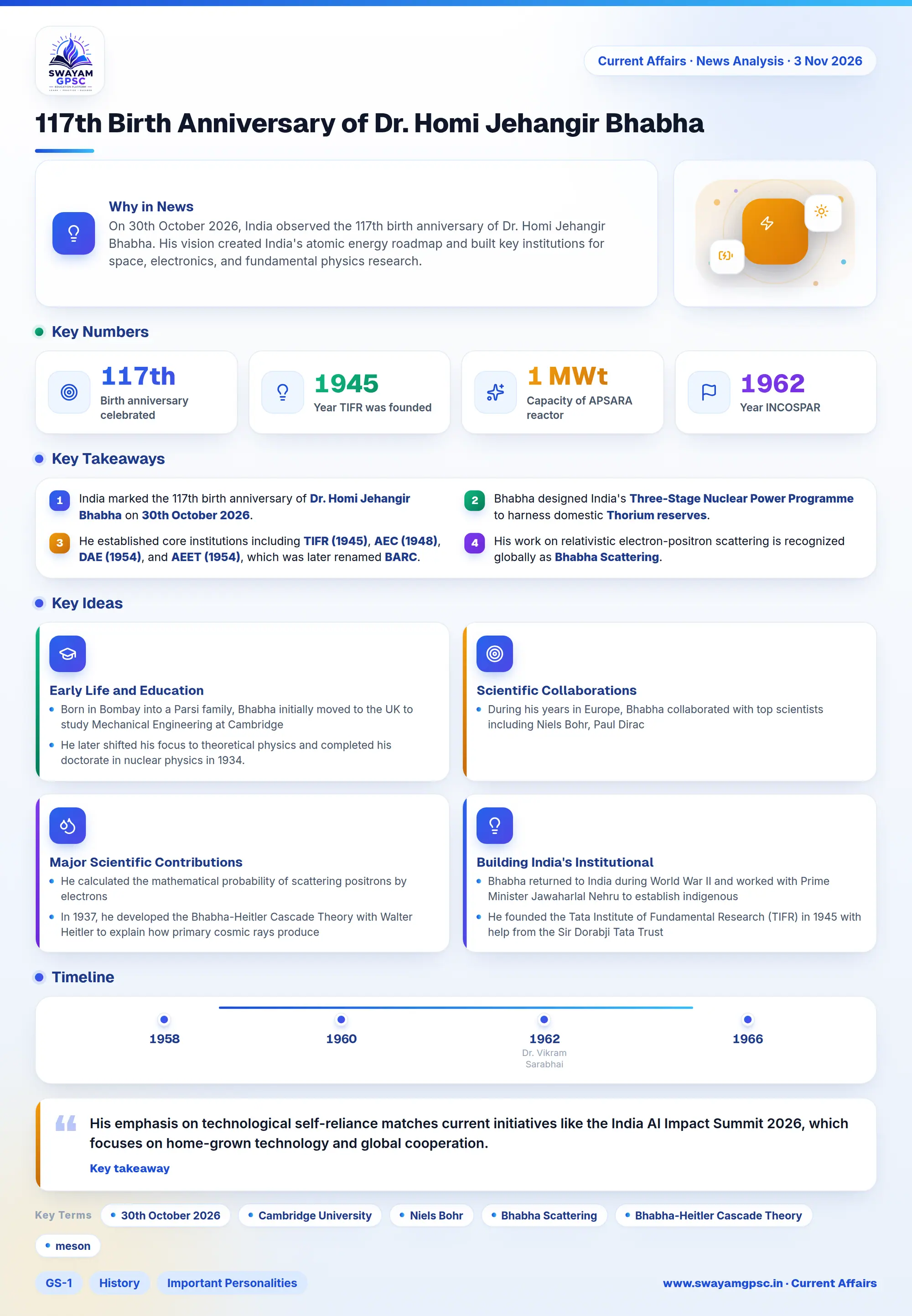
117th Birth Anniversary of Dr. Homi Jehangir Bhabha
#GS-1 #History #Important Personalities #GS-3 #Science & Technology #Energy #Nuclear Technology #Quick Facts For Prelims
Key takeaways
- India marked the 117th birth anniversary of Dr. Homi Jehangir Bhabha on 30th October 2026.
- Bhabha designed India's Three-Stage Nuclear Power Programme to harness domestic Thorium reserves.
- He established core institutions including TIFR (1945), AEC (1948), DAE (1954), and AEET (1954), which was later renamed BARC.
- His work on relativistic electron-positron scattering is recognized globally as Bhabha Scattering.
- He helped create INCOSPAR in 1962 under the Department of Atomic Energy, which later evolved into ISRO.
Why in News
- On 30th October 2026, India observed the 117th birth anniversary of Dr. Homi Jehangir Bhabha.
- His vision created India's atomic energy roadmap and built key institutions for space, electronics, and fundamental physics research.
Early Life and Education
- Born in Bombay into a Parsi family, Bhabha initially moved to the UK to study Mechanical Engineering at Cambridge University.
- He later shifted his focus to theoretical physics and completed his doctorate in nuclear physics in 1934.
Scientific Collaborations
- During his years in Europe, Bhabha collaborated with top scientists including Niels Bohr, Paul Dirac, and Wolfgang Pauli while studying quantum mechanics.
Major Scientific Contributions in Fundamental Physics
- He calculated the mathematical probability of scattering positrons by electrons, a process known worldwide as Bhabha Scattering.
- In 1937, he developed the Bhabha-Heitler Cascade Theory with Walter Heitler to explain how primary cosmic rays produce subatomic particles in Earth's atmosphere.
- His cosmic ray research helped predict the existence of the meson, a subatomic particle later confirmed by experimental physicists.
Building India's Institutional Framework
- Bhabha returned to India during World War II and worked with Prime Minister Jawaharlal Nehru to establish indigenous scientific institutions.
- He founded the Tata Institute of Fundamental Research (TIFR) in 1945 with help from the Sir Dorabji Tata Trust to train Indian researchers.
- He became the first Chairman of the Atomic Energy Commission (AEC) upon its setup in 1948 to guide national nuclear policy.
- The government formed the Department of Atomic Energy (DAE) in 1954 directly under the Prime Minister's Office to secure funding and operational independence.
- He established the Atomic Energy Establishment, Trombay (AEET) in 1954, which was renamed the Bhabha Atomic Research Centre (BARC) after his death in 1966.
Vision for Nuclear Power
- Bhabha designed India's Three-Stage Nuclear Power Programme using PHWRs, Fast Breeder Reactors, and Advanced Heavy Water Reactors.
- This plan aimed to use India's massive Thorium reserves in monazite sands rather than relying on imported Uranium.
- He led the creation of APSARA, India's first research reactor with 1 MWt capacity, and helped draft the Atomic Energy Act of 1948.
Contributions Beyond Nuclear Energy
- He supported Dr. Vikram Sarabhai in setting up the Indian National Committee for Space Research (INCOSPAR) under the DAE in 1962, which later became ISRO.
- He led an electronics committee in the 1960s to foster local manufacturing of electronic parts, helping lay the ground for India's IT sector.
- He served as President of the first UN Conference on the Peaceful Uses of Atomic Energy in Geneva in 1955.
- He joined the first Scientific Advisory Committee of the International Atomic Energy Agency (IAEA) in 1958 and served on its Board of Governors.
- He advocated for peaceful nuclear energy while building a strategic option for defence, which laid the foundation for tests like Pokhran-I (1974) and Pokhran-II (1998).
Awards and Contemporary Relevance
- He was elected a Fellow of the Royal Society in 1941 and received the Padma Bhushan in 1954.
- His emphasis on technological self-reliance matches current initiatives like the India AI Impact Summit 2026, which focuses on home-grown technology and global cooperation.