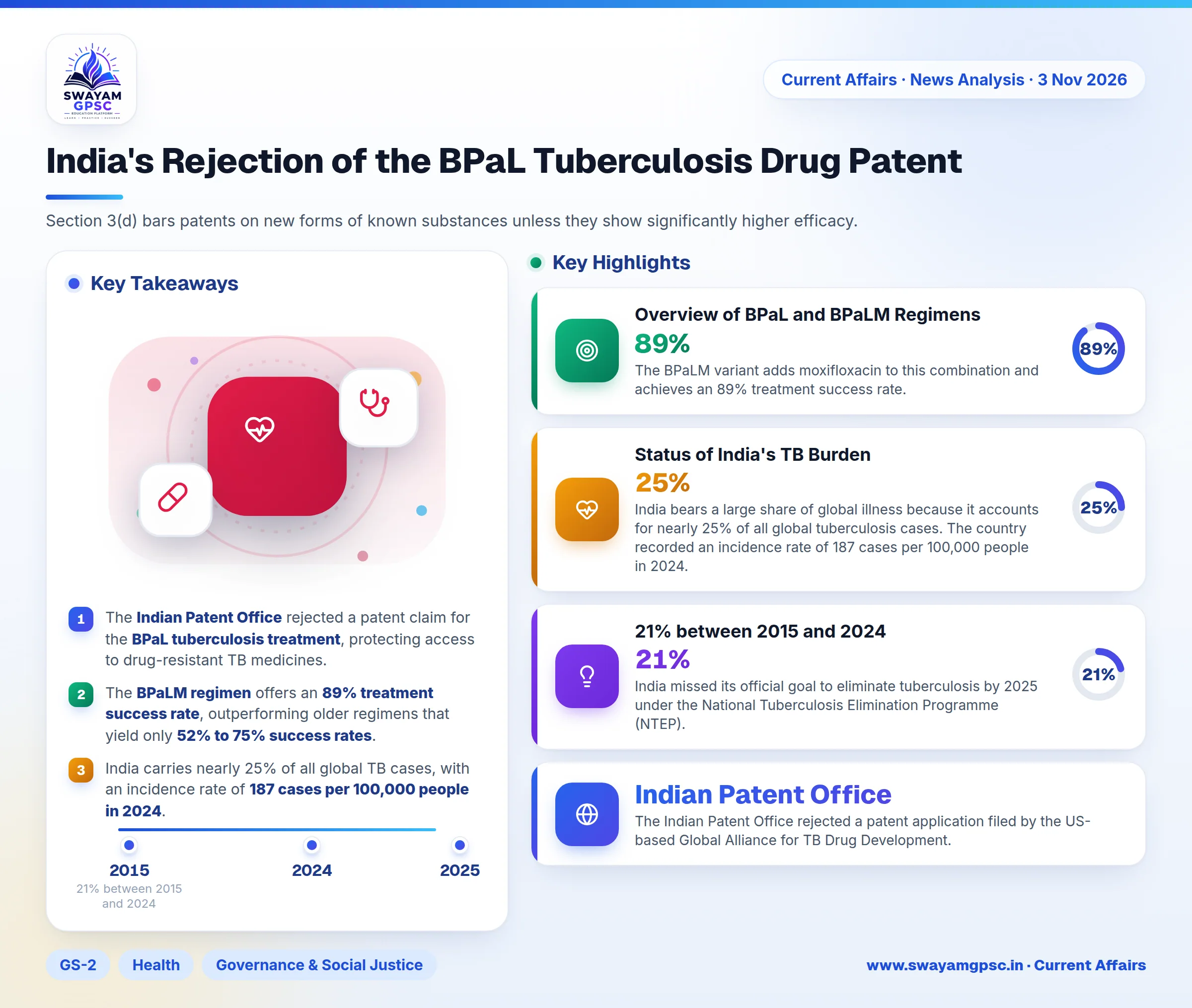
India's Rejection of the BPaL Tuberculosis Drug Patent
#GS-2 #Health #Governance & Social Justice #Current Events #National #GS-3 #Intellectual Property Rights (IPRs) #Science & Technology #Rapid Fire CA #Quick Facts For Prelims
Key takeaways
- The Indian Patent Office rejected a patent claim for the BPaL tuberculosis treatment, protecting access to drug-resistant TB medicines.
- The BPaLM regimen offers an 89% treatment success rate, outperforming older regimens that yield only 52% to 75% success rates.
- India carries nearly 25% of all global TB cases, with an incidence rate of 187 cases per 100,000 people in 2024.
- India reduced its overall TB incidence rate by 21% between 2015 and 2024, even though it missed its 2025 elimination goal.
- Key rejections were made under Section 3(d), Section 3(e), and Section 3(i) of the Patents Act, 1970 to prevent drug evergreening and lower costs for the NTEP.
Why in News
- The Indian Patent Office rejected a patent application filed by the US-based Global Alliance for TB Drug Development. This application was for the BPaL regimen, which treats drug-resistant tuberculosis.
Overview of BPaL and BPaLM Regimens
- The BPaL regimen is an all-oral treatment lasting six months that is recommended by the World Health Organization (WHO). It combines three key medicines: bedaquiline, pretomanid, and linezolid.
- The BPaLM variant adds moxifloxacin to this combination and achieves an 89% treatment success rate. This is significantly better than traditional longer treatments, which only achieve 52% to 75% success rates and often require painful daily injections.
Status of India's TB Burden
- India bears a large share of global illness because it accounts for nearly 25% of all global tuberculosis cases. The country recorded an incidence rate of 187 cases per 100,000 people in 2024.
- India missed its official goal to eliminate tuberculosis by 2025 under the National Tuberculosis Elimination Programme (NTEP). Even though it missed this target, India reduced its TB incidence rate by 21% between 2015 and 2024.
Key Grounds for Patent Rejection
- Civil society organizations filed pre-grant oppositions against the patent under Section 25(1) of the Patents Act, 1970. They pointed out that clinical trials as far back as 2015 had already made this combination of medicines public.
- The Patent Controller rejected the claim due to a lack of novelty, no clear inventive step, and insufficient disclosure. The authority relied on specific statutory provisions within the law.
- Section 3(d) bars patents on new forms of known substances unless they show significantly higher efficacy. This rule acts as a critical protection against evergreening, which occurs when companies try to extend monopolies with minor changes.
- Section 3(e) excludes simple mixtures of known substances from being patented.
- Section 3(i) prevents medical treatment methods for human beings from receiving patent protection.
Economic Impact and Public Health Benefits
- Rejecting this patent lets local generic manufacturers make the drugs legally. Increased market competition will drive down medicine prices for patients across the country.
- Cheaper medicines allow the government to purchase more treatments under the NTEP without exceeding its existing budget allocations.
- This decision supports the Right to Health under Article 21 of the Constitution. The Supreme Court highlighted the duty of the State to preserve human life in the case of Parmanand Katara v. Union of India (1989).
Regulatory Independence and Requirements
- Denying a patent does not automatically allow generic drugs onto the market right away. Manufacturers must still obtain safety approvals from the Central Drugs Standard Control Organisation (CDSCO) and meet national quality standards.