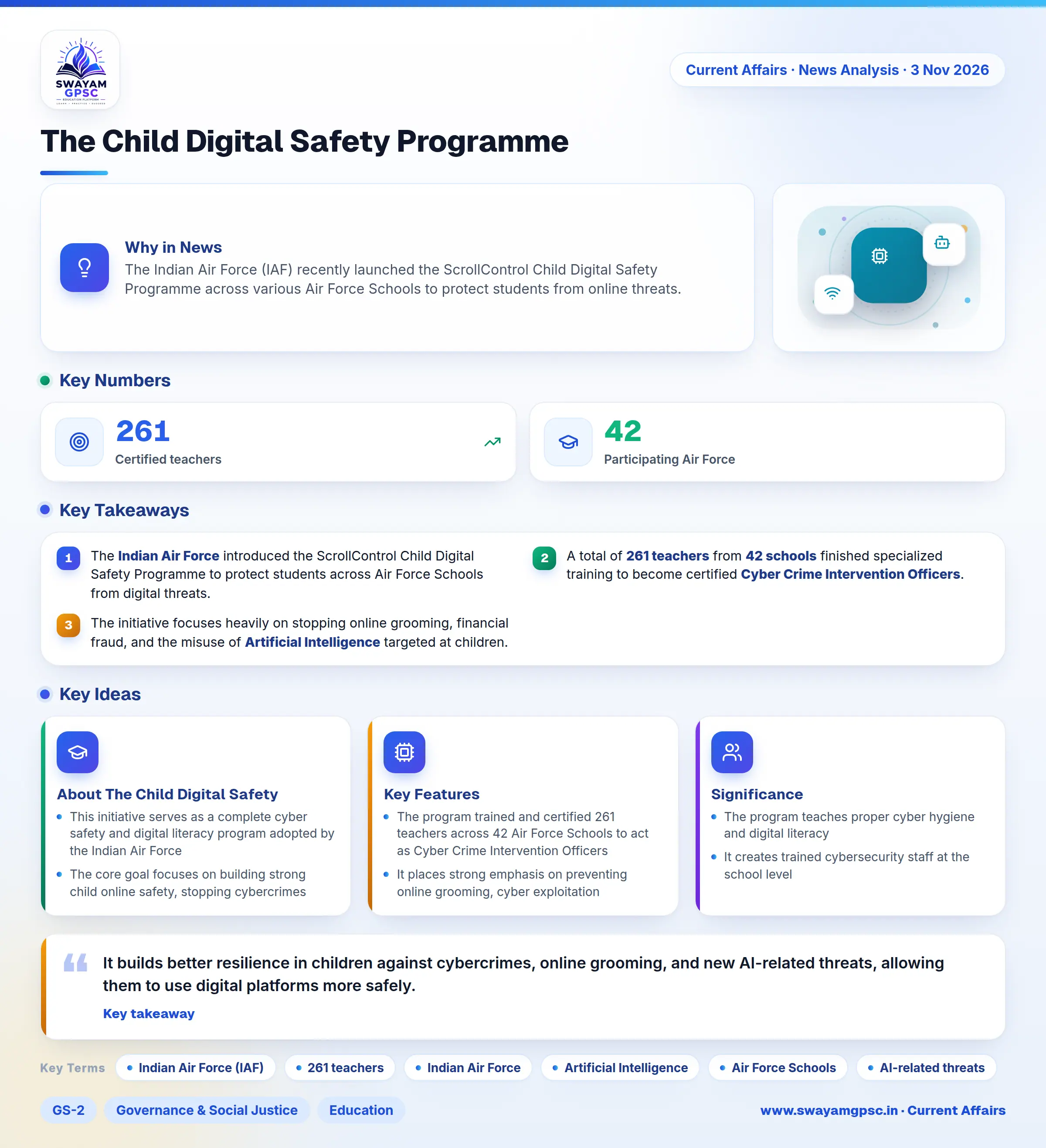
The Child Digital Safety Programme
#GS-2 #Governance & Social Justice #Education #Vulnerable Sections #GS-3 #Science & Technology #Cyber Security #Artificial Intelligence #GS-4 #Ethics #Current Events #National
Key takeaways
- The Indian Air Force introduced the ScrollControl Child Digital Safety Programme to protect students across Air Force Schools from digital threats.
- A total of 261 teachers from 42 schools finished specialized training to become certified Cyber Crime Intervention Officers.
- The initiative focuses heavily on stopping online grooming, financial fraud, and the misuse of Artificial Intelligence targeted at children.
Why in News
- The Indian Air Force (IAF) recently launched the ScrollControl Child Digital Safety Programme across various Air Force Schools to protect students from online threats.
- As part of this initiative, 261 teachers from 42 schools successfully completed their training and received certification as Cyber Crime Intervention Officers.
About The Child Digital Safety Programme
- This initiative serves as a complete cyber safety and digital literacy program adopted by the Indian Air Force to shield schoolchildren from new online dangers.
- The core goal focuses on building strong child online safety, stopping cybercrimes, and teaching responsible digital habits through trained teachers and school awareness.
Key Features
- The program trained and certified 261 teachers across 42 Air Force Schools to act as Cyber Crime Intervention Officers who can spot and handle student cyber risks.
- It places strong emphasis on preventing online grooming, cyber exploitation, and the misuse of Artificial Intelligence to protect children from advanced digital dangers.
- Students learn about the dangers hidden inside online games and digital financial fraud, which helps them make safer choices online.
- The framework builds a solid cyber safety system inside Air Force Schools by using trained teachers to improve readiness against digital threats.
Significance
- It builds better resilience in children against cybercrimes, online grooming, and new AI-related threats, allowing them to use digital platforms more safely.
- The program teaches proper cyber hygiene and digital literacy, helping students move through connected online spaces with care.
- It creates trained cybersecurity staff at the school level, making it easier to catch digital threats early and respond quickly.