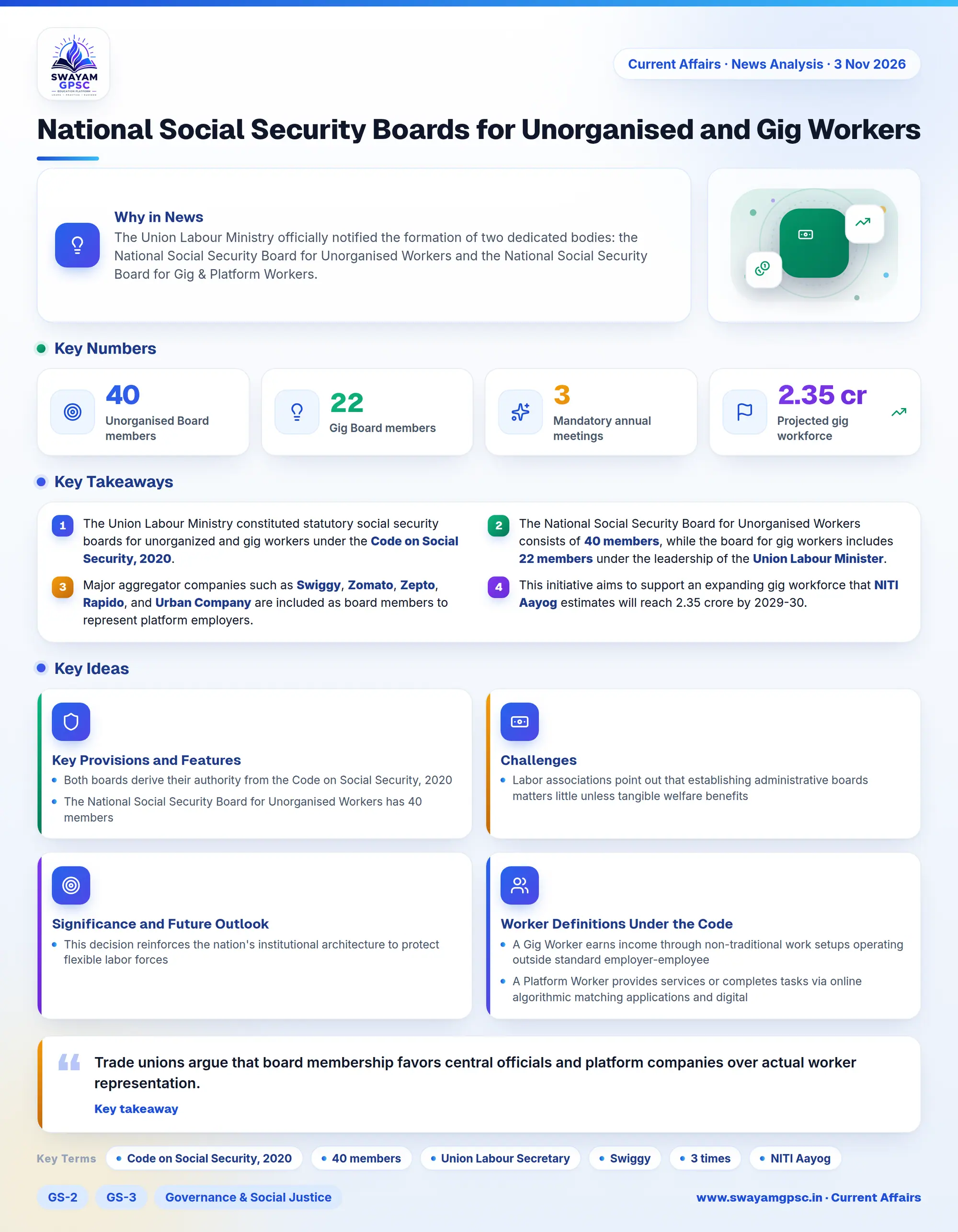
National Social Security Boards for Unorganised and Gig Workers
#GS-2 #GS-3 #Governance & Social Justice #Government Policies & Interventions #Economy #Employment #Current Events #National #Rapid Fire CA #Quick Facts For Prelims
Key takeaways
- The Union Labour Ministry constituted statutory social security boards for unorganized and gig workers under the Code on Social Security, 2020.
- The National Social Security Board for Unorganised Workers consists of 40 members, while the board for gig workers includes 22 members under the leadership of the Union Labour Minister.
- Major aggregator companies such as Swiggy, Zomato, Zepto, Rapido, and Urban Company are included as board members to represent platform employers.
- This initiative aims to support an expanding gig workforce that NITI Aayog estimates will reach 2.35 crore by 2029-30.
- Statutory rules make it mandatory for both newly established security boards to convene meetings at least 3 times per year.
Why in News
- The Union Labour Ministry officially notified the formation of two dedicated bodies: the National Social Security Board for Unorganised Workers and the National Social Security Board for Gig & Platform Workers.
Key Provisions and Features of the Boards
- Both boards derive their authority from the Code on Social Security, 2020, marking a major legislative step to extend formal welfare protection to non-traditional workers.
- The National Social Security Board for Unorganised Workers has 40 members, whereas the National Social Security Board for Gig & Platform Workers comprises 22 members.
- The Union Minister for Labour and Employment leads both boards as Chairman, while the Union Labour Secretary serves as Vice-Chairman.
- Board members come from central and state departments, labor unions, civil society groups, and leading digital aggregators including Swiggy, Zomato, Zepto, Rapido, and Urban Company.
- The primary mandate of these boards is to formulate, supervise, and suggest specialized welfare programs tailored for unorganized, gig, and platform workers.
- They are tasked with advising the Union Government on implementing the Code on Social Security, 2020 effectively.
- They will regularly inspect fund expenditures and track state-level worker registration and record-keeping mechanisms.
- By statutory rules, each board must hold official meetings at least 3 times a year.
Challenges
- Trade unions argue that board membership favors central officials and platform companies over actual worker representation.
- Labor associations point out that establishing administrative boards matters little unless tangible welfare benefits actually reach the workers on the ground.
Significance and Future Outlook
- This decision reinforces the nation's institutional architecture to protect flexible labor forces, which NITI Aayog projects will expand to 2.35 crore workers by 2029-30.
Worker Definitions Under the Code on Social Security 2020
- A Gig Worker earns income through non-traditional work setups operating outside standard employer-employee arrangements.
- A Platform Worker provides services or completes tasks via online algorithmic matching applications and digital platforms without a traditional employment contract.
- An Unorganised Worker includes self-employed individuals, home-based workers, or wage earners outside organized coverage, as well as formal sector workers not protected by laws like the Industrial Disputes Act, 1947.