El Niño and Drought Relationships
#GS-3 #Environment #Climate Change #Geography #Physical Geography #Agriculture #Current Events #National #El Niño #Indian Monsoon #Indian Ocean Dipole
Key takeaways
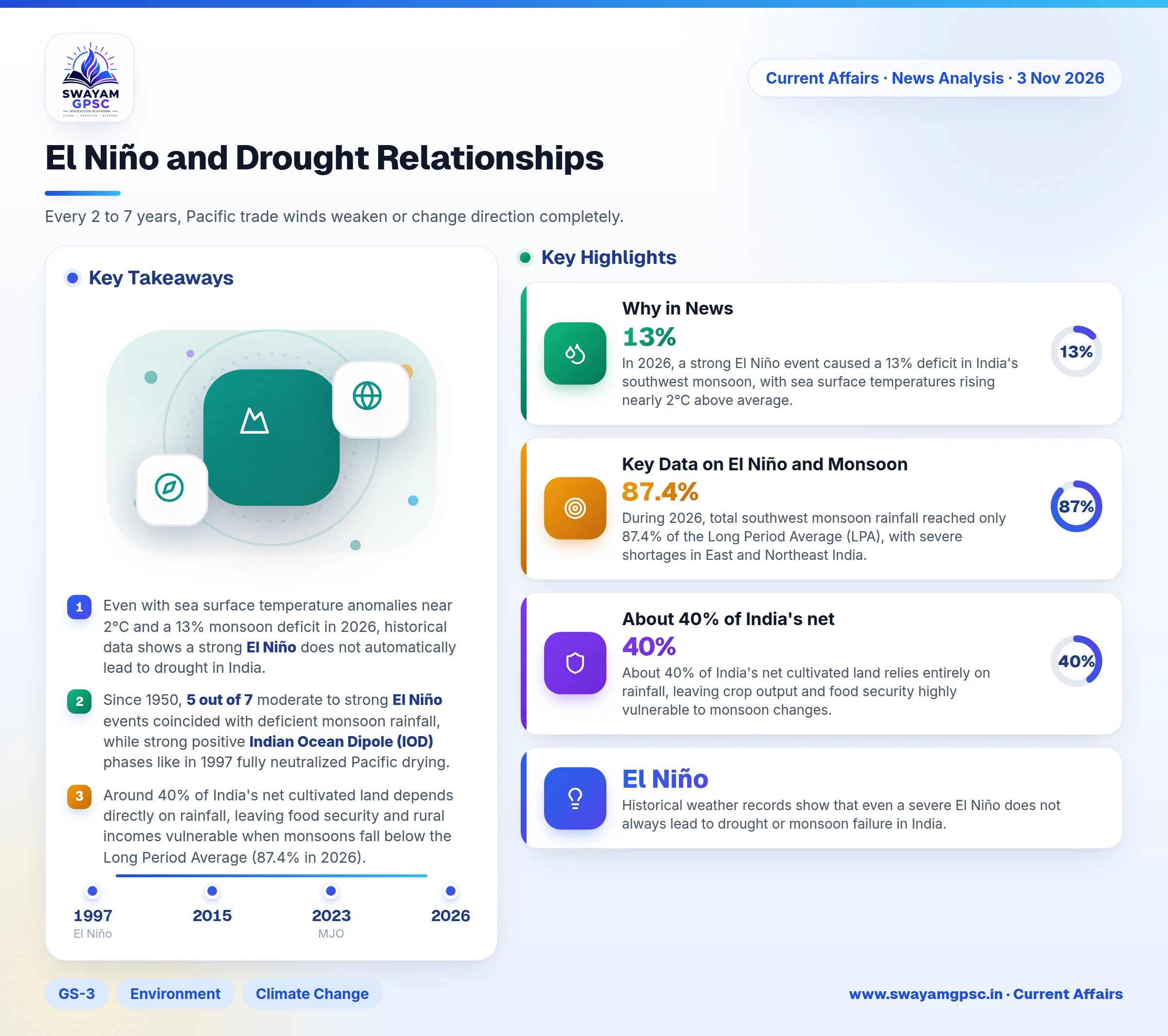
- Even with sea surface temperature anomalies near 2°C and a 13% monsoon deficit in 2026, historical data shows a strong El Niño does not automatically lead to drought in India.
- Since 1950, 5 out of 7 moderate to strong El Niño events coincided with deficient monsoon rainfall, while strong positive Indian Ocean Dipole (IOD) phases like in 1997 fully neutralized Pacific drying.
- Around 40% of India's net cultivated land depends directly on rainfall, leaving food security and rural incomes vulnerable when monsoons fall below the Long Period Average (87.4% in 2026).
- Upgrading IMD coupled forecasting models and expanding low-water crops like millets under PM Fasal Bima Yojana coverage are crucial for climate resilience.
Why in News
- In 2026, a strong El Niño event caused a 13% deficit in India's southwest monsoon, with sea surface temperatures rising nearly 2°C above average.
- Historical weather records show that even a severe El Niño does not always lead to drought or monsoon failure in India.
Walker Circulation Normal State
- Under normal conditions, trade winds blow from east to west across the tropical Pacific Ocean.
- These winds push warm surface water toward Indonesia, creating strong convective clouds and heavy rainfall in the western Pacific.
- At the same time, cold and nutrient-rich water rises from the deep ocean along the western coast of South America.
El Niño Perturbation Mechanics
- Every 2 to 7 years, Pacific trade winds weaken or change direction completely.
- The warm surface water moves back eastward toward South America, shifting storm activity away from the western Pacific.
- Rising warm air over the eastern Pacific forces dry air to descend over other parts of the tropics.
- A major sinking air branch forms directly over the Indian subcontinent, heating up and drying the atmosphere.
- This descending air prevents convective clouds from forming and weakens the southwesterly monsoon winds.
Key Data on El Niño and Monsoon
- Since 1950, 5 out of 7 moderate to strong El Niño years resulted in deficient monsoon rainfall across India.
- In 1997, India received normal rainfall despite a strong El Niño with a +1.64°C temperature anomaly, unlike the severe deficits seen in 2015 and 2026.
- During 2026, total southwest monsoon rainfall reached only 87.4% of the Long Period Average (LPA), with severe shortages in East and Northeast India.
- About 40% of India's net cultivated land relies entirely on rainfall, leaving crop output and food security highly vulnerable to monsoon changes.
Factors Preventing Automatic Droughts
- The Indian Ocean Dipole (IOD) acts as a temperature balance between the western Indian Ocean near Africa and the eastern Indian Ocean near Indonesia.
- A Positive IOD creates warmer sea surface temperatures in the western Indian Ocean, driving extra moisture into India across the Arabian Sea to offset Pacific drying.
- A strong positive IOD offset the massive 1997 El Niño, whereas altered wind belts around Antarctica prevented this dipole effect in 2015.
- Pacific warming during Canonical El Niño focuses near South America as in 1997, keeping dry descending air far away from South Asia.
- Pacific warming during El Niño Modoki stays in the Central Pacific, positioning dry descending air straight over India and significantly raising drought risks.
- The Madden-Julian Oscillation (MJO) travels around the tropics every 30 to 60 days, bringing shifting bands of clouds and rain.
- In August 2023, the MJO stalled over Africa and the Western Hemisphere, causing India's driest August in 122 years before late rainfall arrived in September.
- Independent weather patterns like high-pressure ridges over Iran or low-pressure systems over the Arabian Sea can pull moisture into India, counteracting Pacific drying as occurred in 1983 and 1997.
Economic and Agricultural Impacts
- Dry spells during key crop growth stages lower planted area and reduce yields for water-heavy crops like paddy, pulses, and oilseeds.
- Monsoon deficits in southern and central states in 2026 triggered regional drought declarations and reduced overall farm earnings.
- Weak monsoon rains prevent underground aquifers and key multipurpose reservoirs from recharging fully, limiting water for winter irrigation and cities.
- Water rationing and agricultural electricity restrictions were enforced across major river basins in Maharashtra and Karnataka.
- Lower agricultural output weakens rural consumer spending, drives up food prices, and forces government export bans on staples like rice, wheat, or sugar.
- Complex interactions between ENSO, the IOD, and short-term atmospheric waves make seasonal monsoon forecasting difficult for climate models.
Way Forward
- The India Meteorological Department (IMD) must upgrade its forecasting models to track Indian Ocean Dipole changes and tropical waves alongside Pacific data.
- Farmers should adopt drought-resistant seeds, short-duration crop varieties, and low-water crops like millets and pulses in rain-fed regions.
- States must expand micro-irrigation systems, farm ponds, and community recharge projects using digital tools like Punah Bharan to protect watersheds.
- The government should improve PM Fasal Bima Yojana by using drones and satellite imagery to calculate crop losses faster for small farmers.
Conclusion
- Pacific sea surface temperatures do not automatically dictate Indian monsoon outcomes, as El Niño represents a major risk factor rather than a guaranteed drought.
- Regional weather systems like the Indian Ocean Dipole and short-term atmospheric waves strongly influence whether monsoon rainfall will fail or recover.
- Building decentralized water resources and refining multi-ocean weather forecasting models are essential steps to protect India's farming economy against climate risks.