Youth Unemployment and Household Economic Cost in India
#GS-3 #Economy #Employment #GS-2 #Governance & Social Justice #Education #Poverty #PLFS 2025 #Youth Unemployment
Key takeaways
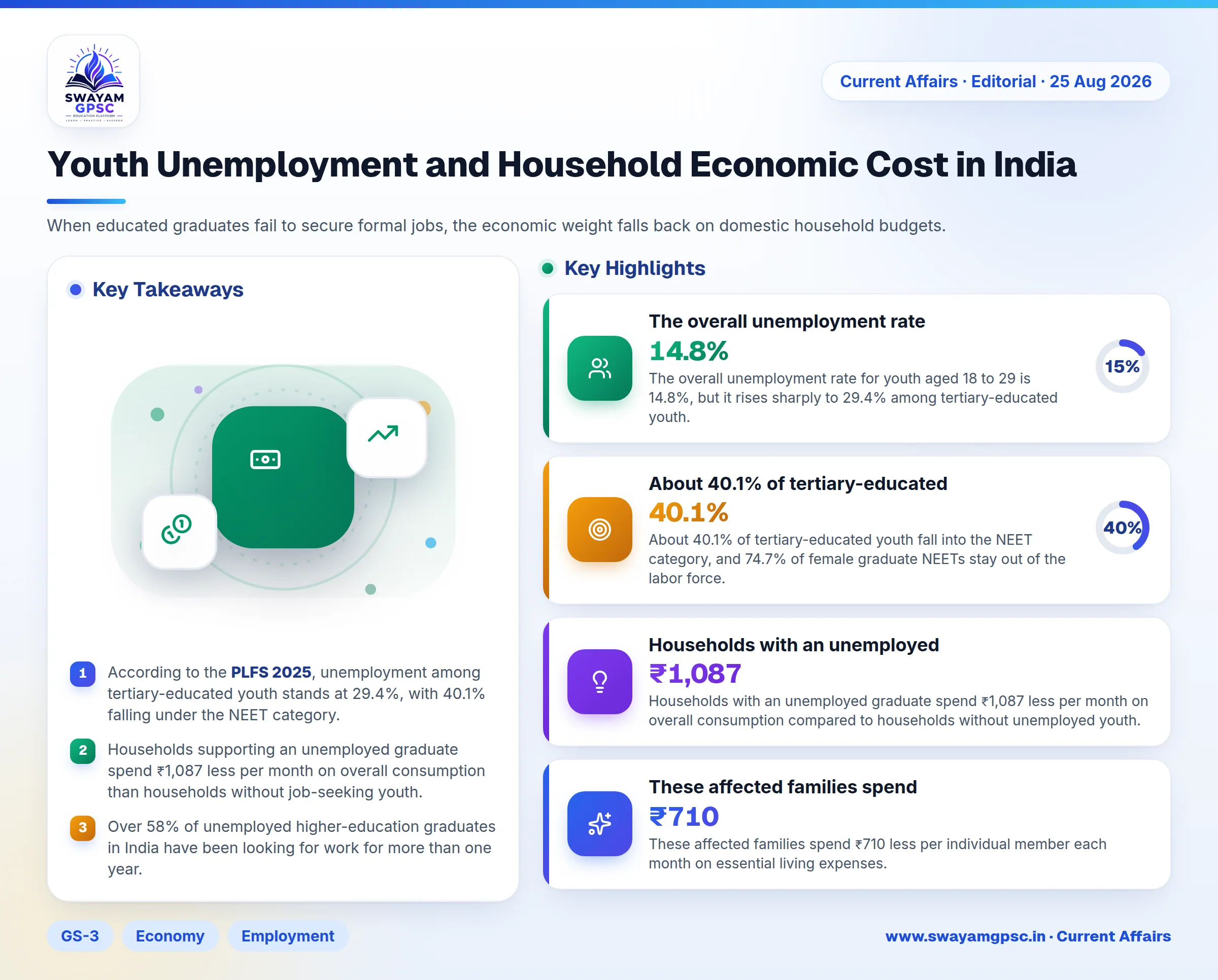
- According to the PLFS 2025, unemployment among tertiary-educated youth stands at 29.4%, with 40.1% falling under the NEET category.
- Households supporting an unemployed graduate spend ₹1,087 less per month on overall consumption than households without job-seeking youth.
- Over 58% of unemployed higher-education graduates in India have been looking for work for more than one year.
- Around 62.5% of families with unemployed graduates lack even a single regular salaried earner, putting pressure on household budgets.
Why in News
- A recent analysis of the PLFS 2025 by economists shows that youth joblessness creates a direct financial burden on Indian families.
- This data shifts the view of unemployment from an individual career issue to a systemic economic struggle for households.
Understanding Youth Unemployment and Household Costs
- Families often invest heavy savings into higher education degrees expecting their children to gain social mobility.
- When educated graduates fail to secure formal jobs, the economic weight falls back on domestic household budgets.
- This dynamic reduces daily family consumption and forces educated youth into low-skilled informal work out of urgent necessity.
Key Data and Statistics
- The overall unemployment rate for youth aged 18 to 29 is 14.8%, but it rises sharply to 29.4% among tertiary-educated youth.
- About 40.1% of tertiary-educated youth fall into the NEET category, and 74.7% of female graduate NEETs stay out of the labor force.
- Households with an unemployed graduate spend ₹1,087 less per month on overall consumption compared to households without unemployed youth.
- These affected families spend ₹710 less per individual member each month on essential living expenses.
- Families supporting an unemployed graduate average only 1.5 earners, while 62.5% have no member with a regular salaried job.
- Nearly 58% of unemployed graduates have been searching for employment for over one year, and 28.9% have waited for over two years.
Challenges
- Higher education raises wage expectations, leading graduates to wait for white-collar jobs instead of accepting informal manual labor.
- Frequent recruitment delays, paper leaks, and legal disputes keep millions of candidates stuck in long exam preparation cycles.
- Outdated college curricula fail to provide the technical skills required by private sector firms in modern industries.
- Formal private enterprises offering regular employment contracts and social security remain scarce relative to the growing graduate supply.
- Safety concerns, lack of childcare support, and limited local formal jobs keep nearly three-fourths of female NEET graduates out of work.
Impact on Households
- Heavy spending on college tuition and coaching classes exhausts family savings, leaving parents trapped in educational debt.
- Single-earner families cut spending on healthcare, nutrition, and schooling for younger siblings to support an unemployed adult child.
- Depleted savings force graduates to take low-paying informal jobs, creating long-term wage penalties throughout their careers.
- Unsuccessful transitions from college to employment lock lower-middle-class families into continuous economic vulnerability.
- Long job hunts cause severe mental stress, loss of self-confidence, and social stigma within local communities.
Way Forward
- Governments must enforce fixed exam schedules and strict anti-paper leak laws to complete public hiring without long delays.
- Universities should update curricula to include compulsory industry apprenticeships, technical certificates, and practical internships.
- Policymakers need to expand employment-linked incentives and subsidize payroll expenses for small businesses hiring fresh graduates.
- States should provide need-based job search stipends and digital vouchers to low-income single-earner households.
- Authorities must build safe public transit, affordable hostels, and flexible work options to help educated women join the formal workforce.
Conclusion
- Families bear the primary economic burden when educated graduates remain locked out of formal employment for extended periods.
- India must shift focus from basic skilling to rapid hiring timelines and formal job creation to unlock its demographic dividend.