Transforming Higher Education in India: Key Reforms and Future Solutions
#GS-2 #Governance & Social Justice #Education #Current Events #National #PM-Vidyalaxmi Scheme #National Education Policy 2020 #Higher Education #ANRF #SWAYAM
Key takeaways
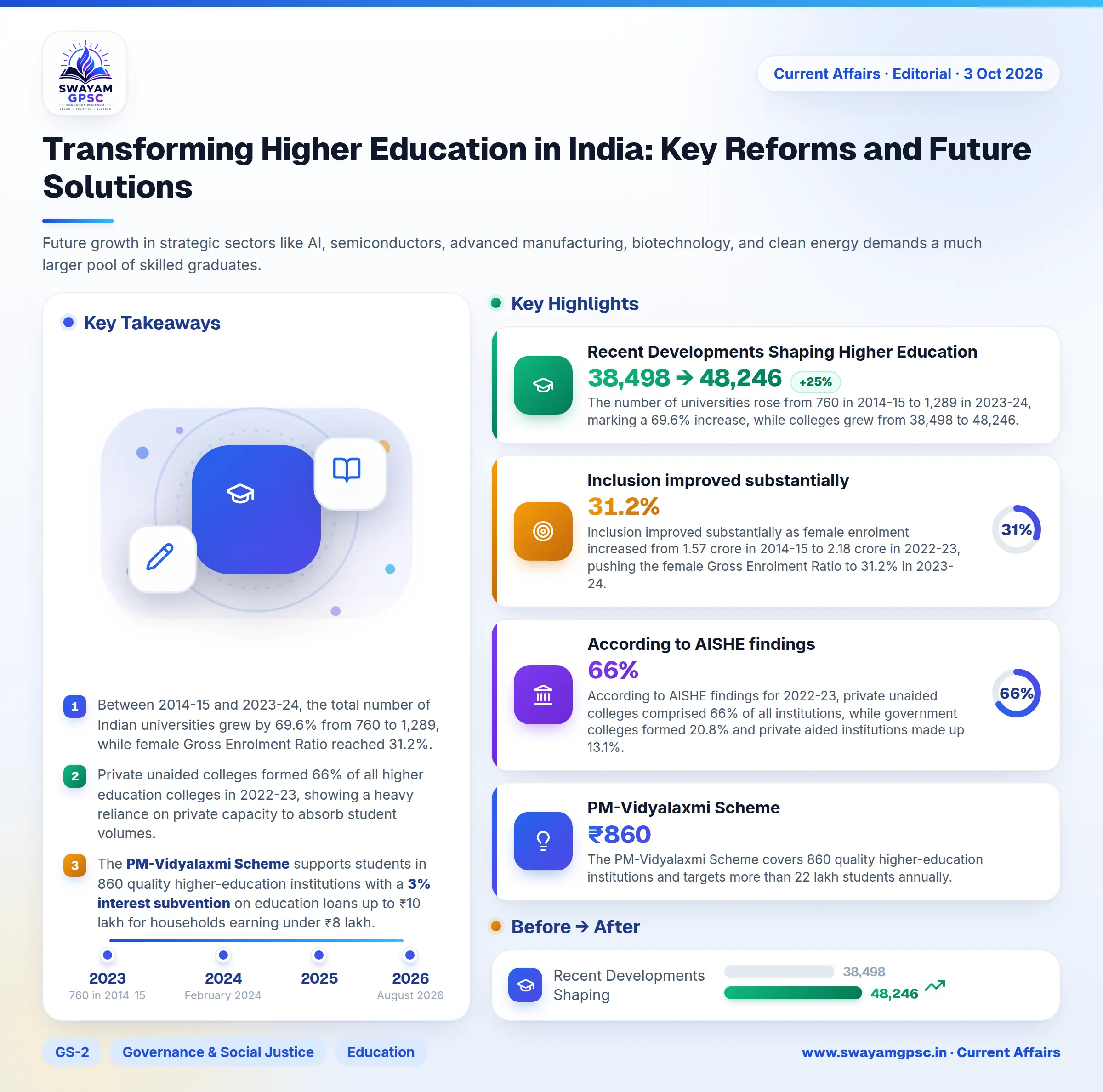
- Between 2014-15 and 2023-24, the total number of Indian universities grew by 69.6% from 760 to 1,289, while female Gross Enrolment Ratio reached 31.2%.
- Private unaided colleges formed 66% of all higher education colleges in 2022-23, showing a heavy reliance on private capacity to absorb student volumes.
- The PM-Vidyalaxmi Scheme supports students in 860 quality higher-education institutions with a 3% interest subvention on education loans up to ₹10 lakh for households earning under ₹8 lakh.
- Faculty shortages remain acute across premier institutions, with IIT Roorkee having only 556 faculty in position against 939 sanctioned posts as of January 2026.
- National research spending remains low at around 0.65% of GDP, while graduate employability stood at just 42.6% according to the India's Graduate Skill Index 2025.
Why in News
- Recent protests over examination irregularities and paper leaks have highlighted deep structural stress in competitive exams across India.
- The core crisis stems from an acute scarcity of affordable, high-quality seats across premier higher education institutions.
- India heavily subsidized top public institutions like IITs and IISc in past decades to ensure access to excellence.
- Future growth in strategic sectors like AI, semiconductors, advanced manufacturing, biotechnology, and clean energy demands a much larger pool of skilled graduates.
Recent Developments Shaping Higher Education
- India significantly expanded university capacity to boost access, though institutional quality remains uneven nationwide.
- The number of universities rose from 760 in 2014-15 to 1,289 in 2023-24, marking a 69.6% increase, while colleges grew from 38,498 to 48,246.
- Inclusion improved substantially as female enrolment increased from 1.57 crore in 2014-15 to 2.18 crore in 2022-23, pushing the female Gross Enrolment Ratio to 31.2% in 2023-24.
- Private colleges have grown into a critical pillar of capacity expansion beyond state-run campuses.
- According to AISHE findings for 2022-23, private unaided colleges comprised 66% of all institutions, while government colleges formed 20.8% and private aided institutions made up 13.1%.
- Private colleges and universities stepped in to address surging local demand where public institutions lacked seat capacity.
- Public policy has begun shifting toward direct student financial support rather than funding only institutional operating subsidies.
- The PM-Vidyalaxmi Scheme covers 860 quality higher-education institutions and targets more than 22 lakh students annually.
- Under PM-Vidyalaxmi, students from households earning up to ₹8 lakh yearly receive a 3% interest subvention on loans up to ₹10 lakh.
- The central government provides credit guarantees on student loans up to ₹7.5 lakh, removing collateral demands for underprivileged applicants.
- Digital and hybrid learning tools are democratizing top-tier academic content beyond premier metro universities.
- By August 2026, the SWAYAM portal hosted over 20,370 courses and achieved more than 6.5 crore enrolments across disciplines.
- Under the UGC Credit Framework for Online Learning Courses through SWAYAM Regulations, 2021, colleges can let students earn up to 40% of programme credits through SWAYAM.
- Policymakers are prioritizing scientific research, physical infrastructure, and academic excellence over simple enrolment growth.
- India doubled its Gross Expenditure on Research and Development from ₹60,196.75 crore in 2010-11 to ₹1,27,380.96 crore in 2020-21, alongside ₹99,494.24 crore sanctioned for top technical institutes from 2020-21 to 2025-26.
- The government established the Anusandhan National Research Foundation (ANRF) under the 2023 legislation, operationalizing it in February 2024 with an outlay of ₹50,000 crore.
- Guided by the National Education Policy 2020, universities are adopting four-year undergraduate programmes with multiple entry and exit paths.
- Under flexible degree structures, students can exit with certificates after one year, diplomas after two years, standard bachelor's degrees after three years, or research honors after four years.
- The Academic Bank of Credits (ABC) acts as a verified digital ledger that safely logs and transfers academic credits across different universities.
- India opened its academic ecosystem to international partnerships through updated cross-border campus regulations.
- Authorities now allow foreign institutions to open domestic branch campuses, while domestic Indian universities establish operational offshore branches overseas.
- Australian universities like Deakin University and the University of Wollongong established global branch campuses in GIFT City in Gujarat.
- Simultaneously, IIT Delhi expanded its overseas presence by launching an international branch campus in Abu Dhabi, UAE.
Challenges in the Higher Education Sector
- A severe mismatch exists between India's enormous student talent pool and the limited availability of high-quality, subsidized seats.
- Over 20 lakh candidates compete for a restricted pool of medical MBBS seats in national entrance tests each year.
- The National Testing Agency recorded massive test applicant volumes in 2026, with 94,513 registrations for B.Arch and 45,729 registrations for B.Planning in JEE Main.
- Hyper-competitive exam pressure reflects an artificial scarcity of quality higher education infrastructure rather than a shortage of capable students.
- Severe teacher vacancies undermine academic standards across leading state and national institutions.
- As of January 2026, IIT Roorkee operated with 556 faculty in position against 939 sanctioned posts, while IIT (ISM) Dhanbad had 398 against 781.
- Persistent staff shortages burden existing professors with heavy teaching duties, reducing research output, mentorship, and personalized student contact.
- Expanding student enrollment without hiring sufficient qualified professors dilutes learning quality across university campuses.
- National research spending remains inadequate, with Gross Expenditure on Research and Development stagnating at around 0.65% of GDP.
- Research funds remain heavily concentrated in elite national institutes, leaving state-level public universities starved of laboratory equipment and project capital.
- A wide gap separates classroom curricula from private sector hiring requirements, depressing graduate employment outcomes.
- The Mercer Mettl India's Graduate Skill Index 2025 revealed that only 42.6% of tested Indian graduates were employable in modern industries.
- Heavy regulatory oversight from multiple bodies like the University Grants Commission (UGC) creates red tape and restricts academic flexibility.
- Bureaucratic inertia and delayed structural reforms hinder state institutions from quickly designing courses around emerging technologies like generative artificial intelligence.
- A continuous talent drain occurs as ambitious Indian students travel overseas to seek modern laboratories and higher global career mobility.
- Official figures confirm that hundreds of thousands of Indian students migrate every year to higher education hubs in Canada, the UK, the US, and Australia.
- Students enrolled outside elite public universities carry an unequal financial burden due to unsubsidized private college fee structures.
- Premier public institutes provide substantial hidden subsidies to enrolled learners, while equally talented students in private institutes receive no comparable state support.
- Standard commercial education loans create heavy debt burdens on graduates, demonstrating the need for income-sensitive repayment options.
Way Forward
- Institutions must utilize hybrid learning platforms to deliver specialized technical curricula at low marginal distribution costs.
- The SWAYAM portal's record of nearly 4 crore course enrolments demonstrates high student readiness for quality digital instruction.
- Top-ranked institutions should collaborate to create joint digital courses covering critical fields like semiconductors, biotechnology, and clean energy.
- Blending virtual lectures with local physical laboratories allows regional students to master advanced subjects without migrating to expensive cities.
- Authorities should direct competitive funding from the Anusandhan National Research Foundation (ANRF) into regional state universities.
- Decentralizing research grants, innovation incubators, and seed funding helps build an active research culture across non-elite colleges.
- Universities must replace rote-learning curricula with mandatory outcome-oriented courses, field internships, and corporate co-designed projects.
- The government should expand direct support mechanisms like the PM-Vidyalaxmi Scheme while placing transparent caps on private college fees.
- Recruitment boards must fast-track faculty hiring through competitive compensation packages, campus infrastructure, and attractive research seed funding.
- Universities need to diversify income streams through alumni endowments, corporate research sponsorships, and technology commercialization.
- Adopting multi-source funding models seen in top international universities protects institutional quality without raising student tuition fees.
Conclusion
- India's higher education challenge centers on balancing massive student capacity with institutional excellence and affordability.
- Realizing India's demographic dividend requires upgrading state universities, resolving faculty shortages, expanding digital platforms, and diversifying institutional finance.