India's Urban Transformation: Trends, Challenges, and Solutions
#GS-1 #Indian Society #Effects of Globalization #GS-3 #Economy #Infrastructure #Environment #Climate Change #Sustainable Development #Urbanization #Population and Associated Issues #Poverty and Developmental Issues
Key takeaways
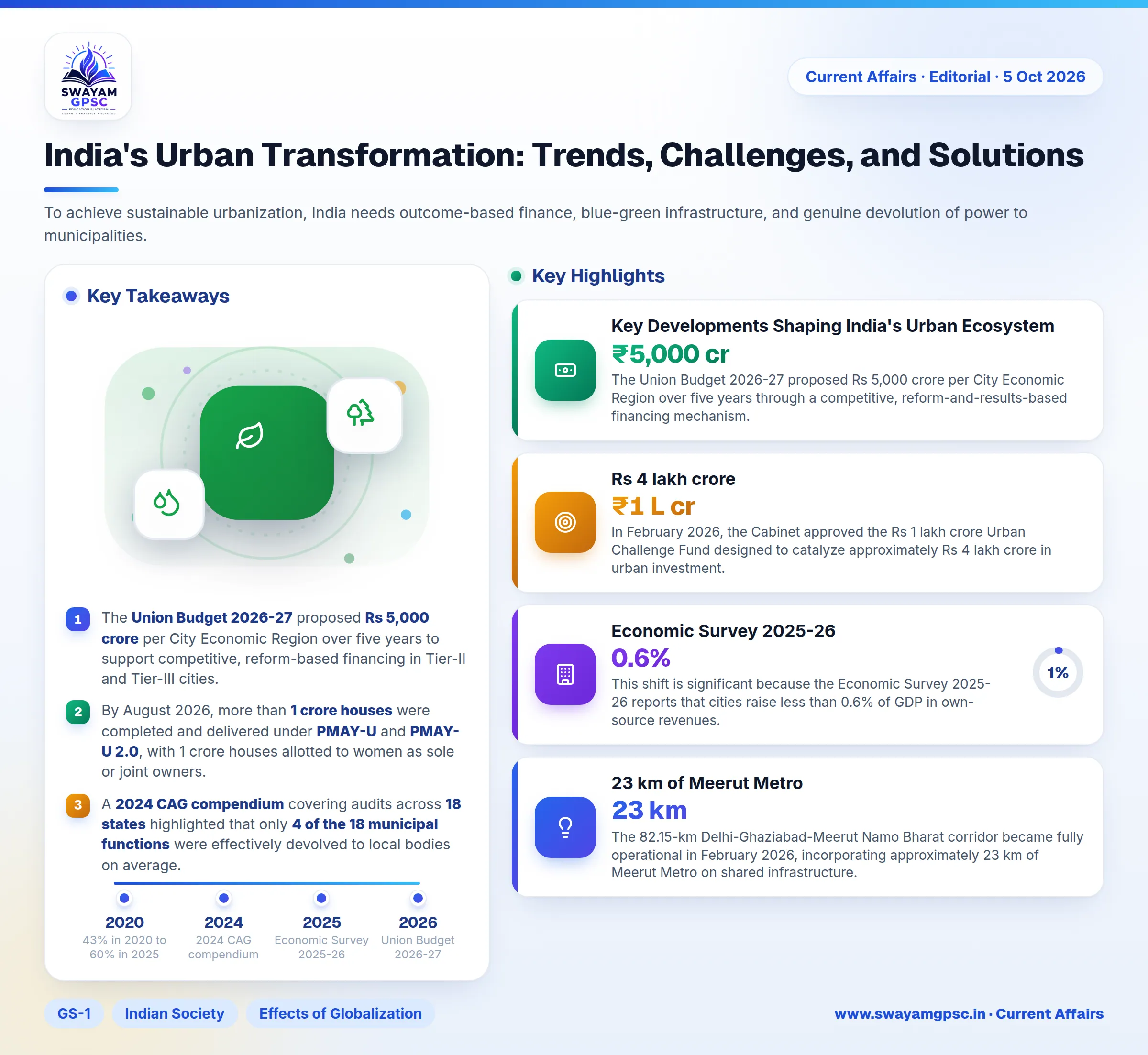
- The Union Budget 2026-27 proposed Rs 5,000 crore per City Economic Region over five years to support competitive, reform-based financing in Tier-II and Tier-III cities.
- By August 2026, more than 1 crore houses were completed and delivered under PMAY-U and PMAY-U 2.0, with 1 crore houses allotted to women as sole or joint owners.
- A 2024 CAG compendium covering audits across 18 states highlighted that only 4 of the 18 municipal functions were effectively devolved to local bodies on average.
- The Knight Frank Affordable Housing Report 2025 revealed that homes priced under Rs 50 lakh fell to 17% of new launches in major cities in 2025, down from 52.4% in 2018.
- The TomTom Traffic Index 2025 highlighted severe urban congestion, showing 74.4% congestion in Bengaluru and 71.1% in Pune, leading to massive productivity losses.
Why in News
- India's urban ecosystem is undergoing a structural transformation through City Economic Regions, the Urban Challenge Fund, and transit-oriented development.
- However, cities continue to face major issues like fragmented governance, weak municipal finances, lack of affordable housing, and high climate vulnerability.
- The Smart Cities Mission showed how top-down, spectacle-driven models can bypass local capacity and equity.
- To achieve sustainable urbanization, India needs outcome-based finance, blue-green infrastructure, and genuine devolution of power to municipalities.
Key Developments Shaping India's Urban Ecosystem
- Urban planning is increasingly connecting neighboring cities, industrial centers, and surrounding areas into integrated economic regions.
- The Union Budget 2026-27 proposed Rs 5,000 crore per City Economic Region over five years through a competitive, reform-and-results-based financing mechanism.
- This initiative focuses on Tier-II and Tier-III cities to distribute economic opportunities beyond established metropolitan centers.
- A concrete planning example is NITI Aayog's Bhubaneswar-Cuttack-Puri-Paradeep Economic Region which covers four districts.
- This regional framework connects Bhubaneswar's education and services, Cuttack's commerce, Puri's tourism, and Paradip's port-led industry.
- Urban infrastructure financing is placing greater emphasis on municipal revenue strength, private participation, and measurable service outcomes.
- In February 2026, the Cabinet approved the Rs 1 lakh crore Urban Challenge Fund designed to catalyze approximately Rs 4 lakh crore in urban investment.
- A Rs 5,000 crore Credit Repayment Guarantee Scheme supports eligible smaller municipalities and urban bodies in northeastern and hilly states.
- This shift is significant because the Economic Survey 2025-26 reports that cities raise less than 0.6% of GDP in own-source revenues.
- Urban mobility is expanding toward networks that integrate travel within cities with movement across metropolitan regions.
- The 82.15-km Delhi-Ghaziabad-Meerut Namo Bharat corridor became fully operational in February 2026, incorporating approximately 23 km of Meerut Metro on shared infrastructure.
- The corridor integrates with three metro lines, two railway stations, and four bus terminals to provide seamless travel.
- Transit-Oriented Development (TOD) zones have also been incorporated into the master plans of Ghaziabad and Meerut to link transport investment with development around stations.
- Urban housing policy is broadening its instruments to address ownership, rental needs, and the financial security of vulnerable households.
- By August 2026, more than 1 crore houses had been completed and delivered across PMAY-U and PMAY-U 2.0.
- Among the 1.25 crore houses sanctioned under PMAY-U and PMAY-U 2.0, 1 crore houses have been allotted to women through sole or joint ownership.
- To address migrant labor vulnerabilities, Affordable Rental Housing Complexes (ARHCs) convert existing government-funded housing or construct new rental units near industrial corridors.
- Urban land administration is moving toward integrated spatial information that connects property records with planning and public services.
- The DILRMP 3.0 operational guidelines propose a GIS-based Land Stack to integrate land information, accelerate urban mapping under NAKSHA, and issue Urban Property Cards.
- The widespread adoption of Gujarat's Land Pooling and Town Planning Scheme model across states like Maharashtra and Odisha enables planned urban expansion without compulsory land acquisition friction.
- Constitutional activation of Metropolitan Planning Committees (MPCs) under Article 243ZE is improving cross-boundary coordination between core metros and peripheral rural-urban fringe zones.
- Cities are increasingly managing water supply, groundwater replenishment, and treated-water reuse as connected parts of one urban water system.
- Under AMRUT 2.0, nearly 1.21 lakh acres of water bodies were being rejuvenated through desilting, inlet-outlet restoration, and shoreline protection.
- Cities like Burdwan and Vizianagaram provide examples of recharge pits linked to injection borewells.
- Korba and Warangal had operationalized recharge structures before the monsoon, demonstrating the use of shallow-aquifer management in urban water planning.
- Water Resource Recovery Cells had been established in 25 states and Union Territories, while Jal Hi AMRIT incentivized sustained improvements in sewage-treatment quality.
- Climate resilience is gaining dedicated financing and becoming an explicit consideration in urban infrastructure planning.
- By August 2026, the Centre had approved the Urban Flood Risk Management Programme Phase-I for 7 cities, and Phase-II for 11 cities like Guwahati, Patna, Jaipur, and Lucknow.
- Beyond drainage, the World Bank's 2025 report identifies Ahmedabad's Heat Action Plan, Kolkata's flood-warning system, and Chennai's climate action plan as city-level adaptation examples.
- These approaches connect early warnings, public health, outdoor-worker protection, and risk-informed planning to widen the meaning of urban resilience.
- Urban waste management is increasingly recovering materials and returning land occupied by dumpsites to productive public use.
- Approximately 3.66 crore metric tonnes of legacy waste had been remediated during 2025, with the Dumpsite Remediation Accelerator Programme launched in November 2025 to speed up the remaining work.
- Gorakhpur's 40-acre Kachre Se Kanchan Rapti Eco Park demonstrates the connection between biomining and public-space regeneration.
- Recovered materials were directed to reuse and industrial co-processing, and the restored site now includes recreation facilities and a restaurant operated by the women-led Shakti Ki Rasoi self-help group.
Key Case Studies Related to Urban Transformation
- In Indore, the Gobar-Dhan plant converts segregated organic waste into transport fuel and compost through a public-private partnership.
- The plant produces approximately 17,000 kilograms of Bio-CNG and 100 tonnes of compost daily, which municipal buses use to link sanitation with cleaner mobility.
- The replicable lesson here is integrating waste segregation, reliable processing, and assured demand for locally recovered resources.
- Odisha's Jaga Mission combines settlement upgrading with community participation through Slum Dwellers Associations.
- More than 1,684 slums have become Adarsh Colonies, benefiting over 2 lakh families through improved infrastructure and services while utilizing 3,000 associations to engage with civic authorities.
- This model demonstrates how organized communities can shape inclusive urban transformation and strengthen accountability for neighborhood improvements.
- Pimpri Chinchwad has implemented over 30 kilometers of Healthy Streets guided by community feedback and technical support from the ITDP.
- Its 2025 Vehicle-Free Day temporarily converted the Pimpri market's core into a public plaza, while municipal green bonds raised Rs 200 crore for walking and cycling projects.
- The lesson is combining demonstrated street improvements, public participation, and dedicated financing for sustained urban transformation.
Challenges
- Overlapping institutions and weak municipal authority make responsibility for urban services difficult to establish.
- The 2024 CAG compendium covering audits across 18 states found that only 4 of the 18 municipal functions were effectively devolved on average.
- It also found that municipalities in Odisha and Uttarakhand lacked full jurisdiction over any of the listed functions during the audit assessments.
- The compendium recorded an average 37% vacancy against sanctioned municipal posts, with water supply and land-use planning remaining with state departments, which weakens local accountability.
- Weak recurring revenues undermine the ability of cities to maintain urban assets after construction.
- The 2024 CAG compendium found that own-source revenue averaged only 32% of municipal revenue in the states with available data.
- Maintenance financing is particularly vulnerable, as CAG found that municipal bodies in Madhya Pradesh recovered only 21% to 31% of water-supply operation and maintenance expenditure through user charges.
- Formal housing increasingly fails to match the incomes and location needs of lower-income urban households.
- The Knight Frank Affordable Housing Report 2025 found that homes priced below Rs 50 lakh accounted for approximately 17% of new launches across 8 major cities during January to June 2025, compared with 52.4% in 2018.
- The same report estimated that the EMI-to-income ratio for an economically weaker section household increased from 43% in 2020 to 60% in 2025 under its affordability assessment.
- Congestion reduces the effective accessibility of jobs and services, even where cities attract substantial economic investment.
- The TomTom Traffic Index 2025 recorded 74.4% congestion in Bengaluru and 71.1% in Pune.
- Under its commuting benchmark, estimated annual time lost during rush hours reached 168 hours in Bengaluru and 152 hours in Pune.
- Longer and unpredictable journeys raise the costs of deliveries, business travel, and household commuting, reducing the productivity benefits of cities.
- Deficient treatment and distribution systems can turn basic-service failures into serious health emergencies.
- The CPCB's October 2025 assessment identified 296 polluted river stretches nationwide, showing weaknesses in protecting water bodies from wastewater.
- In January 2026, the NHRC took cognisance of reports of 7 deaths and over 40 hospitalizations following contaminated water supply in Bhagirathpura, Indore.
- Urban development can amplify climatic hazards when buildings, drainage, and ecological systems are poorly planned.
- A CEEW 2025 study revealed 15 and 11 additional very warm summer nights in Mumbai and Bengaluru respectively compared to the baseline.
- A 2025 CAG report exposed preventable drainage failures and backflow in Shivamogga caused by inadequate outflows and unresolved administrative correspondence.
- For informal settlements and low-income households, climate vulnerability brings lost workdays, damaged belongings, and rising cooling expenses.
- High particulate exposure and inconsistent enforcement continue to undermine urban liveability.
- The IQAir 2025 World Air Quality Report recorded an annual PM 2.5 concentration of 112.5 micrograms per cubic meter in Loni, Uttar Pradesh, which is over 22 times the WHO annual guideline of 5 micrograms per cubic meter.
- Enforcement gaps persist alongside formal pollution-control programmes, as a March 2026 report stated that 64 pollution complaints were recorded in Faridabad during 2025 with no fines or environmental compensation imposed.
Way Forward
- Urban ecosystems require the integration of natural hydrological pathways with municipal master plans to neutralize climate-induced floods.
- Instead of relying solely on concrete storm drains, integrating permeable pavements, retention basins, and deep aquifer recharge wells can absorb peak rainfall naturally.
- Chennai's eco-restoration of wetlands and temple tanks serves as a scalable model for mitigating urban flooding.
- Planners need to structure urban growth around high-density, multi-modal transit networks to reduce automobile reliance and lower transport emissions.
- Zoning for high-density, mixed-use commercial and residential spaces alongside metro corridors, paired with pedestrianized zero-emission zones and last-mile EV shared mobility, prevents traffic bottlenecks.
- Cities must transform linear consumption models into closed-loop ecosystems through mandatory at-source waste segregation and localized processing.
- Establishing ward-level anaerobic bio-methanation plants and enforcing strict construction and demolition waste recycling converts urban refuse into renewable energy.
- Administrators need to deploy predictive spatial analytics and real-time civic data to run stress tests for climate risks, utility usage, and traffic flow.
- Implementing GIS-based digital twins allows city planners to simulate cloudburst scenarios, optimize renewable energy grids, and trigger automated early-warning systems through Integrated Command and Control Centres (ICCCs).
- Urban finance should support assets that remain functional, financially manageable, and publicly accountable throughout their useful life.
- States should fund feasibility studies, environmental assessments, and financial structuring for smaller cities while aggregating suitable projects through pooled procurement and financing.
- Performance-linked components must be included in contracts, requiring whole-life costing, maintenance provisions, and independent verification before sanctioning major infrastructure.
- State governments should establish agreements between adjoining municipalities, development authorities, and peri-urban panchayats for shared transport, drainage, waste processing, and water supply.
- Cities must maintain a common GIS-based spatial database covering buildings, employment clusters, service deficits, and environmental risks, and update it periodically.
- Establishing shared technical teams for smaller municipalities and a Dig-Once Protocol will help coordinate underground utility works before road resurfacing.