West Asian Crisis and Securing India's Strategic Interests
#GS-2 #Current Events #International #Bilateral Groupings & Agreements #Groupings & Agreements Involving India and/or Affecting India's Interests #Effect of Policies & Politics of Countries on India's Interests #International Treaties & Agreements #West Asia Crisis #Energy Security #Maritime Security
Key takeaways
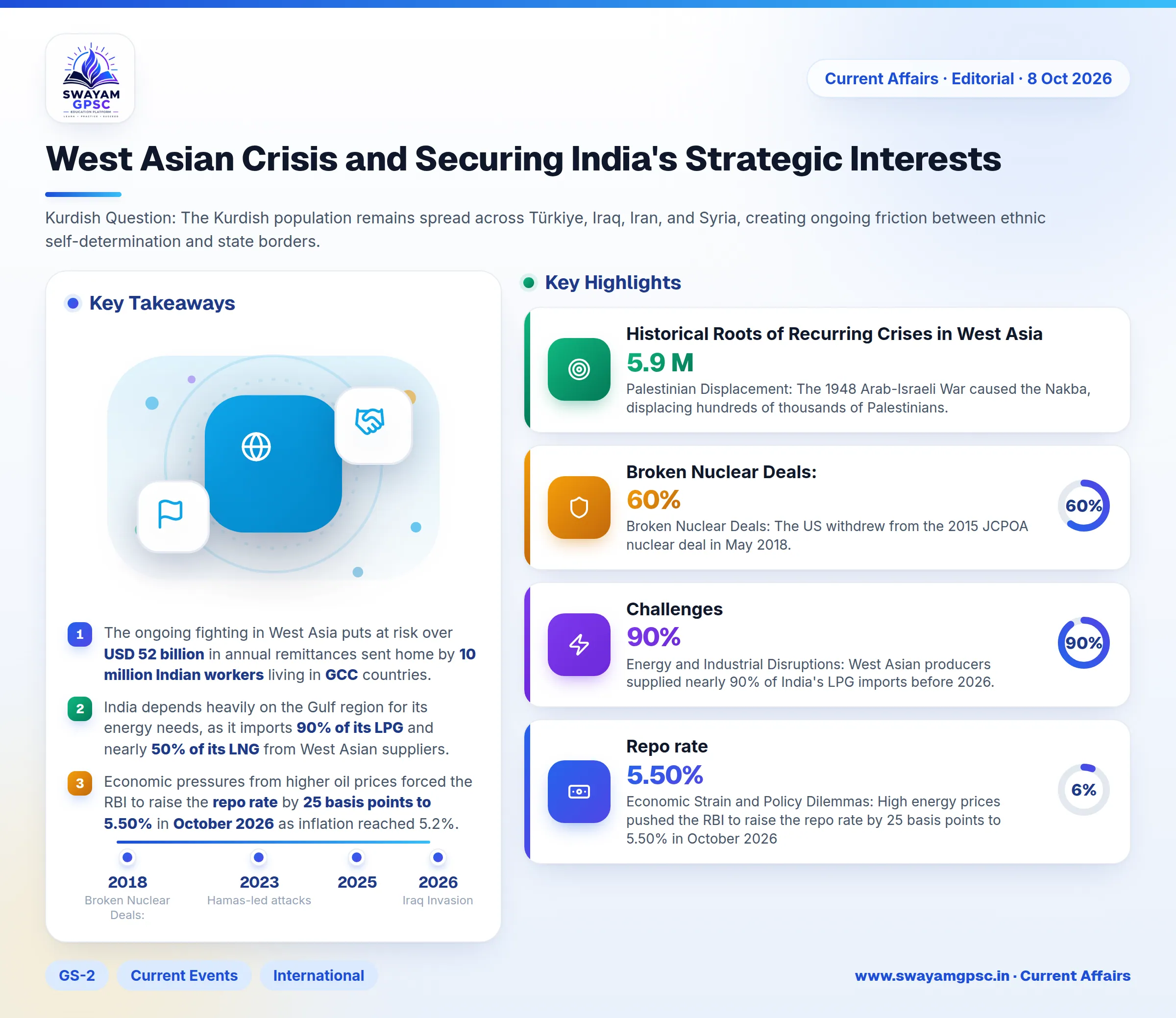
- The ongoing fighting in West Asia puts at risk over USD 52 billion in annual remittances sent home by 10 million Indian workers living in GCC countries.
- India depends heavily on the Gulf region for its energy needs, as it imports 90% of its LPG and nearly 50% of its LNG from West Asian suppliers.
- Economic pressures from higher oil prices forced the RBI to raise the repo rate by 25 basis points to 5.50% in October 2026 as inflation reached 5.2%.
- India's continental trade connectivity faces roadblocks following the expiration of the US conditional sanctions waiver for Iran's Chabahar port in April 2026.
- To guard against shipping disruptions, India set up the Bharat Maritime Insurance Pool in May 2026 backed by a Rs 12,980-crore sovereign guarantee.
Why in News
- The war that began after the Hamas-led attacks on Israel on 7th October 2023 continues to create wider fighting across West Asia.
- This ongoing instability directly threatens India by disturbing energy supplies, international trade routes, foreign workers, and key infrastructure projects.
Historical Roots of Recurring Crises in West Asia
- Colonial Agreements: Imperial powers drew artificial borders after the Ottoman Empire collapsed. The Sykes-Picot Agreement (1916) divided the region between Britain and France, while the Balfour Declaration (1917) promised a national home for Jewish people in Palestine without local consent.
- Kurdish Question: The Kurdish population remains spread across Türkiye, Iraq, Iran, and Syria, creating ongoing friction between ethnic self-determination and state borders.
- Palestinian Displacement: The 1948 Arab-Israeli War caused the Nakba, displacing hundreds of thousands of Palestinians. UNRWA was created in 1950 to care for 750,000 Palestine refugees; today, that number has grown to 5.9 million refugees without a final agreement on their right to return.
- Territorial Occupation: The Six-Day War (1967) resulted in Israel occupying the West Bank, East Jerusalem, and Gaza. Despite UN Security Council Resolution 242, expanding Israeli settlements have made a viable, continuous Palestinian state difficult to form.
- Iranian Revolution and Regional Rivalry: US involvement in the 1953 overthrow of Mohammad Mossadegh created lasting Iranian mistrust. The 1979 Iranian Revolution turned Iran into an anti-Western state, sparking a deep rivalry with Saudi Arabia that fueled local conflicts like Yemen's civil war after the Saudi-led intervention in 2015.
- Iraq Invasion Consequences: The US-led invasion of Iraq in 2003 dismantled Iraqi military and state institutions. This power vacuum allowed armed militias to grow, and a July 2026 UN report noted that ISIL still kept around 3,000 fighters in Syria.
- Lebanese Civil War Fragility: Lebanon's 1975-1990 civil war ended with the 1989 Taif Agreement, but armed groups like Hezbollah kept their weapons, preventing the state from gaining full control over security.
- Broken Nuclear Deals: The US withdrew from the 2015 JCPOA nuclear deal in May 2018. By June 2025, the IAEA estimated Iran possessed 440.9 kg of 60% enriched uranium, increasing regional security fears.
- Unfinished Peace Processes: The Oslo Accords (1993) set a five-year timeline for a final peace deal that never happened. Recently, UN Security Council Resolution 2803 introduced the Board of Peace (BoP) as a temporary body to manage Gaza's recovery.
- Maritime Chokepoints and Energy Warfare: History shows energy supplies being used as political weapons, starting with the 1973 Arab oil embargo and the 1980s Tanker War. Modern disruptions in Hormuz and Bab el-Mandeb continue this trend, including a Houthi blockade against Saudi-affiliated shipping in July 2026.
Maritime Chokepoints in West Asia
- Strait of Hormuz: Located between Iran and Oman, this waterway connects the Persian Gulf to the Gulf of Oman and serves as India's primary route for oil and gas imports.
- Bab el-Mandeb Strait: Positioned between Yemen and East Africa, this passage connects the Red Sea to the Gulf of Aden and guards the southern entrance toward the Suez Canal.
- Suez Canal: Running through Egypt, this artificial canal links the Red Sea directly to the Mediterranean Sea, offering the fastest sea route between Asia and Europe.
Challenges
- Energy and Industrial Disruptions: West Asian producers supplied nearly 90% of India's LPG imports before 2026. Cuts in these supplies force India to prioritize cooking gas over commercial and industrial uses.
- Economic Strain and Policy Dilemmas: High energy prices pushed the RBI to raise the repo rate by 25 basis points to 5.50% in October 2026, raising domestic borrowing costs while war factors pushed projected inflation to 5.2%.
- Agricultural Subsidy Pressures: The Gulf region provides 20-30% of India's urea, 30% of DAP, and almost 50% of LNG imports. Gas supply cuts to Indian fertilizer plants to 60% directly hurt local crop production.
- Export Losses and Logistics Cash Squeeze: Longer sea routes around Africa increase shipping fees and delay customer payments, locking up working capital for Indian exporters.
- Risks to Overseas Indian Workers: Over 10 million Indians work in GCC countries and send home more than USD 52 billion in remittances every year. Regional conflict threatens their jobs and financial security.
- Naval Safety Burdens: Escalating sea attacks harm Indian crew members, such as the fatal strike on the MT Al Bahiyah and MT Mombasa carrying 30 Indian seafarers.
- Connectivity Delays and Sanctions: India's access to Central Asia faces roadblocks because the US conditional sanctions waiver for Iran's Chabahar port expired in April 2026. Similarly, the IMEC infrastructure plan faces delays.
- Diplomatic Balancing Pressure: Elevating relations with Israel to a Special Strategic Partnership in February 2026 makes it harder for India to balance ties with Arab nations and Iran simultaneously.
Way Forward
- Active Regional Diplomacy: India should create a special contact group within the Ministry of External Affairs and use the India-Arab Cooperation Forum's Executive Programme (2026-2028) to protect trade, shipping, and citizens.
- Strategic Energy Reserves: India must expand agreements like the May 2026 ISPRL-ADNOC deal to store up to 30 million barrels of crude oil and build additional storage facilities in Fujairah.
- Enhanced Maritime Protection: The IFC-IOR must coordinate real-time tracking data with naval forces to safeguard merchant vessels and offer escorts through high-risk zones.
- Financial Safety Nets for Exporters: The government should strengthen the Bharat Maritime Insurance Pool, created in May 2026 with US$ 1.5 billion capacity and a Rs 12,980-crore guarantee, to cover shipping losses and speed up bank credit.
- Digital Protection for Migrants: Expanding tools like e-Migrate and MADAD will help track Indian workers digitally and secure emergency funds for them during regional crises.
- Humanitarian Reconstruction Projects: India can build long-term goodwill by expanding medical aid, such as the planned 200-bed Indian hospital in Jenin, and working with Gulf nations to rebuild damaged basic infrastructure.