Towards a Uniform Civil Code
#GS-2 #Indian Polity & Constitution #Constitution #Directive Principles of State Policy #Indian Constitution
Key takeaways
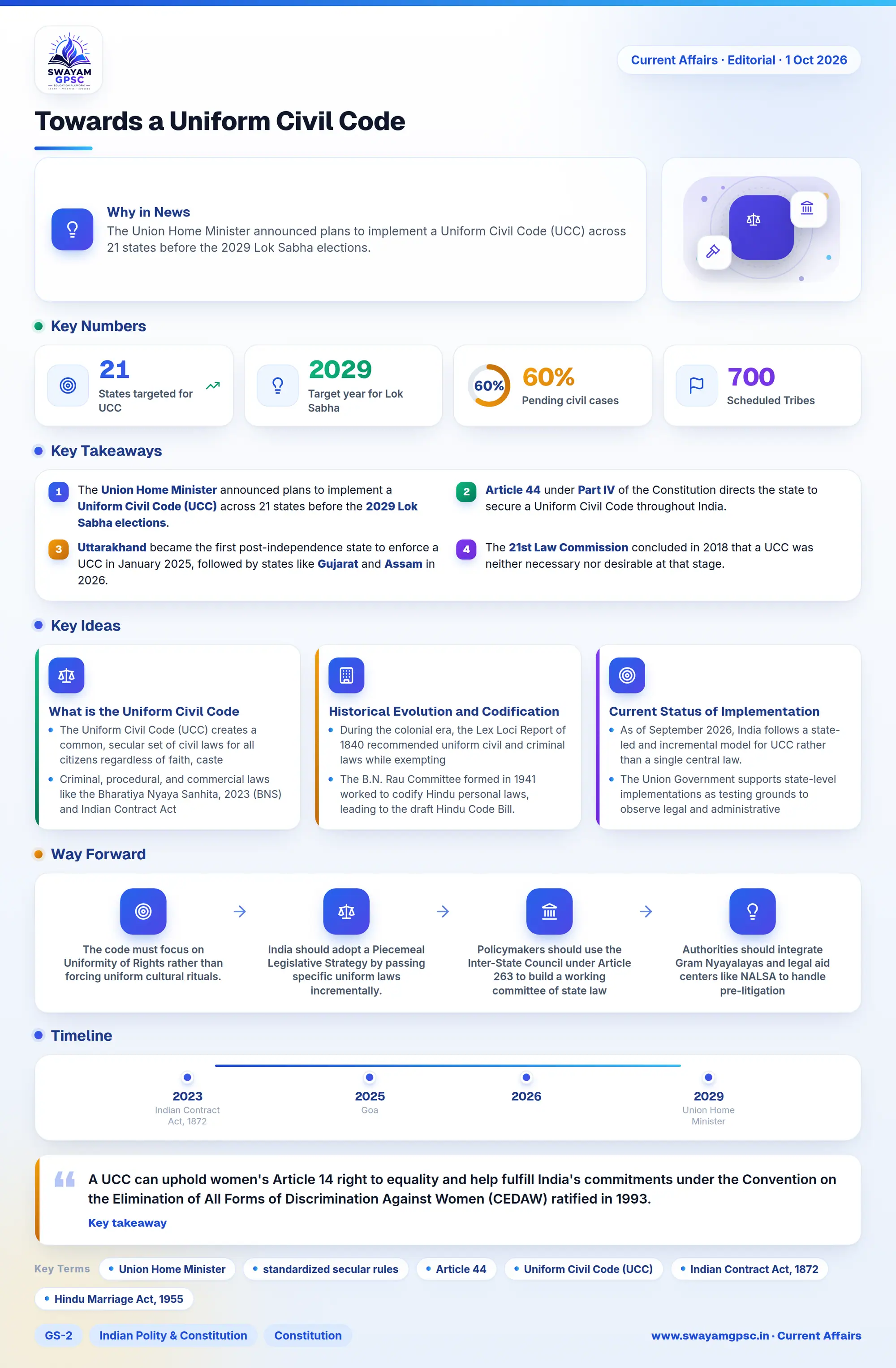
- The Union Home Minister announced plans to implement a Uniform Civil Code (UCC) across 21 states before the 2029 Lok Sabha elections.
- Article 44 under Part IV of the Constitution directs the state to secure a Uniform Civil Code throughout India.
- Uttarakhand became the first post-independence state to enforce a UCC in January 2025, followed by states like Gujarat and Assam in 2026.
- The 21st Law Commission concluded in 2018 that a UCC was neither necessary nor desirable at that stage.
- Around 60% of pending civil cases in India involve property and land disputes that could be addressed through succession reforms.
Why in News
- The Union Home Minister announced plans to implement a Uniform Civil Code (UCC) across 21 states before the 2029 Lok Sabha elections.
- This announcement restarts an intense national discussion about replacing religion-based personal laws with standardized secular rules for marriage, divorce, and inheritance.
- The proposed framework aims to balance gender justice goals against complex minority and tribal rights concerns under Article 44.
What is the Uniform Civil Code
- The Uniform Civil Code (UCC) creates a common, secular set of civil laws for all citizens regardless of faith, caste, gender, or tribe.
- Criminal, procedural, and commercial laws like the Bharatiya Nyaya Sanhita, 2023 (BNS) and Indian Contract Act, 1872 are already uniform across India.
- Family matters remain split across faith-based rules such as the Hindu Marriage Act, 1955 and the Shariat Application Act, 1937.
- Article 44 under Part IV of the Constitution states that the government shall try to secure a UCC throughout India.
- Since Article 44 is a Directive Principle, it guides governance but courts cannot enforce it directly through writs.
- Personal laws fall under Entry 5 of List III (Concurrent List), giving both Parliament and State Assemblies power to make civil laws.
Historical Evolution and Codification Trajectory
- During the colonial era, the Lex Loci Report of 1840 recommended uniform civil and criminal laws while exempting personal laws to avoid native resistance.
- The B.N. Rau Committee formed in 1941 worked to codify Hindu personal laws, leading to the draft Hindu Code Bill.
- During Constituent Assembly debates between 1948 and 1949, leaders like Dr. B.R. Ambedkar and K.M. Munshi argued that personal laws promote gender discrimination.
- Other members feared majoritarian rule, leading to the political compromise of placing the UCC under Article 44 (DPSP) instead of Fundamental Rights.
- Parliament passed four Hindu Code Bills between 1955 and 1956 to modernize Hindu, Buddhist, Jain, and Sikh personal laws while leaving other codes uncodified.
Current Status of Implementation
- As of September 2026, India follows a state-led and incremental model for UCC rather than a single central law.
- The Union Government supports state-level implementations as testing grounds to observe legal and administrative outcomes.
- Goa uses the historic 1867 Portuguese Civil Code, while Uttarakhand became the first post-independence state to enforce a UCC in January 2025.
- Momentum grew in 2026 when Gujarat passed its UCC Act in March, followed by Assam in May and Madhya Pradesh in July.
Arguments in Favour of UCC
- Personal laws often reflect patriarchal structures, causing dual marginalization of women based on gender and religion.
- Under the Muslim Personal Law (Shariat) Application Act, 1937, a female heir usually receives half the share of a male heir.
- A UCC can uphold women's Article 14 right to equality and help fulfill India's commitments under the Convention on the Elimination of All Forms of Discrimination Against Women (CEDAW) ratified in 1993.
- Fulfilling Article 44 treats uniformity as a tool for modernization and equal citizenship rather than cultural homogenization.
- The Income Tax Act, 1961 recognizes the Hindu Undivided Family (HUF) as a separate tax entity, creating unequal economic privileges.
- Around 60% of pending civil cases involve property disputes, which a uniform inheritance framework can help reduce.
- A UCC can resolve tensions between Article 25 and Articles 14 and 15 by treating family matters as secular civil contracts.
- Existing personal laws contain gender-based guardianship hierarchies, whereas a UCC can establish a gender-neutral framework based on the Best Interests of the Child.
Constraints in Implementation
- Special provisions like Article 371A for Nagaland and Article 371G for Mizoram protect tribal customary laws and create hurdles for a blanket uniform code.
- Regions under the Sixth Schedule feature Autonomous District Councils with legislative powers over marriage and inheritance.
- Groups like the Arunachal Indigenous Tribes Forum (AITF) fear that a UCC threatens their historical autonomy.
- Minorities worry that absolute legal uniformity amounts to majoritarian assimilation and threatens their cultural identity under Article 29.
- The Hindu community itself follows diverse customs, including cross-cousin marriages in South India and varying traditions between the Dayabhaga school and Mitakshara school.
- Matrilineal systems among the Khasi, Jaintia and Garo tribes of Meghalaya risk disruption under a standardized inheritance framework.
- India has over 700 Scheduled Tribes with micro-level customs, making documentation and codification extremely difficult.
- The 21st Law Commission of India concluded in 2018 that a UCC was neither necessary nor desirable at that stage.
Landmark Supreme Court Judgments on UCC
- In Mohd. Ahmed Khan v. Shah Bano Begum (1985), the court noted that Article 44 had remained a dead letter.
- In Sarla Mudgal v. Union of India (1995), the court asked the government to retrieve Article 44 from cold storage to prevent legal loopholes.
- In Shayara Bano v. Union of India (2017), the ruling reinforced that personal law practices must conform to constitutional morality.
- In Jose Paulo Coutinho v. Maria Luiza Valentina Pereira (2019), the court praised Goa as a shining example of a functioning UCC.
Law Commission Recommendations
- The 21st Law Commission led by Justice B.S. Chauhan stated in 2018 that a UCC was neither necessary nor desirable at that stage.
- The Commission recommended reforming discriminatory practices within existing personal laws instead of imposing absolute uniformity.
- The 22nd Law Commission chaired by Justice Ritu Raj Awasthi issued a notice in June 2023 to re-examine the issue based on fresh public feedback.
Way Forward
- The code must focus on Uniformity of Rights rather than forcing uniform cultural rituals.
- India should adopt a Piecemeal Legislative Strategy by passing specific uniform laws incrementally.
- Policymakers should use the Inter-State Council under Article 263 to build a working committee of state law ministers.
- Authorities should integrate Gram Nyayalayas and legal aid centers like NALSA to handle pre-litigation mediation.
- Governments should publish draft provisions as public policy white papers translated into all 22 scheduled languages.