Building an Inclusive India for Persons with Disabilities
#GS-2 #Governance & Social Justice #Vulnerable Sections #Government Policies & Interventions #Welfare Schemes #Issues Related to Disability
Key takeaways
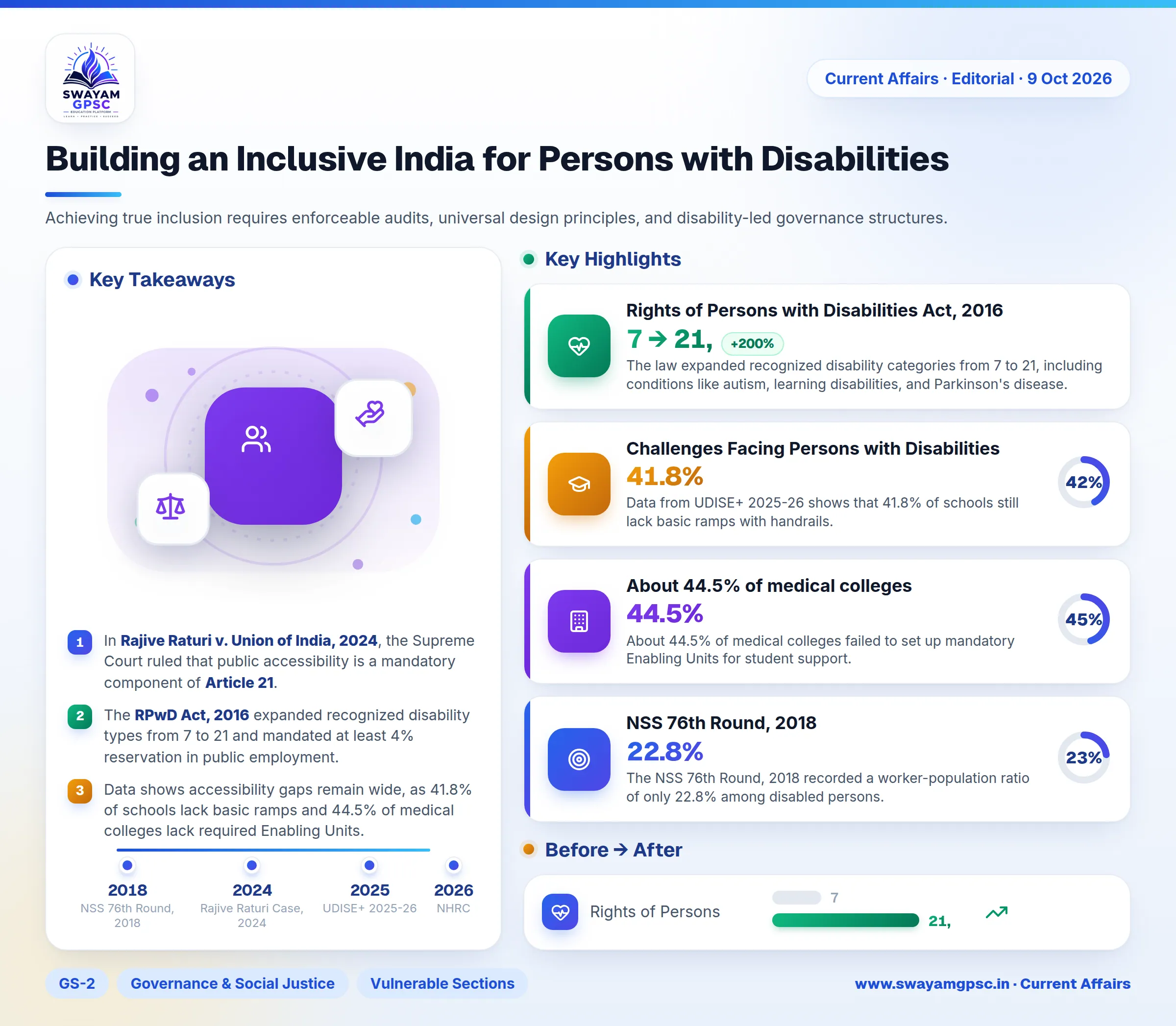
- In Rajive Raturi v. Union of India, 2024, the Supreme Court ruled that public accessibility is a mandatory component of Article 21.
- The RPwD Act, 2016 expanded recognized disability types from 7 to 21 and mandated at least 4% reservation in public employment.
- Data shows accessibility gaps remain wide, as 41.8% of schools lack basic ramps and 44.5% of medical colleges lack required Enabling Units.
- Under the Indira Gandhi National Disability Pension Scheme (IGNDPS), eligible individuals receive a central contribution of just Rs 300 per month.
- Digital accessibility tools like the Unique Disability ID (UDID) system and the Sugamya Bharat App are reforming service delivery and grievance handling.
Introduction
- The Supreme Court affirmed in the Rajive Raturi Case, 2024 that accessibility is a binding aspect of Article 21.
- Persons with disabilities in India still face fragmented infrastructure, educational barriers, employment discrimination, and digital exclusion.
- Technology like assistive devices and Digital Public Infrastructure (DPI) offers path-breaking solutions for personal autonomy.
- Achieving true inclusion requires enforceable audits, universal design principles, and disability-led governance structures.
Challenges Facing Persons with Disabilities
- Physical public spaces remain poorly integrated, making independent movement very hard for citizens with disabilities.
- In the Rajive Raturi v. Union of India Case, 2024, the Supreme Court ruled that guidelines cannot replace mandatory accessibility standards.
- Data from UDISE+ 2025-26 shows that 41.8% of schools still lack basic ramps with handrails.
- About 44.5% of medical colleges failed to set up mandatory Enabling Units for student support.
- The NSS 76th Round, 2018 recorded a worker-population ratio of only 22.8% among disabled persons.
- In March 2025, the Supreme Court struck down state rules that barred visually impaired candidates from judicial service recruitment.
- Access to rehabilitation remains uneven, leaving informal workers and older persons without adequate assistive devices.
- Devices like wheelchairs and hearing aids need ongoing fitting, maintenance, and support services to stay useful.
- Digital verification steps often exclude blind persons and acid-attack survivors from essential online services.
- In the Pragya Prasun v. Union of India Case, 2025, the Supreme Court ordered accessible alternatives for digital verification.
- In January 2026, the NHRC warned against forcing people with irreversible disabilities to undergo repeated medical reassessments.
- Administrative delays in issuing disability certificates prevent students and job seekers from accessing legal benefits.
- Central pension support under the Indira Gandhi National Disability Pension Scheme (IGNDPS) provides only Rs 300 per month for severely disabled citizens.
- High daily expenses for special transport and personal care often trap disabled individuals and their families in a poverty cycle.
- In the Nipun Malhotra v. Sony Pictures Case, 2024, the Supreme Court cautioned against using demeaning humor targeting disabled people.
- A 2025 systematic review highlighted severe obstacles faced by disabled women regarding reproductive rights and healthcare access.
- Persons with intellectual disabilities often face family or institutional denial of their right to give informed consent.
Rights of Persons with Disabilities Act, 2016
- The RPwD Act, 2016 took effect on April 19, 2017, aligning Indian law with the UNCRPD.
- The law defines Persons with Benchmark Disabilities as those having at least 40% certified specified disability.
- The law expanded recognized disability categories from 7 to 21, including conditions like autism, learning disabilities, and Parkinson's disease.
- Under Section 3, the law guarantees equality, personal dignity, and protection against any arbitrary deprivation of liberty.
- Defined in Section 2(y), denial of reasonable accommodation is now explicitly treated as a form of discrimination.
- Under Section 31, disabled children aged 6-18 years receive free education in nearby or special schools.
- Under Section 32, government higher education institutions must reserve at least 5% of seats for disabled students.
- Under Section 34, government job listings must reserve at least 4% of positions for disabled candidates.
- Every workplace must publish an Equal Opportunity Policy under Section 21 of the law.
- Sections 40 to 43 set clear accessibility requirements for physical buildings, public transport systems, and digital platforms.
- Under Section 24, social security allowances for disabled persons must be at least 25% higher than standard schemes.
- Sections 56 to 59 make disability evaluation certificates valid across all states in India.
- Section 11 orders accessible voting facilities, while Section 12 guarantees fair access to courtrooms and legal assistance.
- Sections 6 to 8 mandate special protections against violence, physical abuse, and emergency disaster risks.
- Implementation relies on Advisory Boards, District Committees, and Commissioners at central and state levels.
- Section 23 obliges institutions to appoint Grievance Officers who must investigate formal complaints within two weeks.
- Under Section 89, initial statutory violations bring fines up to Rs 10,000, with subsequent fines reaching Rs 5 lakh.
- Fraudulent claims for disability benefits carry a punishment of up to two years in prison or a Rs 1 lakh fine.
Role of Technology in Inclusive Development
- Inventions like 'NeoBolt' from IIT Madras convert regular wheelchairs into safe motor vehicles for personal travel.
- Screen readers like NVDA and Microsoft's Seeing AI turn physical visual details into instant voice or touch signals.
- High-tech bionic limbs distributed through the ADIP Scheme help individuals regain independent physical movement.
- The Unique Disability ID (UDID) system digitizes record-keeping, allowing smooth access to welfare benefits across state borders.
- Through the Sugamya Bharat App, citizens report inaccessible civic buildings directly to local administrative teams.
- Adhering to WCAG 2.1 standards ensures government platforms remain easy to read with screen-reading software.
- The ISLRTC developed an online dictionary with over 10,000 sign language entries and converted standard school textbooks.
- Educational TV channels under PM e-VIDYA air lessons with sign language interpretation and clear audio descriptions.
- Accessible reading formats like DAISY allow vision-impaired students to study complex book diagrams and math equations independently.
- Remote work models and digital collaboration tools let severely disabled employees build careers in professional IT sectors.
- The PM-DAKSH platform matches job seekers with aligned skill training courses and open market employment options.
- Ergonomic hardware accessories and eye-tracking systems allow disabled workers to handle administrative tasks effectively.
- Under the Accessible India Campaign, cities are adding low-floor buses and tactile floor markings to transit stations.
- Talking cash machines, voice payment tools, and AI software like AI Bhashini give users full control over personal financial transactions.
Way Forward for an Inclusive India
- India must establish a National Disability Accessibility Authority (NDAA) empowered to fine entities that ignore accessibility standards.
- Certified accessibility professionals from the disabled community should conduct regular design checks on public facilities.
- The government should purchase low-floor electric buses under PM-eBus Sewa and install tactile paths across cities.
- Pedestrian walkways need uniform tactile ground surface indicators (TGSIs) alongside audio signals at traffic crossings.
- SEBI should track disability inclusion metrics within the Business Responsibility and Sustainability Reporting (BRSR) framework.
- Corporate funding and state support can launch Social Impact Bonds tied to stable job placements for disabled workers.
- The PM-DAKSH initiative can create startup hubs backed by affordable credit from the NDFDC.
- Schools under the PM-SHRI model should add Assistive Technology Labs to support tailored learning approaches.
- Local early childhood centers should use screening apps like PRASHAST App to spot learning difficulties early.
- All official apps must meet international WCAG 2.2 AA standards backed by supervision under the DPDP Act.
- Open-source tools from AI Bhashini can convert live spoken words into Indian Sign Language on basic mobile phones.
- The ADIP Scheme should subsidize advanced equipment like braille displays through local manufacturing hubs.
- National survey bodies should adopt the Washington Group Questions on Disability Statistics for accurate population data collection.
- Social welfare plans must address compound hardships faced by disabled women, rural residents, and minority groups.
- Disaster management teams must integrate NDMA Guidelines using map-linked UDID records for quick emergency rescues.
- Election authorities should use the Saksham App to make polling booths fully accessible to all voters.
- Reserving seats in Panchayati Raj Institutions and local bodies will give disabled leaders a direct voice in governance.
Conclusion
- India needs to shift its strategy from traditional charity to a rights-based model of complete social inclusion.
- Enforceable laws, accessible designs, and broad social security can secure true equal citizenship for all disabled individuals.