The Evolving Dynamic Between India and Canada
#GS-2 #GS-3 #International #Bilateral Groupings & Agreements #Indian Diaspora #Economy #Infrastructure #Agriculture #Environment
Key takeaways
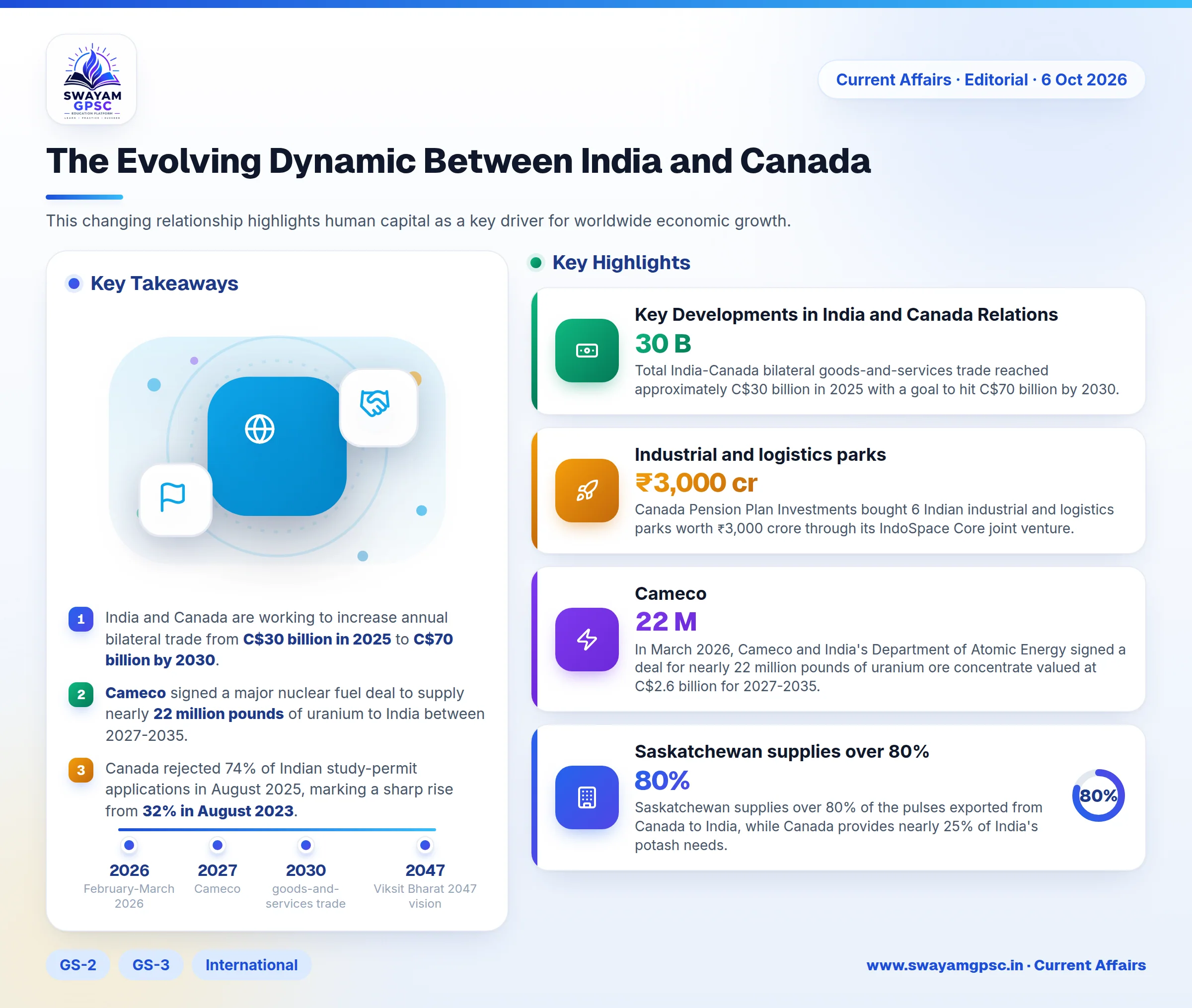
- India and Canada are working to increase annual bilateral trade from C$30 billion in 2025 to C$70 billion by 2030.
- Cameco signed a major nuclear fuel deal to supply nearly 22 million pounds of uranium to India between 2027-2035.
- Canada rejected 74% of Indian study-permit applications in August 2025, marking a sharp rise from 32% in August 2023.
- Saskatchewan supplies over 80% of the pulses exported from Canada to India, forming a strong foundation for agricultural trade.
Overview of India and Canada Relations
- India and Canada are rebuilding their partnership by connecting India's Viksit Bharat 2047 vision with Canada's Indo-Pacific Strategy.
- Both governments are actively fast-tracking trade negotiations and strengthening energy partnerships despite past diplomatic disagreements and rule-bound hurdles.
- They plan to build secure supply chains through strong educational cooperation and shared work on critical minerals.
- This changing relationship highlights human capital as a key driver for worldwide economic growth.
Key Developments in India and Canada Relations
- High-level talks are bringing back the official channels needed to maintain cooperation after past diplomatic tensions.
- Both countries reinstated High Commissioners in August 2025 and Canadian PM Mark Carney visited India in February-March 2026 as the first bilateral visit since 2018.
- The March leaders statement welcomed an NSA-level security workplan and agreed to set up a regular Defence Dialogue.
- Foreign Office Consultations in September 2026 reviewed ongoing cooperation, followed by the Jaishankar-Anita Anand meeting during the UN General Assembly.
- Both nations are working on a Comprehensive Economic Partnership Agreement (CEPA) covering goods, services, agriculture, digital trade, and worker mobility.
- The Terms of Reference for CEPA were signed in March 2026 with a target to finish talks by end-2026.
- Total India-Canada bilateral goods-and-services trade reached approximately C$30 billion in 2025 with a goal to hit C$70 billion by 2030.
- At the inaugural Finance Ministers’ Economic and Financial Dialogue in August 2026, India announced its readiness to start Bilateral Investment Treaty talks.
- Canada Pension Plan Investments bought 6 Indian industrial and logistics parks worth ₹3,000 crore through its IndoSpace Core joint venture.
- In March 2026, Cameco and India's Department of Atomic Energy signed a deal for nearly 22 million pounds of uranium ore concentrate valued at C$2.6 billion for 2027-2035.
- The Ministerial Energy Dialogue supports investments in hydrogen, sustainable aviation fuel, and carbon capture, utilisation and storage (CCUS).
- A March 2026 Critical Minerals MoU focuses on exploration, mining, and technical exchanges.
- The AICTE-Mitacs agreement will fund 300 Indian senior undergraduate students each year for 3 years starting in summer 2027.
- The Dalhousie University-SRM Institute partnership created a Nursing Dual Degree Programme with special supernumerary seats and clinical training in Canada.
- The Jubilant Bhartia Foundation-McGill University MoU launched an AI Education and Research Centre of Excellence in India to train about 200 graduates yearly.
- The countries plan to expand CSA-ISRO cooperation in space robotics and human spaceflight.
- A Canada-India Pulse Protein Centre of Excellence is being set up at NIFTEM-Kundli in Haryana.
- Saskatchewan supplies over 80% of the pulses exported from Canada to India, while Canada provides nearly 25% of India's potash needs.
Challenges in India and Canada Relations
- Canada’s CSIS Public Report 2025 claims India engages in foreign interference, which India has strongly rejected.
- The report notes Canada-based Khalistani extremists as a security threat while separating peaceful protests from violent acts.
- Canadian authorities rejected 74% of Indian study-permit applications in August 2025, compared to 32% in August 2023.
- Immigration rules now demand proof of C$23,448 in living-expense funds per single applicant alongside tuition costs.
- India placed a 30% import duty on yellow peas in November 2025, which disrupted existing trade patterns.
- Canada continues to protect its domestic market for dairy, poultry and eggs without offering new access to foreign farmers.
- Non-tariff barriers like fumigation requirements and quarantine weed-seed lists create extra delays for agricultural trade.
- Canada sanctioned 100 additional Russian shadow-fleet vessels, bringing its listed total to more than 600 vessels.
- India continues to buy Russian oil, which stood at approximately 2.1 million barrels per day in August 2026.
- India’s Digital Personal Data Protection Rules, 2025 and Canada's proposed Bill C-36 create complex compliance rules for cross-border data transfers.
Way Forward
- Both nations must create a joint case-coordination mechanism to handle security threats and extradition requests smoothly.
- Establishing a bilateral regulatory problem-solving portal will help businesses report customs and licensing issues quickly.
- Setting up a joint project-preparation facility involving Export Development Canada and EXIM Bank of India will boost infrastructure investments.
- KABIL and Indian firms should partner with Canadian companies to secure long-term supplies of essential critical minerals.
- A verified student admissions system will stop fraudulent agents and ensure fair immigration processing.
- State-level partnerships like Karnataka-Ontario and Punjab-Saskatchewan can drive regional cooperation in tech and farming.
- Creating a joint regulatory sandbox will allow safe testing for agricultural and industrial technology projects.