World Bank Report on India Poverty Trends and Challenges
#GS-2 #Governance & Social Justice #Poverty #GS-3 #Economy #Employment #Human Resource #Population and Associated Issues #Social Empowerment
Key takeaways
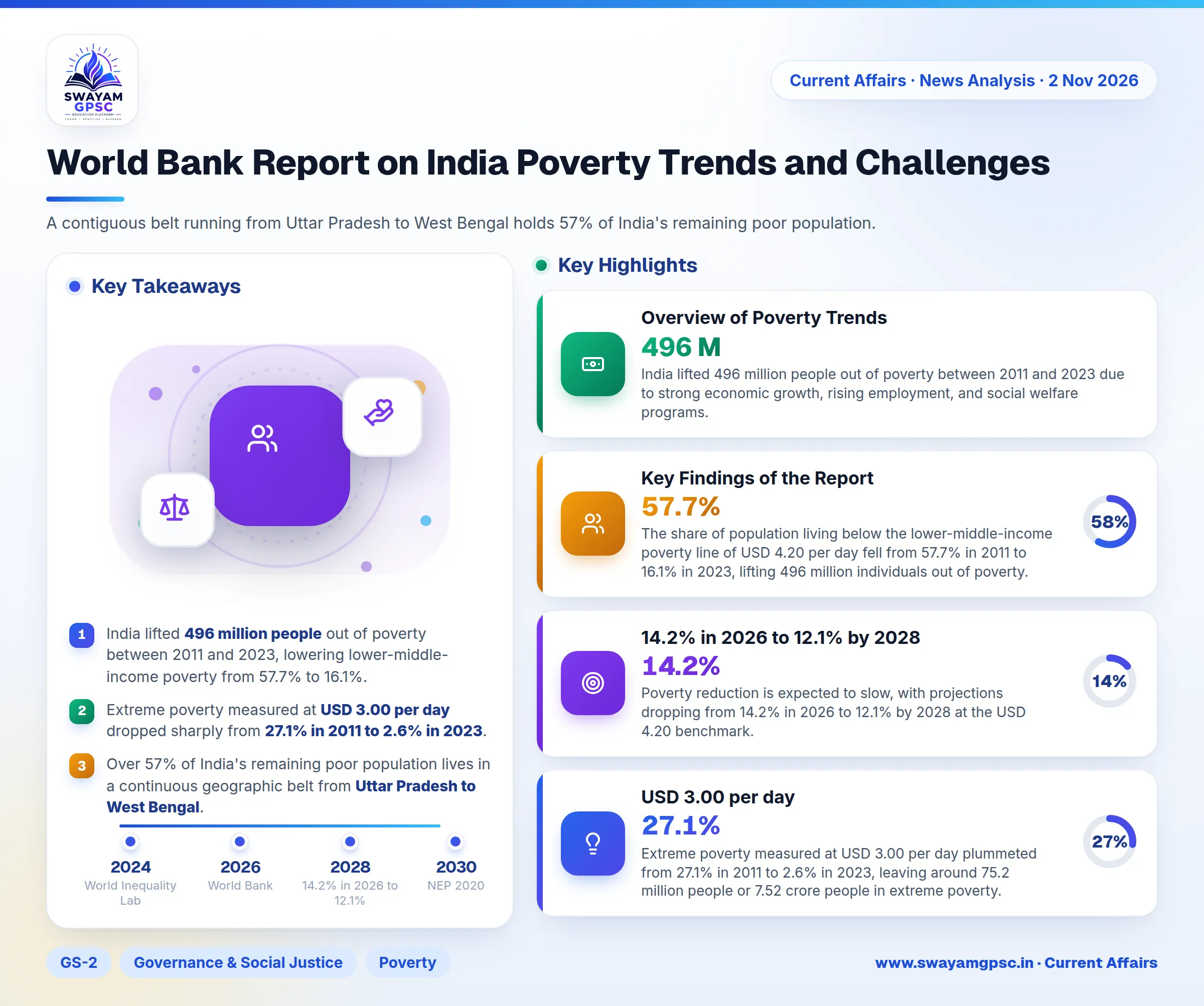
- India lifted 496 million people out of poverty between 2011 and 2023, lowering lower-middle-income poverty from 57.7% to 16.1%.
- Extreme poverty measured at USD 3.00 per day dropped sharply from 27.1% in 2011 to 2.6% in 2023.
- Over 57% of India's remaining poor population lives in a continuous geographic belt from Uttar Pradesh to West Bengal.
- The top 10% of wage earners in India earned 13 times more than the bottom 10%, highlighting persistent income inequality.
- Out-of-pocket medical expenses force approximately 55 million people back into poverty every year.
Why in News
- The World Bank published the India Poverty and Equity Brief (October 2026), showing that India recorded one of the fastest rates of poverty reduction globally.
- While monetary poverty dropped sharply, macroeconomic risks and structural inequalities continue to threaten this progress.
Overview of Poverty Trends
- India lifted 496 million people out of poverty between 2011 and 2023 due to strong economic growth, rising employment, and social welfare programs.
- Systemic challenges like inequality, joblessness, rural distress, and social exclusion still block complete poverty removal.
Key Findings of the Report
- The share of population living below the lower-middle-income poverty line of USD 4.20 per day fell from 57.7% in 2011 to 16.1% in 2023, lifting 496 million individuals out of poverty.
- Poverty reduction is expected to slow, with projections dropping from 14.2% in 2026 to 12.1% by 2028 at the USD 4.20 benchmark.
- Extreme poverty measured at USD 3.00 per day plummeted from 27.1% in 2011 to 2.6% in 2023, leaving around 75.2 million people or 7.52 crore people in extreme poverty.
- The Oxford Poverty and Human Development Initiative (OPHI) reported that India's Multidimensional Poverty Index (MPI) rate fell from 53.8% in 2005-06 to 16.4% in 2019-21, while the World Bank estimated it at 15.5% in 2022-23.
- A contiguous belt running from Uttar Pradesh to West Bengal holds 57% of India's remaining poor population.
- Rural poverty stands at 19.3% compared to 8.6% in urban areas due to a lack of non-farm jobs and low farm productivity.
- Poverty affects 21.8% of children aged 0-14, 16.6% of females, 21.3% of uneducated individuals, and only 7.4% of tertiary-educated adults.
- The top 10% of wage earners made 13 times the median earnings of the bottom 10%, while the consumption Gini index fell to 23.0 in 2023.
- Domestic consumption growth, expanding rural female employment, and government food transfers served as primary drivers for poverty reduction.
- At the upper-middle-income line of USD 8.30 per day, the impoverished population share dropped from over 90% in 2011 to 80.0% or 115 crore people in 2023.
- Employment expanded by 13.4 crore between 2017 and 2023, which was double the growth rate of the working-age population.
- Basic infrastructure access expanded significantly, leaving only 1.0% of the population without electricity and 6.4% without clean drinking water.
Understanding Poverty and Its Estimation
- The World Bank defines poverty as a severe deprivation in well-being where individuals lack adequate income or consumption to meet basic standards.
- Poverty covers non-monetary deprivations including poor access to food, healthcare, education, shelter, dignity, and political freedom.
- Poverty measurement involves picking a poverty line, choosing income or expenditure as a welfare measure, and counting people below the line.
- Absolute poverty means lacking the money to buy a basic minimum consumption basket.
- Relative poverty measures how far an individual's income falls below the median or average income of a society.
- NITI Aayog manages national poverty estimation using consumption expenditure data collected by the National Sample Survey Office (NSSO) under MoSPI.
- The Planning Commission started official poverty estimates in 1962, followed by the Alagh Committee (1979) and Lakdawala Committee (1993) using calorie norms.
- The Tendulkar Committee (2009) introduced a uniform Poverty Line Basket (PLB), setting 2011-12 poverty lines at Rs 816 for rural areas and Rs 1,000 for urban areas per person per month.
- The Rangarajan Committee (2014) proposed separate poverty lines of Rs 972 in rural areas and Rs 1,407 in urban areas, though the government did not formally adopt them.
Challenges
- According to the World Inequality Lab (2024), the top 1% holds over 40% of national wealth, violating the intent of Article 39(c) of the Constitution.
- Labor deregulation leaves over 80% of workers in the informal sector without social security or job stability.
- Capital-intensive GDP growth creates jobless growth that fails to absorb surplus farm labor, leaving youth to account for 83% of unemployed workers according to the ILO (2024).
- Agriculture employs 45% of the workforce but produces only 18% of GDP, trapping small farmers in debt.
- Sociological traps marginalize Scheduled Castes (SCs) and Scheduled Tribes (STs) through land alienation and historical displacement as noted by the Xaxa Committee.
- Unpaid care work limits female labor participation and reduces overall family income potential.
- Biological traps persist because anemia affects over 50% of women according to NFHS-5, while healthcare out-of-pocket costs drive 55 million people into poverty every year.
- Climate disasters repeatedly destroy homes, crops, and assets owned by marginal farmers and slum dwellers.
- Low spending on health at 1.3% of GDP and education at 2.9% of GDP weakens human capital development.
- Volatile food inflation cuts into the real purchasing power of poor families.
- Elderly individuals will make up over 20% of the population by 2050, creating financial strain for poor households without universal pensions.
- Youth unemployment rose from 14.6% in Q1 FY2025-26 to 15.9% in Q1 FY2026-27, hitting young rural women hardest.
Way Forward
- Link rural development projects with vocational skilling like PM Kaushal Vikas Yojana and offer Employment-Linked Incentives (ELI) to boost formal hiring.
- Connect Self-Help Groups (SHGs) to the Open Network for Digital Commerce (ONDC) to support 3 crore 'Lakhpati Didis', deploy 17,000 creches under the National Creche Scheme, and enforce a 4% disability job quota under the RPwD Act, 2016.
- Apply progressive taxes on extreme wealth under Article 39(c) to fund public health spending up to 2.5% of GDP.
- Issue Kisan e-IDs for instant access to Kisan Credit Card (KCC) loans and shift crop incentives toward Shree Anna (millets).
- Collect a 1-2% fee on gig platform revenues under the Code on Social Security, 2020 to provide pensions and health coverage, inspired by the Rajasthan Gig Workers Act, 2023.
- Provide vocational training to all students by 2030 under NEP 2020 and add pulses, oils, and fortified millets to the Targeted Public Distribution System (TPDS).
- Set up weather-based insurance systems and create retraining funds for coal workers in eastern states to support India's 2070 Net-Zero target.
- Focus industrial investments along the Uttar Pradesh to West Bengal region to generate high-paying local jobs.
- Modernize labor data collection methods and update the 2011 Census framework to reflect urban growth accurately.