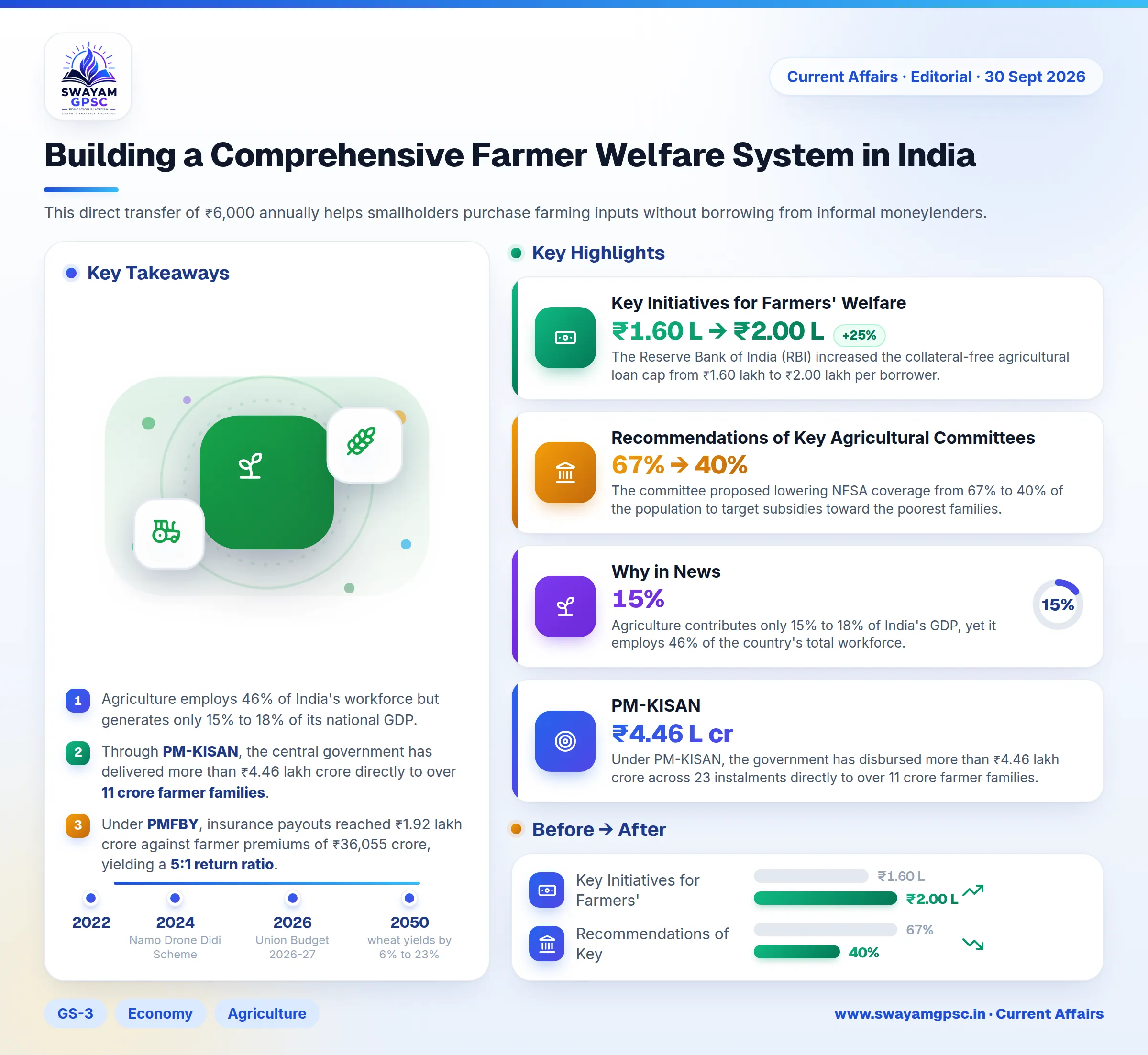
Building a Comprehensive Farmer Welfare System in India
#GS-3 #Economy #Agriculture #Food Security #Agricultural Marketing #E-Technology in the Aid of Farmers #Direct & Indirect Farm Subsidies #Public Distribution System (PDS) #Economics of Animal-Rearing #Food Processing
Key takeaways
- Agriculture employs 46% of India's workforce but generates only 15% to 18% of its national GDP.
- Through PM-KISAN, the central government has delivered more than ₹4.46 lakh crore directly to over 11 crore farmer families.
- Under PMFBY, insurance payouts reached ₹1.92 lakh crore against farmer premiums of ₹36,055 crore, yielding a 5:1 return ratio.
- According to the Agriculture Census 2015-16, small and marginal holdings make up 86% of all operational farms with an average size of 1.08 hectares.
- Studies show annual post-harvest crop losses cost India ₹1.53 lakh crore, while over 51% of cultivated land still relies on rain.
Why in News
- Agriculture contributes only 15% to 18% of India's GDP, yet it employs 46% of the country's total workforce.
- Because of this huge gap, policymakers must shift their focus from raising crop yields to securing stable farm incomes.
- Flagship initiatives like PM-KISAN, PMFBY, and AgriStack offer income support and manage risks across rural regions.
- However, issues like tiny landholdings, severe water shortages, and unfair crop markets still hold back long-term farm sustainability.
Key Initiatives for Farmers' Welfare
- Under PM-KISAN, the government has disbursed more than ₹4.46 lakh crore across 23 instalments directly to over 11 crore farmer families.
- This direct transfer of ₹6,000 annually helps smallholders purchase farming inputs without borrowing from informal moneylenders.
- The Union Budget 2026-27 continued this strong support by setting aside a ₹60,000 crore outlay for the scheme.
- Under PMFBY, farmers paid ₹36,055 crore in premiums while settling ₹1.92 lakh crore in claims across 23.22 crore beneficiaries, delivering a 5:1 return ratio.
- The newly launched DigiClaim module levies a 12% penalty on insurance companies for delayed payouts to speed up settlements.
- For FY 2025-26, the government set a record agricultural credit target of ₹32.50 lakh crore to expand institutional lending.
- The Reserve Bank of India (RBI) increased the collateral-free agricultural loan cap from ₹1.60 lakh to ₹2.00 lakh per borrower.
- Prompt borrowers using the Kisan Credit Card (KCC) receive an additional 3% subvention incentive, bringing net interest down to 4%.
- The government approved the Digital Agriculture Mission with a ₹2,817 crore budget outlay to build modern digital farm tools.
- This mission centers on AgriStack, a digital public infrastructure featuring registries for farmers, geo-referenced village maps, and sown crops.
- Nineteen states have signed agreements to map soil profiles across 142 million hectares to refine fertilizer subsidies and yield forecasts.
- Platforms like Bharat-VISTAAR deploy artificial intelligence to give farmers localized, real-time advice tailored to their specific plots.
- By March 2026, the e-NAM portal electronically connected 1,656 mandis, hosting 1.80 crore registered farmers and 4,724 FPOs.
- The platform recorded over 204.76 lakh metric tonnes of trade volume across 247 notified commodities to ensure open price discovery.
- Integrating Electronic Negotiable Warehouse Receipts (e-NWR) enables farmers to store produce safely and avoid forced harvest-season sales.
- The PM-PRANAM Scheme aims to cut national chemical fertilizer expenditure by ₹20,000 crore by promoting organic inputs.
- Under PM-PRANAM, states receive 50% of subsidy savings when they shift to bio-fertilizers like zinc-solubilising nutrients.
- Widespread adoption of Nano Urea and balanced micronutrients helps reverse soil degradation while improving crop quality grades.
- Under the PM-KUSUM Scheme, farmers installed over 11.49 lakh off-grid solar pumps by August 2026, reaching 10,203 MW capacity.
- Farmers generate 16 to 18 lakh units per MW annually on barren land, earning ₹25,000 to ₹80,000 per hectare from surplus power sales.
- Between 2024 and 2026, the Namo Drone Didi Scheme supplied advanced farm drones to 15,000 Women Self-Help Groups (SHGs).
- Backed by an 80% central financial assistance subsidy, these women earn about ₹1 lakh annual additional income by providing drone-spraying services.
- In August 2024, researchers released 109 new climate-resilient and biofortified seed varieties covering 61 distinct crops.
- Notable releases include drought-tolerant Arhar AKT-801, dryland Kharif Sorghum CSH-16, and heat-resistant Wheat HD-3288.
- A decentralized storage initiative through the Agriculture Infrastructure Fund (AIF) aims to add 70 million tonnes of grain capacity at PACS.
- The Krishi Udan scheme provides air transport subsidies to link farm produce from hilly, tribal, and northeastern regions to major markets.
Challenges
- According to the Agriculture Census 2015-16, smallholders make up 86% of operational holdings but cultivate only 46.94% of farm land.
- The average operational farm size has dropped to 1.08 hectares, preventing smallholders from adopting large machinery like harvesters economically.
- Data from the Central Ground Water Board (CGWB) and NITI Aayog shows agriculture consumes 85% to 90% of total groundwater extractions.
- Flood irrigation runs at a low 30% to 40% efficiency, while 20.7% of tested wells exceed safe nitrate limits from fertilizer runoff.
- Free electricity for tube-wells in Punjab and Haryana causes water tables to sink by 0.5 to 1 meter yearly, causing aquifer salinization.
- Due to heavy urea subsidies, the national Nitrogen-Phosphorus-Potassium (NPK) application ratio stands distorted at 10.9:4.1:1 instead of the ideal 4:2:1.
- Excessive nitrogen application acidifies arable soils, harms beneficial microbes, and steadily reduces crop response ratios across regions.
- Studies by NABCONS and ICAR-CIPHET estimate annual post-harvest losses across Indian crops at ₹1.53 lakh crore.
- Perishable produce like tomatoes suffers up to 15% wastage at farm gates and 12% in retail due to missing cold-chain networks.
- In tomato centers like Kolar and Nashik, the lack of controlled atmosphere storage forces farmers to dump produce during seasonal price crashes.
- Farmers receive only 20% to 35% of the retail price paid by consumers for fresh fruits and vegetables.
- Middlemen and commission agents in local mandis manipulate auctions through cartels, delayed payments, and arbitrary quality deductions.
- In Lasalgaon, wholesale onion cartels drop farmgate prices to ₹2-₹3 per kg, while retail consumers pay ₹30-₹40 per kg.
- The NSS 77th Round Survey (2019) revealed that 50% of rural farm households carry debt, averaging ₹74,121 per household.
- Smallholders lacking clear property records turn to local moneylenders who charge interest rates between 24% and 36% per annum.
- More than 51% of India's net sown area depends completely on monsoon rainfall without any artificial irrigation support.
- ICAR projects that rising temperatures from unmitigated climate change could reduce national wheat yields by 6% to 23% by 2050.
- In March 2022, sudden early heat waves reduced crop yields by 10% to 35% across Punjab, Haryana, and Uttar Pradesh.
- The Periodic Labour Force Survey (PLFS) shows that 73% of rural female workers work in agriculture as primary field labor.
- Despite their dominant role in field operations, women hold operational titles to less than 14% of land holdings.
- Because credit cards and subsidies require land titles, women farmers remain largely cut off from formal bank loans and state schemes.
Recommendations of Key Agricultural Committees
- The Ashok Dalwai Committee recommended placing agricultural marketing on the Concurrent List and rolling out model APMC regulations.
- It urged farmers to diversify into high-value fruits, vegetables, dairy, and fisheries rather than relying solely on traditional staple grains.
- The panel stressed building integrated cold-storage chains and village food processing units to eliminate post-harvest crop destruction.
- It recommended expanding Farmer Producer Organisations to boost collective purchasing power and market bargaining strength for smallholders.
- The Shanta Kumar Committee advised handing FCI grain procurement duties over to states with well-developed infrastructure.
- It suggested replacing physical food grain distribution under the PDS with direct cash transfers across large urban centers.
- The committee proposed lowering NFSA coverage from 67% to 40% of the population to target subsidies toward the poorest families.
- The M.S. Swaminathan Committee recommended setting the Minimum Support Price at at least 50% above the comprehensive cost of production (C2).
- It called for distributing ceiling-surplus land to landless workers and prohibiting the transfer of fertile farmland to non-farm corporations.
- The commission proposed capping crop loan interest at 4% and issuing dedicated Kisan Credit Cards to women cultivators.
Way Forward
- States must adopt the Model Agricultural Land Leasing Act and assign the 14-digit ULPIN (Bhu-Aadhaar) to recognize tenant cultivators legally.
- Formal recognition lets tenant farmers access institutional credit, subsidized crop insurance, and disaster relief without standard land deeds.
- Distributing the 109 climate-resilient and biofortified crop varieties alongside sub-surface fertigation lifts water efficiency to 90%.
- India should create verification systems on voluntary carbon markets to pay farmers adopting direct seeded rice and alternate wetting methods.
- Funding rural processing clusters through the PMFME scheme and AIF can boost farmer price realization by 20% to 35%.
- Connecting farmer collectives directly to the Open Network for Digital Commerce (ONDC) cuts out middlemen and lowers bulk input costs.
- Promoting polyhouses and solar-powered cold stores near urban centers protects high-value crops from weather extremes and market swings.