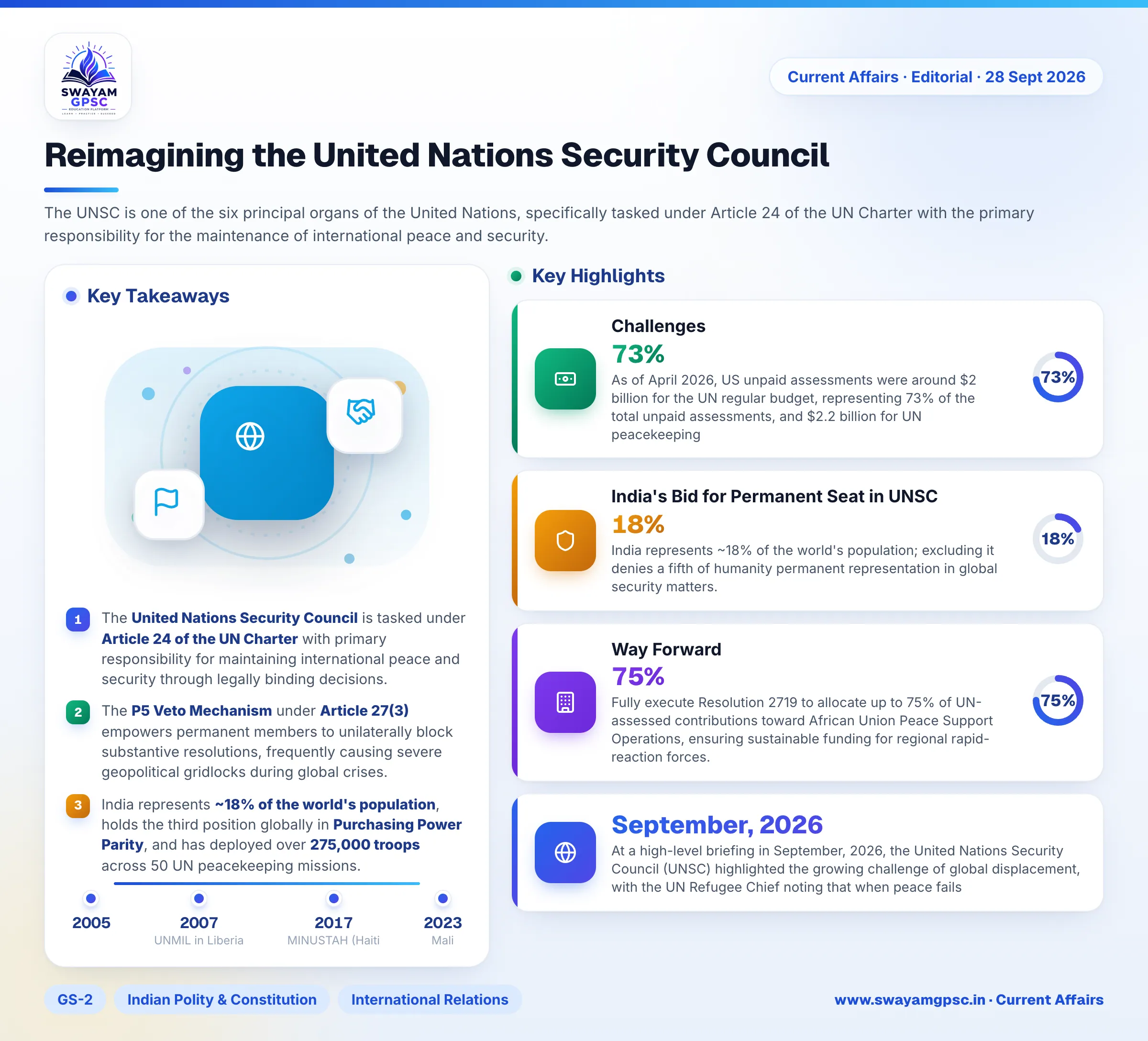
Reimagining the United Nations Security Council
#GS-2 #Indian Polity & Constitution #International Relations #Governance & Social Justice #Important International Institutions #Groupings & Agreements Involving India and/or Affecting India's Interests #Effect of Policies & Politics of Countries on India's Interests #Economy #Infrastructure
Key takeaways
- The United Nations Security Council is tasked under Article 24 of the UN Charter with primary responsibility for maintaining international peace and security through legally binding decisions.
- The P5 Veto Mechanism under Article 27(3) empowers permanent members to unilaterally block substantive resolutions, frequently causing severe geopolitical gridlocks during global crises.
- India represents ~18% of the world's population, holds the third position globally in Purchasing Power Parity, and has deployed over 275,000 troops across 50 UN peacekeeping missions.
- Major financial crises plague the UN, with US unpaid assessments reaching $2 billion for the regular budget and $2.2 billion for peacekeeping as of April 2026.
Why in News
- At a high-level briefing in September, 2026, the United Nations Security Council (UNSC) highlighted the growing challenge of global displacement, with the UN Refugee Chief noting that when peace fails, people move.
- As the premier global organ tasked with maintaining international peace and security, the UNSC faces increasing scrutiny because structural obsolescence, geopolitical paralysis, and the strategic weaponization of the veto power have undermined its credibility.
- Addressing these challenges requires ambitious multilateral reforms, including expanding representation, ensuring responsible veto use during humanitarian crises, and aligning the Council with contemporary security realities.
What is the United Nations Security Council?
- The UNSC is one of the six principal organs of the United Nations, specifically tasked under Article 24 of the UN Charter with the primary responsibility for the maintenance of international peace and security.
- Unlike the UN General Assembly, which can only make non-binding recommendations, UNSC decisions under Chapter VII carry legally binding authority over all UN member states.
- It composes 5 Permanent Members (P5: United States, United Kingdom, France, Russia, China) and 10 Non-Permanent Members (E10) elected for staggered two-year terms by the UN General Assembly.
- Procedural matters require an affirmative vote of any 9 members, while substantive issues require 9 votes including the concurring votes of all P5 members.
- Under Article 27(3) of the UN Charter, the P5 Veto Mechanism empowers any of the 5 permanent members of the Security Council to unilaterally block any substantive resolution, regardless of international support.
- Due to the veto mechanism, gridlock frequently occurs during major global crises due to geopolitical fault lines, such as the Ukraine Conflict where Russia repeatedly used its veto to block resolutions condemning its military action.
- Similarly, in the Gaza/Middle East crisis, the US historically exercised its veto multiple times to block or alter resolutions demanding immediate ceasefires before abstaining or passing compromised texts.
- Under Chapter VI (Pacific Settlement of Disputes), the council holds powers to investigate disputes, mediate negotiations, and recommend terms of settlement.
- Under Chapter VII (Action with Respect to Threats to Peace), it enforces mandatory measures involving or not involving armed force, such as Sanctions & Asset Freezes targeting rogue regimes or terrorist networks through bodies like the 1267 Al-Qaida/Da'esh Sanctions Committee.
- It also enforces Arms Embargoes to restrict military hardware supply, such as long-standing embargoes on Somalia and Libya, and authorizes military interventions like Resolution 1973 authorizing a no-fly zone in Libya or Resolution 2699 authorizing the Multinational Security Support mission in Haiti.
Key Contributions of UNSC
- Modern UNSC peacekeeping has evolved from merely monitoring ceasefires to actively engaging in robust civilian protection, state-building, and offensive military operations against armed groups.
- Key operational successes include UNMIL (Liberia, 2003-2018) which disarmed 100,000+ combatants and supported democratic transition after civil war.
- MINUSTAH (Haiti, 2004-2017) restored stability and strengthened the Haitian National Police after political crisis.
- UNMISET (Timor-Leste, 2002-2005) built governance and security institutions before sovereignty transfer.
- MINURCAT (Central African Republic & Chad, 2007-2010) protected 250,000+ refugees and Internally Displaced Persons amidst regional conflict spillovers.
- Recognizing that military intervention alone does not stop countries from relapsing into conflict, the UNSC helped engineer the UN's long-term stabilization architecture.
- Established via Resolution 1645 (2005), the Peacebuilding Commission (PBC) serves as a unique intergovernmental advisory body bridging emergency security operations with long-term economic development.
- It has successfully engaged in over 26 different countries and regions, marshaling international funds for Disarmament, Demobilization, and Reintegration (DDR) and Security Sector Reform (SSR) to ensure fragile states transitioning out of UN mandates do not fall back into violence.
- The UNSC has pioneered the legal architecture required to prosecute mass atrocities, bypassing national sovereign immunity to enforce international human rights.
- Using its Chapter VII enforcement powers, the Council created ad hoc criminal tribunals such as the International Criminal Tribunal for the former Yugoslavia (ICTY) in 1993 and the International Criminal Tribunal for Rwanda (ICTR) in 1994.
- Because drafting and ratifying international treaties can take decades, the UNSC frequently acts as a rapid global legislator to mandate universal security standards.
- Passed in 2004, Resolution 1540 legally bound all 193 UN member states to establish rigorous domestic legal and border controls to prevent non-state actors and terrorist networks from acquiring Weapons of Mass Destruction.
- Resolution 2396 (2017) compelled member states to implement specific technological border security measures, such as biometric data collection and the sharing of Advance Passenger Information, to intercept terrorist travel globally.
- The Council continuously adapts its Chapter VII authority to secure the global commons against non-state interference and piracy.
- Resolution 2722 formally condemned Houthi attacks on merchant vessels in the Red Sea, demanded the release of hijacked ships like the *Galaxy Leader*, and explicitly affirmed the right of member states to defend their vessels from asymmetric attacks under international law.
Challenges
- The P5 veto has devolved from an emergency security brake into a tool for geopolitical immunity and stonewalling administrative processes.
- For example, the US vetoed a UNSC resolution recommending the State of Palestine for full UN membership, overriding 12 votes in favor and a global consensus.
- Using the veto to block statehood recognition rather than manage military conflicts deepens the Council's legitimacy crisis, proving that P5 national interests routinely supersede the UN Charter's collective mandate.
- A critical new hindrance is the active destruction of the UNSC's technical oversight bodies by major powers to shield strategic allies.
- Russia strategically vetoed the mandate renewal of the Panels of Experts monitoring the Democratic People's Republic of Korea (DPRK) sanctions regime.
- This unprecedented move left the UN sanctions regime in a zombie-like state where sanctions legally exist, but there is no centralized independent UN mechanism to track evasion such as illicit ship-to-ship petroleum transfers or state-sponsored cyberattacks.
- The UNSC has no recourse when a host government revokes consent, even if doing so guarantees mass civilian casualties or a relapse into civil war.
- In 2023, the military junta in Mali unilaterally demanded the immediate withdrawal of MINUSMA, a 15,000-strong UN force, and Sudan forced the termination of UNITAMS in late 2023 amidst an exploding civil war.
- In these regions, host governments are increasingly replacing UN Blue Helmets with unaccountable Private Military Companies (PMCs), such as the Russian Wagner Group rebranded as Africa Corps.
- The UN faces a chronic liquidity crisis because major member states use the withholding of assessed peacekeeping contributions as political leverage.
- As of April 2026, US unpaid assessments were around $2 billion for the UN regular budget, representing 73% of the total unpaid assessments, and $2.2 billion for UN peacekeeping, representing 63% of total unpaid assessments.
- When member states fall into arrears, the UN cannot reimburse Troop Contributing Countries like Bangladesh, Nepal, and Rwanda, degrading logistical capacity, medical evacuation capabilities, and troop morale.
- The rise of transnational terror syndicates, decentralized militias, and state-sponsored cyber warfare exists largely outside traditional Westphalian frameworks.
- The UNSC struggles to apply traditional tools like territorial blockades to entities that hold no territory or legal status, such as formulating binding resolutions regarding state-sponsored ransomware attacks on critical civilian infrastructure.
- As formal chambers deadlock, diplomacy is increasingly shifting to informal mechanisms that lack legally binding outcomes.
- Created in 1992 for confidential briefings with NGOs and whistleblowers, Arria-Formula Meetings are now heavily exploited by P5 members to bypass formal vetoes and wage unilateral propaganda wars.
- This informalization of diplomacy transforms the UNSC into a geopolitical theater, actively sidelining E10 non-permanent members who lack the diplomatic capital to host competing shadow meetings.
- Existing permanent members are reluctant to dilute their influence, leading to institutional inertia and procedural stonewalling during Intergovernmental Negotiations.
- Groups like the Uniting for Consensus club oppose adding new permanent seats, ensuring negotiations remain bogged down without a unified text-based framework.
- Despite India’s global stature, economic weight, peacekeeping role, and Global South leadership, its permanent membership bid remains stalled due to geopolitical constraints, particularly opposition from China.
India's Bid for Permanent Seat in UNSC
- India represents ~18% of the world's population; excluding it denies a fifth of humanity permanent representation in global security matters.
- India spearheads the L.69 Group of over 40 developing nations and the G4 nations comprising India, Brazil, Germany, and Japan, demanding UNSC expansion in both permanent and non-permanent categories.
- India holds the third position globally among the world's largest economies when measured by Purchasing Power Parity (PPP).
- It serves as a primary Humanitarian Assistance and Disaster Relief (HADR) provider under its MAHASAGAR framework, conducting operations like Operation Karuna in Myanmar and Operation Kaveri in Sudan.
- India has deployed over 275,000 troops across 50 UN peacekeeping missions, with 180+ personnel sacrificing their lives under the UN flag.
- It deployed the UN's first-ever all-female Formed Police Unit to UNMIL in Liberia in 2007, setting a global precedent for women in peacekeeping.
- India operates an exemplary non-proliferation record anchored by an official No First Use doctrine despite being a non-signatory to the NPT.
- It is a full member of key non-proliferation regimes including the MTCR, Wassenaar Arrangement, and the Australia Group.
- India enjoys explicit endorsements from 4 of the P5 nations including the US, UK, France, and Russia, alongside regional blocs like the Visegrád Group.
- It has completed 8 terms as a non-permanent member, last serving in 2021-22, and launched its campaign for a 9th term spanning 2028-29.
Way Forward
- Universally implement the French-Mexican Initiative and the ACT Group Code of Conduct, supported by over 120 states, to mandate that P5 members voluntarily pledge not to exercise veto power in cases of genocide, war crimes, and mass atrocities.
- Strictly enforce Article 27(3) requiring a party to a dispute to abstain from voting, while operationalizing Resolution 76/262 to trigger a Uniting for Peace supermajority override whenever a P5 veto paralyzes the Council.
- Implement UN High-Level Panel Model B to create 4 to 8 year renewable semi-permanent seats, bridging the structural gap between permanent status and short two-year terms.
- Operationalize the African Union's Ezulwini Consensus by guaranteeing at least 2 permanent and 5 non-permanent seats for Africa while reserving dedicated rotating seats for Small Island Developing States facing acute climate security risks.
- Mandate a binding Co-Penholdership system pairing one P5 member with one elected member across all draft resolutions to break the historic P3 drafting monopoly.
- Transfer Panel of Experts appointments directly to the UN Secretariat to prevent single P5 vetoes from shutting down sanctions monitoring, while replacing closed consultations with public recorded sessions.
- Fully execute Resolution 2719 to allocate up to 75% of UN-assessed contributions toward African Union Peace Support Operations, ensuring sustainable funding for regional rapid-reaction forces.
- Embed mandatory Exit Benchmarks and Humanitarian Impact Assessments into Chapter VII mandates while establishing a dedicated Reimbursement Reserve Fund for Troop-Contributing Countries to buffer against financial arrears.
- Empower the UN General Assembly to request binding International Court of Justice Advisory Opinions to review UNSC Chapter VII resolutions if they violate international human rights norms.
- Establish independent technical monitoring bodies under the UN umbrella to track emerging non-traditional security threats, including Lethal Autonomous Weapons Systems, state-sponsored cyberwarfare, and climate-induced conflict displacement.