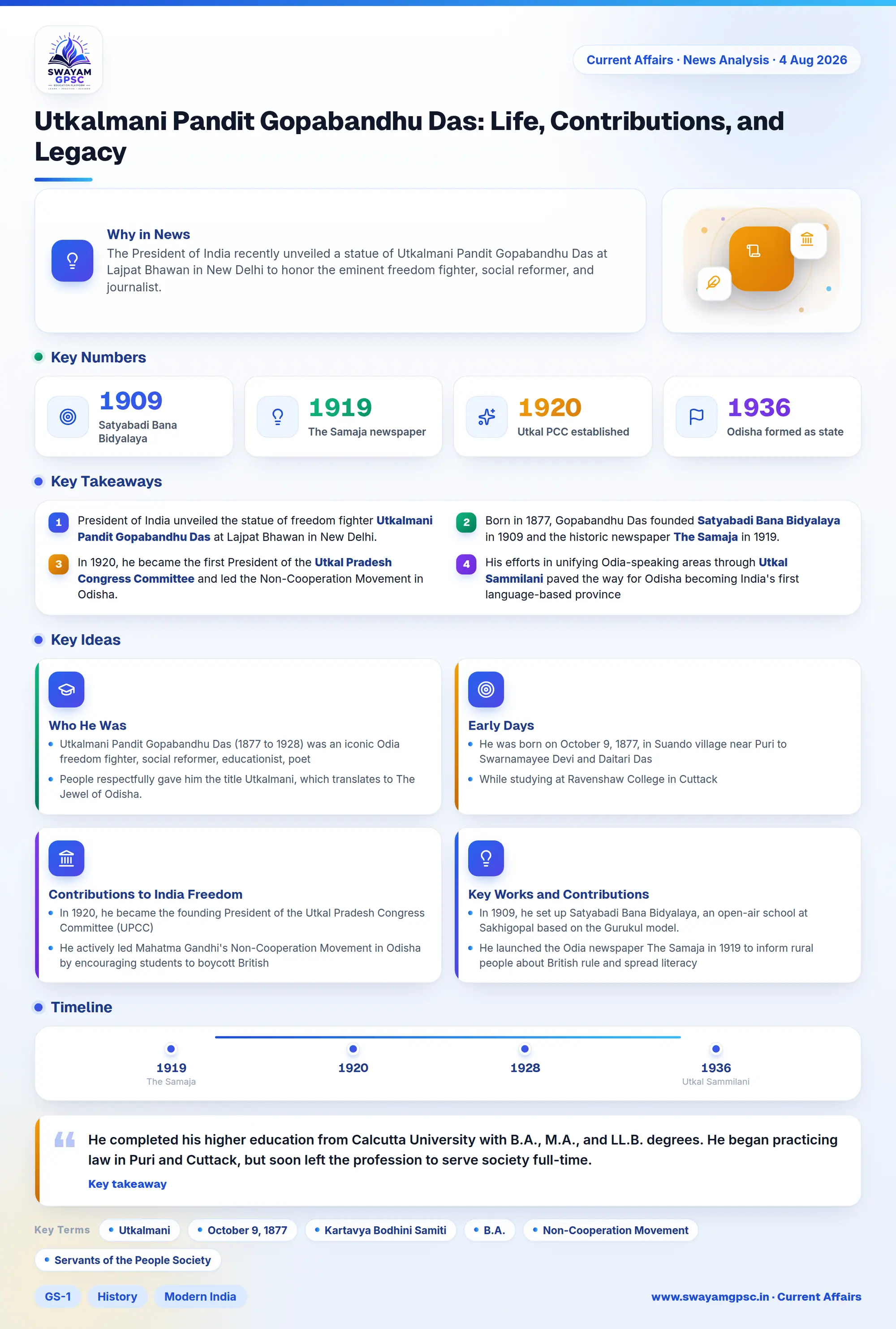
Utkalmani Pandit Gopabandhu Das: Life, Contributions, and Legacy
#GS-1 #History #Modern India #Freedom Struggle #Utkalmani Pandit Gopabandhu Das #Social Reformers #Odisha
Key takeaways
- President of India unveiled the statue of freedom fighter Utkalmani Pandit Gopabandhu Das at Lajpat Bhawan in New Delhi.
- Born in 1877, Gopabandhu Das founded Satyabadi Bana Bidyalaya in 1909 and the historic newspaper The Samaja in 1919.
- In 1920, he became the first President of the Utkal Pradesh Congress Committee and led the Non-Cooperation Movement in Odisha.
- His efforts in unifying Odia-speaking areas through Utkal Sammilani paved the way for Odisha becoming India's first language-based province in 1936.
Why in News
- The President of India recently unveiled a statue of Utkalmani Pandit Gopabandhu Das at Lajpat Bhawan in New Delhi to honor the eminent freedom fighter, social reformer, and journalist.
Who He Was
- Utkalmani Pandit Gopabandhu Das (1877 to 1928) was an iconic Odia freedom fighter, social reformer, educationist, poet, and pioneer journalist.
- People respectfully gave him the title Utkalmani, which translates to The Jewel of Odisha. He devoted his life to national independence, unity of Odia speaking regions, open-air education, and relief work during disasters.
Early Days
- He was born on October 9, 1877, in Suando village near Puri to Swarnamayee Devi and Daitari Das, though his mother died when he was an infant.
- While studying at Ravenshaw College in Cuttack, he created the Kartavya Bodhini Samiti to inspire social service and national duty among young students.
- He completed his higher education from Calcutta University with B.A., M.A., and LL.B. degrees. He began practicing law in Puri and Cuttack, but soon left the profession to serve society full-time.
Contributions to India Freedom Movement
- In 1920, he became the founding President of the Utkal Pradesh Congress Committee (UPCC), bringing Odisha directly into the mainstream national movement.
- He actively led Mahatma Gandhi's Non-Cooperation Movement in Odisha by encouraging students to boycott British institutions, which led to his frequent imprisonments.
- Inspired by Lala Lajpat Rai, he joined the Servants of the People Society and later served as its national Vice-President.
- Through the Utkal Sammilani, he championed the administrative unification of Odia-speaking regions. This effort helped Odisha become India's first language-based state in 1936.
Key Works and Contributions
- In 1909, he set up Satyabadi Bana Bidyalaya, an open-air school at Sakhigopal based on the Gurukul model. The institution eliminated caste barriers by making all students study and eat together.
- He launched the Odia newspaper The Samaja in 1919 to inform rural people about British rule and spread literacy through simple Odia prose.
- While serving prison terms, he authored iconic literary works such as Bandi R Atmakatha, Dharmapada, and Kara Kabita.
Last Days and Legacy
- Gopabandhu Das placed public duty above personal loss. He continued managing flood relief work even while his eldest son was dying.
- Exhausted by continuous hardship and public service, he passed away on June 17, 1928, at the age of 50.
- Before dying, he donated The Samaja newspaper and all his properties to the Servants of the People Society, leaving an unforgettable legacy of sacrifice.