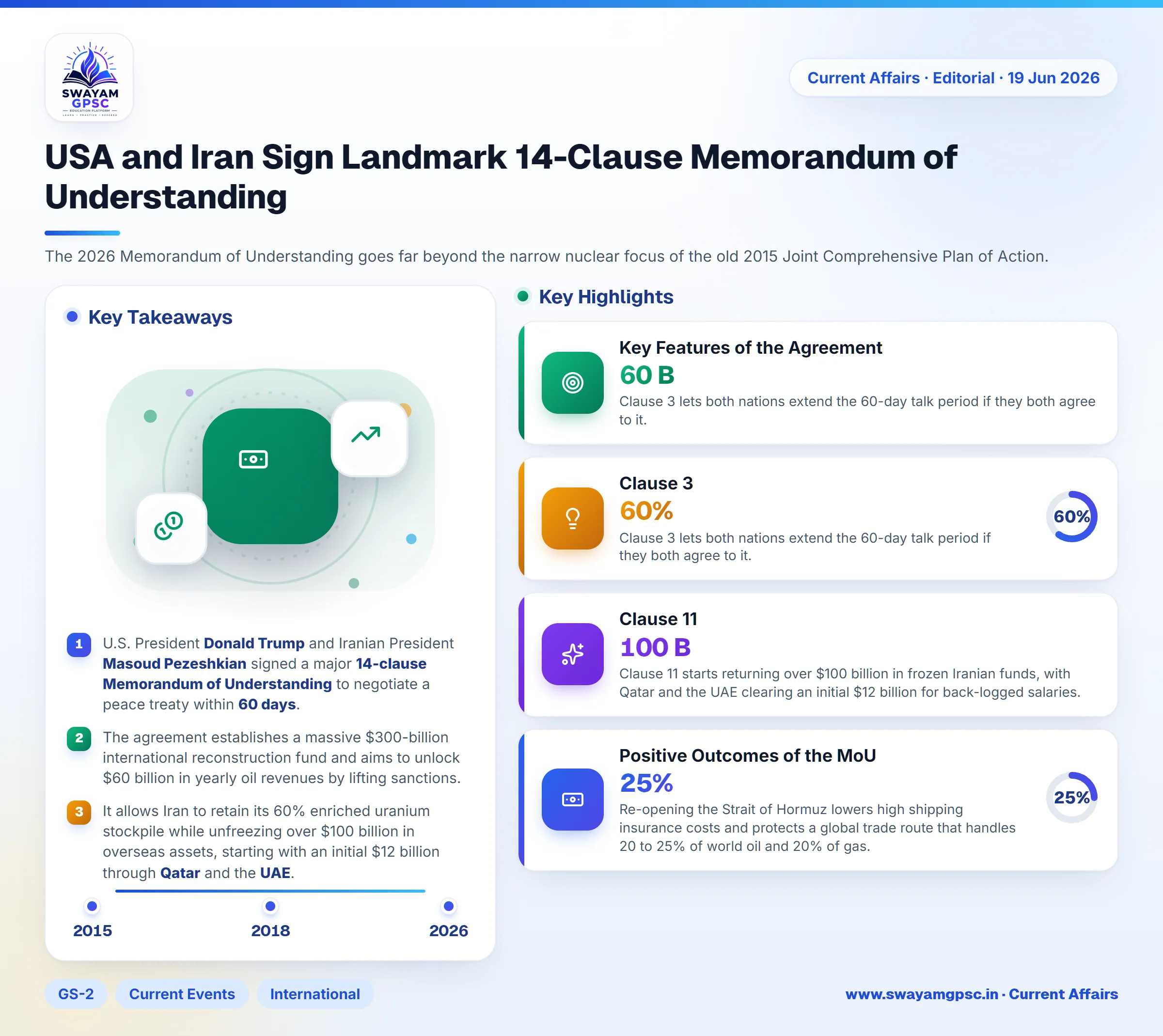
USA and Iran Sign Landmark 14-Clause Memorandum of Understanding
#GS-2 #Current Events #International #Economy #Infrastructure
Key takeaways
- U.S. President Donald Trump and Iranian President Masoud Pezeshkian signed a major 14-clause Memorandum of Understanding to negotiate a peace treaty within 60 days.
- The agreement establishes a massive $300-billion international reconstruction fund and aims to unlock $60 billion in yearly oil revenues by lifting sanctions.
- It allows Iran to retain its 60% enriched uranium stockpile while unfreezing over $100 billion in overseas assets, starting with an initial $12 billion through Qatar and the UAE.
- Re-opening the Strait of Hormuz protects a global maritime trade route responsible for handling 20 to 25% of world oil and 20% of natural gas.
Context and Background
- U.S. President Donald Trump and Iranian President Masoud Pezeshkian signed a major 14-clause Memorandum of Understanding.
- This diplomatic agreement sets up a strict 60-day negotiation window to finalize a permanent peace treaty.
- This development marks a major turning point in the geopolitics of West Asia.
About the Memorandum of Understanding
- The 2026 Memorandum of Understanding goes far beyond the narrow nuclear focus of the old 2015 Joint Comprehensive Plan of Action.
- Instead of only dealing with non-proliferation, this framework aims to reset the overall political relationship between Washington and Tehran.
- It provides Tehran with financial relief, rebuilding funds, and political room to strengthen its standing in West Asia.
Key Features of the Agreement
- Clause 1 orders an immediate stop to all military fighting and brings Lebanon into the ceasefire framework.
- Clause 2 stops the U.S. policy of pursuing regime change and legally respects Iran's internal political sovereignty.
- Clause 3 lets both nations extend the 60-day talk period if they both agree to it.
- Clause 4 removes the U.S. Naval Blockade by withdrawing U.S. warships from the Gulf of Oman and the Strait of Hormuz.
- Clause 5 guarantees open commercial shipping through the Strait of Hormuz, with a possible future fee system managed alongside Oman.
- Clause 6 creates a massive $300-billion international reconstruction fund to rebuild the war-damaged Iranian economy.
- Clause 7 outlines a plan to remove unilateral U.S. sanctions on Iran, which will unlock $60 billion in yearly oil revenues.
- Clause 8 formally caps nuclear weapons procurement while allowing Iran to keep its 60% enriched uranium stockpile.
- Clause 9 freezes all military upgrades during the 60-day period to prevent any sudden escalation.
- Clause 10 provides immediate temporary sanctions relief to help with humanitarian trade and banking work.
- Clause 11 starts returning over $100 billion in frozen Iranian funds, with Qatar and the UAE clearing an initial $12 billion for back-logged salaries.
- Clause 12 sets up a joint bilateral executive committee to monitor how well both sides follow the rules.
- Clause 13 creates a step-by-step schedule for negotiators to deal with political and financial issues within 60 days.
- Clause 14 requires the final deal to become a formal UNSC Resolution under Article 25 of the UN Charter.
Positive Outcomes of the MoU
- Re-opening the Strait of Hormuz lowers high shipping insurance costs and protects a global trade route that handles 20 to 25% of world oil and 20% of gas.
- Unfreezing the initial $12 billion through banks in Qatar and the UAE helps Iran inject money into its economy and pay unpaid public workers.
- Including Lebanon in the peace plan pauses cross-border shelling and calms down the wider security situation.
Challenges
- The agreement ignores Iran's ballistic missile arsenal because leaders believe regional balance allows Iran to keep these weapons.
- The deal completely leaves out any rules or restrictions for regional non-state proxy networks backed by Iran.
- It fails to immediately bring back the International Atomic Energy Agency monitoring protocols, leaving a blind spot in tracking.
- The text lacks a strong physical safeguard to stop a future U.S. administration from walking away, similar to what happened in 2018.
Way Forward
- Both countries must use the Clause 12 monitoring setup to make sure financial unfreezing matches de-mining work in the Strait of Hormuz.
- Future talks must bring back full IAEA monitoring safeguards to rebuild global trust in Iran's civilian nuclear research.
- Iran should tie its incoming $300-billion rebuilding funds to multi-nation commercial contracts to make future sanctions harder to restart.
- Later talks must look beyond nuclear matters to set up clear regional agreements on conventional arms controls and security lines.
Conclusion
- By leaving the 60% enriched uranium and missile programs alone, the deal recognizes Iran's regional influence while securing global trade.
- The long-term success of this agreement depends on whether both nations can build enough trust to turn a temporary 60-day pause into a permanent treaty.