Indian Diaspora and India's Global Influence
#GS-1 #Indian Society #Effects of Globalization #GS-2 #Governance & Social Justice #Current Events #International #GS-3 #Economy #Infrastructure #Current Affairs #Indian Diaspora #Remittances #Foreign Policy
Key takeaways
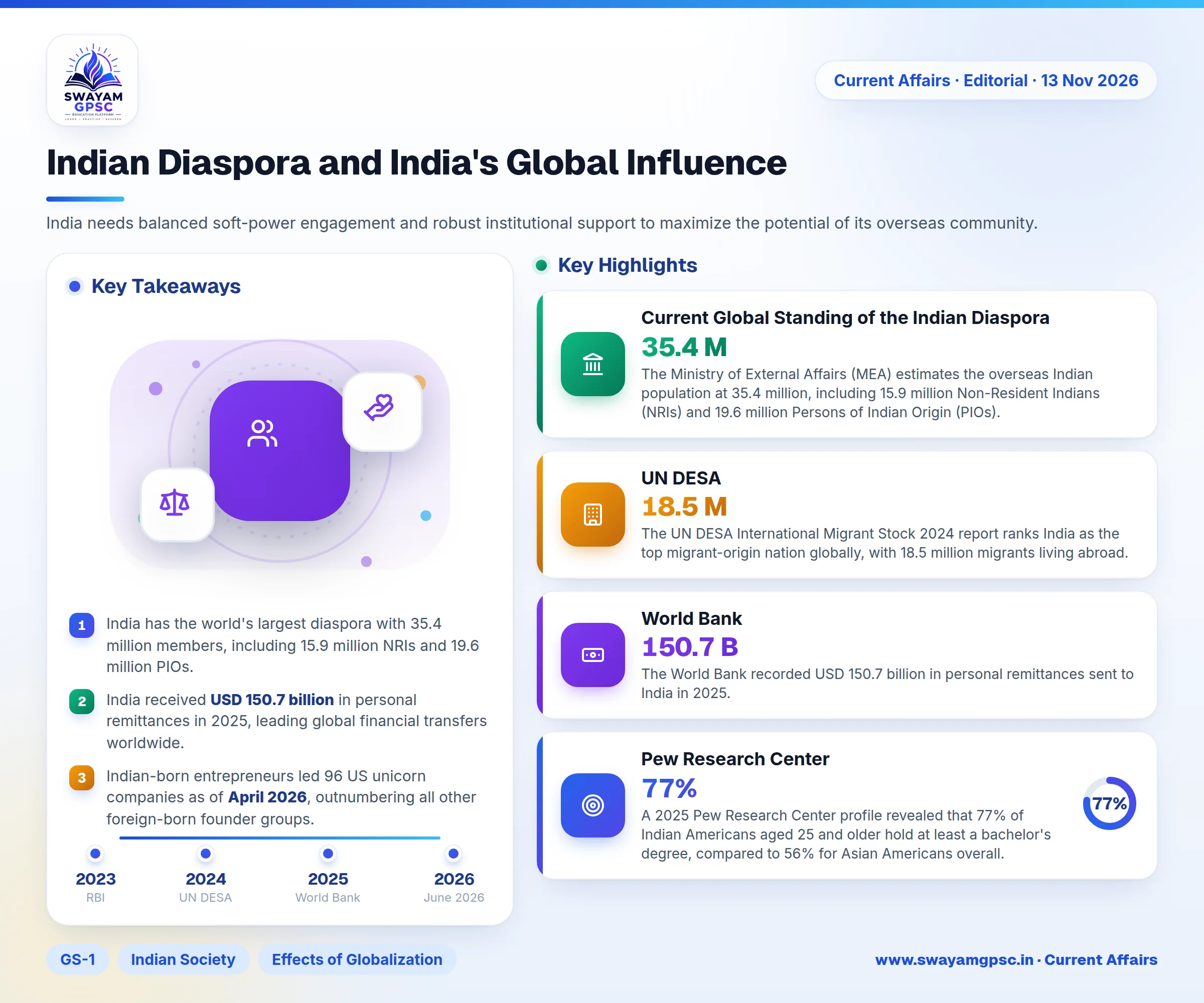
- India has the world's largest diaspora with 35.4 million members, including 15.9 million NRIs and 19.6 million PIOs.
- India received USD 150.7 billion in personal remittances in 2025, leading global financial transfers worldwide.
- Indian-born entrepreneurs led 96 US unicorn companies as of April 2026, outnumbering all other foreign-born founder groups.
- Under Operation Sindhu in June 2025, India successfully evacuated 4,415 citizens from conflict zones in Iran and Israel.
- The Kerala Development Report 2026 logged Rs 2,16,893 crore in remittances in 2023, demonstrating major regional economic impacts.
Why in News
- The 35.4-million-strong Indian diaspora plays a key role as a diplomatic bridge and strategic asset for the nation.
- PM Modi highlighted this contribution by stating that the Indian diaspora acts as the country's brand ambassador and their success brings pride to India.
- Rising challenges like shifting migration rules, social integration issues, political polarization, and partisan outreach could transform this asset into a diplomatic liability.
- India needs balanced soft-power engagement and robust institutional support to maximize the potential of its overseas community.
Current Global Standing of the Indian Diaspora
- India holds the world's largest diaspora network, defined by its massive population size, broad geographic reach, and strong intergenerational ties.
- The Ministry of External Affairs (MEA) estimates the overseas Indian population at 35.4 million, including 15.9 million Non-Resident Indians (NRIs) and 19.6 million Persons of Indian Origin (PIOs).
- The UN DESA International Migrant Stock 2024 report ranks India as the top migrant-origin nation globally, with 18.5 million migrants living abroad.
- Overseas Indians lead global financial transfers, generating the world's largest remittance inflow through their strong earning power and family ties.
- The World Bank recorded USD 150.7 billion in personal remittances sent to India in 2025.
- An RBI survey for 2023-24 showed that over half of India's inward remittances originated from the United States, United Kingdom, Singapore, Canada, and Australia.
- High educational attainment allows a large section of the diaspora to secure high-paying positions in the global knowledge economy.
- A 2025 Pew Research Center profile revealed that 77% of Indian Americans aged 25 and older hold at least a bachelor's degree, compared to 56% for Asian Americans overall.
- Indian-headed households in the US earned a median annual income of USD 151,200 in 2023, surpassing the USD 105,600 median for all Asian-headed households.
- Indian emigrants actively drive global innovation and enterprise as company founders, employers, and patent creators.
- A June 2026 study by the National Foundation for American Policy found 96 US unicorn companies with Indian-born founders or co-founders as of April 2026, leading all foreign-origin groups ahead of Israel's 60.
- Prominent startup founders like Arvind Jain (Rubrik and Glean) and Jyoti Bansal (AppDynamics and Harness) build platforms that shape digital markets, enterprise software, and cybersecurity.
- Indian student mobility continuously feeds the diaspora's research strength, skilled labor pipeline, and professional networks.
- The Open Doors 2025 report logged 363,019 Indian students in the United States during 2024-25, marking a 10% annual growth and making India the top source country.
- The German Academic Exchange Service (DAAD) reported 59,419 Indian students in Germany during winter 2024-25, forming its largest international student group.
- People of Indian origin serve in high constitutional and political roles across several democratic nations.
- Tharman Shanmugaratnam serves as Singapore's President, while Navinchandra Ramgoolam returned as Mauritius's Prime Minister in November 2024.
- This political representation demonstrates the successful integration and electoral trust enjoyed by Indian-origin leaders abroad.
- In the Gulf region, millions of Indian workers support essential sectors like construction, healthcare, hospitality, and public services.
- An MEA report from 2026 estimated 4.33 million Indian nationals residing in the UAE and 2.75 million in Saudi Arabia.
- The Indian Embassy identifies Indians as the largest expatriate group in the UAE, playing a major role in its economy.
- Overseas communities promote Indian culture globally through public festivals, language schools, performing arts, and civic groups.
- UNESCO added Deepavali to its Representative List of the Intangible Cultural Heritage of Humanity in December 2025, highlighting the diaspora's role in preserving heritage across generations.
Role of the Indian Diaspora in India's Development
- Remittances support household stability by funding healthcare, education, housing, and everyday expenses in origin states.
- The Kerala Development Report 2026 showed remittances rising from Rs 85,092 crore in 2018 to Rs 2,16,893 crore in 2023, boosting local demand and employment.
- Overseas investors provide risk capital, technical expertise, and network connections to help Indian startups in complex sectors.
- In September 2025, Celesta Capital co-founder Sriram Viswanathan helped launch the India Deep Tech Investment Alliance, pledging USD 1 billion for Indian startups in semiconductors, quantum technologies, robotics, biotechnology, and clean energy.
- Diaspora commercial networks reduce trade barriers and open global markets for Indian goods.
- In September 2025, APEDA signed an agreement with LuLu Hypermarket, led by Indian entrepreneur M. A. Yusuff Ali.
- Under the BHARTI initiative, this deal secured retail shelf space across 252 LuLu outlets in GCC nations for Indian agricultural startups.
- Overseas academics and researchers share knowledge, mentor scholars, and build links with domestic universities through joint projects.
- An INAE report from March 2026 noted that 17 fellows were selected under the VAIBHAV 2024 call, with 16 receiving first-year funds to launch collaborative research visits.
- Prominent alumni donate funds and build research infrastructure to strengthen higher education in India.
- In 2024, US entrepreneur Sunil Wadhwani donated Rs 110 crore to establish the Wadhwani School of Data Science and AI at IIT Madras.
- Diaspora-backed philanthropic groups fund frontline health, education, and social programs across rural India.
- In June 2025, the American India Foundation (AIF) raised over USD 4.5 million at its New York gala for social initiatives.
- AIF's MANSI initiative has trained over 10,800 frontline workers like ASHAs by January 2025 to improve maternal and newborn healthcare delivery.
- Diaspora advocacy groups help build international support for key bilateral agreements and strategic access.
- Lobbying by Indian Americans helped secure support for the India-US civil nuclear deal, which led to 16 safeguarded nuclear reactors with 6,380 MW capacity running on imported fuel by April 2026.
- Overseas visitors drive domestic tourism and support transport, hospitality, retail, and regional economies.
- Ministry of Tourism data showed 11.07 million NRI arrivals in 2025, marking a 4.26% increase from 2024 and representing over half of all international arrivals.
Challenges Confronting the Indian Diaspora Worldwide
- Skilled migrants face long wait times for permanent residency, creating career and lifestyle instability.
- The US Department of State November 2026 Visa Bulletin placed the green card cut-off for India's EB-2 category at 1st November 2013, highlighting deep green card backlogs.
- Low-skilled migrant workers frequently face wage theft, passport confiscation, contract violations, and poor working conditions.
- An MEA statement in March 2026 revealed that the Indian Embassy in Kuwait received 4,081 labor complaints in 2025 alone.
- Overseas Indians face rising incidents of xenophobia, hate speech, and violent attacks in several host countries.
- In August 2025, Ireland's Justice Minister held talks with community leaders following racial attacks on Indians, prompting a security advisory from the Indian Embassy in Dublin.
- Indian students abroad risk financial distress due to high tuition loans, living expenses, and non-compliant university courses.
- An ICWA report in November 2026 highlighted Indian students in Berlin facing deportation risks after their university's hybrid courses failed to meet local student visa rules.
- Fake job recruiters trap jobseekers into human trafficking networks and forced cybercrime operations.
- In March 2025, India rescued and repatriated 283 citizens from Myanmar via Thailand after fraudulent firms forced them into illegal online scam centers.
- Geopolitical conflicts in host countries place Indian citizens in danger, forcing emergency evacuations.
- Under Operation Sindhu in June 2025, India evacuated 4,415 nationals (3,597 from Iran and 818 from Israel) during regional conflicts.
- Detained overseas citizens struggle to navigate complex foreign legal systems due to financial and language constraints.
- An MEA report in March 2026 showed 9,047 Indians held in foreign prisons, where consular support offers basic guidance but cannot provide full trial defense.
- Spousal abandonment and domestic abuse present major legal challenges for Indian women married to overseas residents.
- Government data presented to Parliament in March 2025 showed 1,617 complaints over five years from NRI wives alleging spousal abandonment and legal hurdles.
Way Forward
- Assign dedicated officers across MEA, DPIIT, and state agencies to track and clear diaspora investment, research, and charity proposals.
- Create regulated investment channels to draw diaspora capital into public infrastructure projects like renewable energy and cold chains.
- Establish joint research roles and project partnerships that let diaspora experts collaborate with domestic institutions without relocating permanently.
- Set up transparent district-level platforms that connect local development goals with diaspora donors and verified non-profits.
- Evaluate returnee skills upon arrival and link them with local industries, MSMEs, and training centers as master trainers.
- Offer paid internships and cultural exchange programs for young, second-generation diaspora members to build long-term ties with India.
- Negotiate bilateral agreements with host nations to protect worker wages, pension benefits, and legal rights after returning to India.
Conclusion
- The Indian diaspora acts as an essential pillar of the nation's rising global footprint.
- Transparent governance frameworks and structured policy engagement can address host-country challenges and maximize diaspora contributions to India's future growth.