Stubble Burning: Challenges and Policy Reforms
#GS-2 #Governance & Social Justice #Regulatory Bodies #GS-3 #Environment #Environmental Pollution & Degradation #Conservation #Climate Change #Pollution #Agriculture
Key takeaways
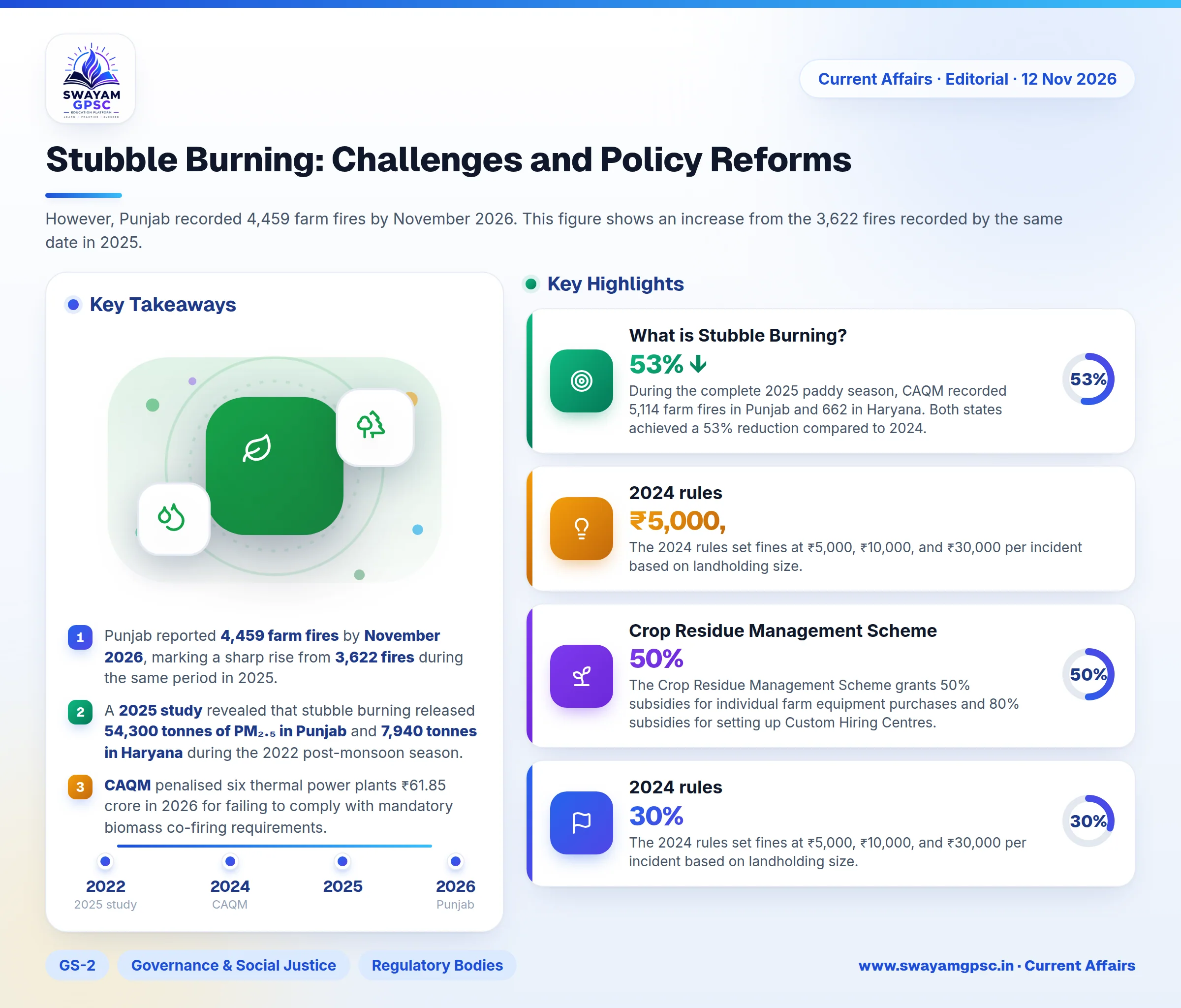
- Punjab reported 4,459 farm fires by November 2026, marking a sharp rise from 3,622 fires during the same period in 2025.
- A 2025 study revealed that stubble burning released 54,300 tonnes of PM₂.₅ in Punjab and 7,940 tonnes in Haryana during the 2022 post-monsoon season.
- CAQM penalised six thermal power plants ₹61.85 crore in 2026 for failing to comply with mandatory biomass co-firing requirements.
- Research published in 2025 demonstrated that providing partial upfront payments to farmers boosted no-burn policy compliance by 10 percentage points.
Why in News
- The Commission for Air Quality Management (CAQM) tightened its enforcement actions in Punjab following a sudden jump in NCR air pollution. It warned district officials that they will be held personally accountable if farm fires continue.
- Author Rachel Carson noted that “In nature nothing exists alone.” This principle shows clearly as open burning in one state pollutes the air and damages public health across the whole region.
- To tackle this problem, policies must shift away from penalties alone. They should focus on local straw collection networks, machinery subsidies, and guaranteed industrial buyers.
What is Stubble Burning?
- Stubble burning means setting fire to crop residues left in fields after harvest to prepare the land quickly for the next crop. Farmers burn kharif paddy straw in October-November and rabi wheat straw in April-May.
- During the complete 2025 paddy season, CAQM recorded 5,114 farm fires in Punjab and 662 in Haryana. Both states achieved a 53% reduction compared to 2024.
- However, Punjab recorded 4,459 farm fires by November 2026. This figure shows an increase from the 3,622 fires recorded by the same date in 2025.
- Farmers face a tight window between harvesting paddy and planting wheat. This urgency forces many of them to burn straw to ensure timely sowing.
- Groundwater protection rules delayed paddy transplanting across the region. When farmers plant long-duration paddy varieties, the delayed harvest leaves very little time for manual residue management.
- Combine harvesters leave behind loose straw and standing stubble. Farmers need high-powered tractors, trained operators, and specialized tools available at short notice to clear this material.
- A CEEW survey of 1,500 Punjab farmers revealed that nearly half of those using in-situ machinery still burned loose straw. This finding highlights a clear gap between tool access and effective field use.
- Paddy straw offers poor value as cattle fodder, while baling and transport add high operational costs. When buyers are far away, burning remains the cheapest option for farmers, creating a negative externality for public health.
- Burning straw destroys weed seeds and harmful crop pathogens present in fields. It acts as a low-cost biological cleaner that lowers the immediate need for chemical weedkillers.
- Under Section 15 of the CAQM Act, 2021, the government can fine farmers for setting fire to crop residue.
- The 2024 rules set fines at ₹5,000, ₹10,000, and ₹30,000 per incident based on landholding size. A September 2026 draft proposal kept these penalty rates and introduced strict rules to recover unpaid fines.
- The Crop Residue Management Scheme grants 50% subsidies for individual farm equipment purchases and 80% subsidies for setting up Custom Hiring Centres.
- Under CAQM Direction No. 92, brick kilns in Punjab and non-NCR Haryana districts must replace part of their fuel with paddy straw, setting a 30% co-firing target from 1st November 2026.
How Stubble Burning Causes Air Pollution
- Open farm fires release primary PM₂.₅ directly into the atmosphere, creating dense smoke blankets over farming zones.
- A 2025 study estimated that crop burning released 54,300 tonnes of PM₂.₅ in Punjab and 7,940 tonnes in Haryana during October-November 2022.
- Incomplete burning releases dangerous gases like carbon monoxide (CO) and volatile organic compounds (VOCs) such as benzene and toluene.
- In Mohali, benzene and toluene levels reached 2.51 and 3.72 parts per billion post-harvest, which is 1.5 times their annual average.
- Smoke gases react with sunlight and atmospheric chemicals to form secondary organic aerosols, adding heavy particulate mass as the smoke drifts.
- During 12th-19th November 2024, secondary organic aerosol in Delhi increased by 33-40 µg/m³, with the Punjab-Haryana farm belt identified as the primary source.
- Nitrogen oxides from farm fires react with atmospheric ammonia to form inorganic nitrate particles.
- In Amritsar, fine nitrate particle levels rose 12-fold, jumping from 0.20 µg/m³ to 2.44 µg/m³ during the peak burning period.
- Sunlight triggers reactions between nitrogen oxides and reactive gases in smoke, leading to toxic tropospheric ozone formation downwind.
- During an Indo-Gangetic Plain pollution event, ground-level ozone in Agra increased by 15.1% above its typical average.
- Smoke particles scatter and absorb sunlight, while black carbon and brown carbon trap heat and reduce visibility.
- Delhi's aerosol optical depth rose from 0.60 on 24th October to 0.95 on 1st November 2024 due to dense upstream smoke.
- Satellites show that peak farm fires shifted from 1-2 p.m. to 4-5 p.m., causing smoke to trap near the ground as evening weather cools.
- A 2025 study in Environment International showed that transported agricultural smoke accounted for 28% of annual organic aerosol in Kanpur.
Technological Interventions to Control Stubble Burning
- The PAU Surface Seeder plants wheat seeds while spreading paddy straw as protective surface mulch in a single operation. It operates using a standard 45-horsepower tractor, covers 1.5 acres per hour, and costs ₹700-800 per acre.
- Tar-wattar direct seeding lets farmers plant rice seeds directly into moist soil without puddling. This method helps Direct Seeded Rice (DSR) mature 7-10 days faster, expanding the post-harvest window.
- In kharif 2026, Punjab expanded DSR coverage over 4 lakh acres, reflecting a 36% growth over the previous year.
- 2G ethanol plants use enzymes to convert paddy straw into industrial ethanol. IndianOil's Panipat biorefinery produces up to 100 kilolitres per day, reaching 62% operational capacity in December 2025.
- Oxygen-limited pyrolysis transforms crop waste into biochar for field application. A trial in Phagwara, Punjab showed that biochar mixed with manure boosted wheat yields by 14%.
- Punjab Agricultural University developed a bio-composite packaging material combining paddy straw powder with polylactic acid (PLA). CSIR-AMPRI created strong building panels containing 60% parali.
- Researchers at CSIR-CRRI and CSIR-IIP converted paddy straw into bio-bitumen for road construction. Pilot tests showed it can replace up to 30% of petroleum bitumen.
- In January 2026, ICAR successfully grew king oyster mushrooms on paddy straw in Arunachal Pradesh, achieving 80-85% biological efficiency over a 30-35-day cycle.
- Studies at DUVASU and GADVASU showed that treating straw with urea and enzymes improves its digestibility for livestock, providing high-quality feed for dairy farms.
Challenges in Ending Stubble Burning
- Guaranteed state procurement makes paddy the safest crop choice for farmers. Punjab procured over 150 lakh tonnes of paddy by November 2026, while alternative crops lacked price security.
- Happy Seeder field trials showed higher stem borer damage in wheat (3.69% damaged tillers) compared to conventional tilled fields (0.51%), raising pest concerns.
- A 2026 CEEW survey found that while 90% of farmers disapproved of stubble burning, 73% still saw neighbours burn straw and 78% knew nothing about training programs.
- Aggregators struggle to secure insurance for leased straw storage yards. CEEW reported fires at five storage units, making seasonal stock accumulation risky.
- Power plants frequently fail to meet bio-firing targets. In 2026, CAQM fined six thermal power units ₹61.85 crore for ignoring biomass co-firing rules.
- Enforcement gaps weaken penalty recovery. Punjab officials verified fires at 1,310 out of 2,998 reported sites, collecting ₹32.60 lakh out of ₹62.55 lakh in imposed fines (52% recovery).
- Source states carry the financial cost of managing straw while neighboring states enjoy cleaner air. The Union government rejected Punjab's proposal for a ₹2,500-per-acre no-burn incentive shared with Delhi.
- Removing all straw depletes valuable organic nutrients from the soil. A 12-year trial by PAU showed that retaining straw increased soil organic carbon to 0.76%, compared to 0.45% when straw was removed.
Way Forward
- Governments should offer upfront payments for ecosystem services before harvest to help small farmers hire equipment. A 2025 study in American Economic Review: Insights showed advance payments increased farmer compliance by 10 percentage points.
- The state should offer three-season crop-switch contracts with assured price support for maize, pulses, and oilseeds to protect farmer incomes.
- Districts should establish guaranteed service contracts with Custom Hiring Centres to deliver machinery and trained operators to farms on time.
- Scientists must define clear soil-specific removal limits so farmers keep enough crop residue in fields to preserve long-term soil carbon.
- The government should build managed aggregate depots with working capital credit lines so businesses can safely store insured straw throughout the year.
- State agencies must collect firm buyer demand across industries before harvest to guarantee steady purchasing prices for collectors.
- Authorities must combine high-resolution satellite tracking with mandatory geotagged field verification to ensure fair and transparent enforcement.
- India needs a regional clean-air fund financed jointly by the central government and benefiting states to support local residue management.