Northeast India: Gateway to Viksit Bharat 2047
#GS-3 #Economy #Growth #Infrastructure #Inclusive Growth #Current Events #National
Key takeaways
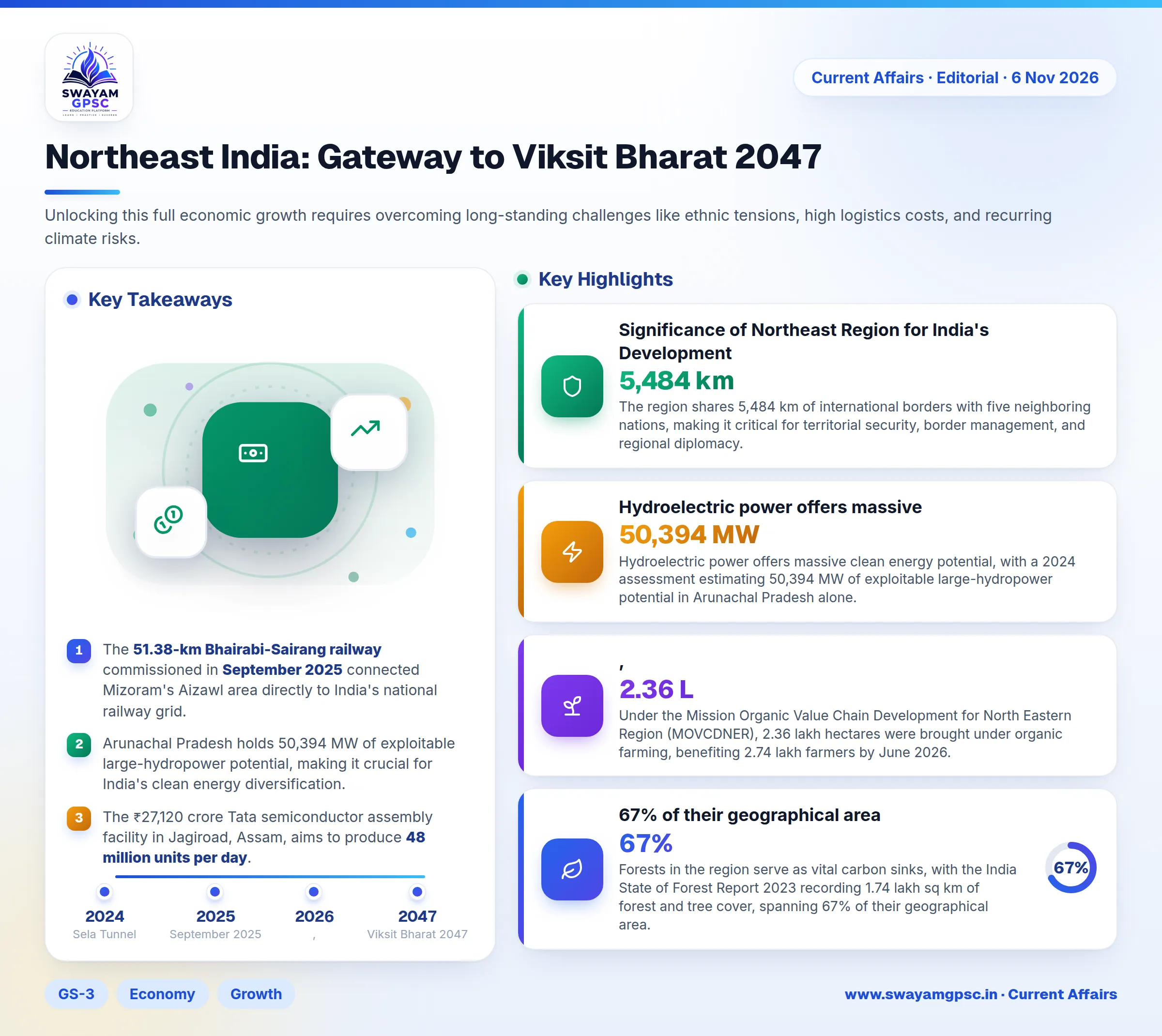
- The 51.38-km Bhairabi-Sairang railway commissioned in September 2025 connected Mizoram's Aizawl area directly to India's national railway grid.
- Arunachal Pradesh holds 50,394 MW of exploitable large-hydropower potential, making it crucial for India's clean energy diversification.
- The ₹27,120 crore Tata semiconductor assembly facility in Jagiroad, Assam, aims to produce 48 million units per day.
- Under MOVCDNER, organic farming expanded across 2.36 lakh hectares, benefiting 2.74 lakh farmers by June 2026.
- Digital infrastructure gaps remain critical as 3,841 villages lacked mobile connectivity and 5,271 villages lacked 4G coverage in June 2025.
Why in News
- India's eight northeastern states are rapidly moving away from their traditional borderland status to become central drivers of Viksit Bharat 2047.
- Prime Minister Narendra Modi has described the region as Ashtalakshmi, meaning eight radiant jewels, to highlight its economic potential.
- The national growth framework now relies on the EAST framework, which stands for Empower, Act, Strengthen, and Transform.
- Unlocking this full economic growth requires overcoming long-standing challenges like ethnic tensions, high logistics costs, and recurring climate risks.
Significance of Northeast Region for India's Development
- The Northeast acts as a vital land link for India's Act East Policy, directly connecting domestic markets with ASEAN, BIMSTEC, and regional value chains.
- Strategic regional initiatives like the India-Myanmar-Thailand Trilateral Highway and the Kaladan Multimodal Transit Transport Project aim to expand trade routes across borders.
- Domestic rail connectivity saw a major boost when the 51.38-km Bhairabi-Sairang railway line was commissioned in September 2025, linking Mizoram's Aizawl region directly to the national rail grid.
- The region shares 5,484 km of international borders with five neighboring nations, making it critical for territorial security, border management, and regional diplomacy.
- Civilian infrastructure projects also double as vital defence assets, as demonstrated by the Sela Tunnel opened in 2024 at 13,000 feet to provide all-weather access toward Tawang.
- Hydroelectric power offers massive clean energy potential, with a 2024 assessment estimating 50,394 MW of exploitable large-hydropower potential in Arunachal Pradesh alone.
- Industrial energy diversification is moving forward through projects like the bamboo-based second-generation biorefinery at Numaligarh, which supports bioenergy and reduces fossil fuel imports.
- Under the Mission Organic Value Chain Development for North Eastern Region (MOVCDNER), 2.36 lakh hectares were brought under organic farming, benefiting 2.74 lakh farmers by June 2026.
- Forests in the region serve as vital carbon sinks, with the India State of Forest Report 2023 recording 1.74 lakh sq km of forest and tree cover, spanning 67% of their geographical area.
- High-tech industrial manufacturing is expanding into the region, exemplified by the ₹27,120 crore semiconductor project by Tata in Jagiroad, Assam, targeting 48 million units per day.
- Cultural and eco-tourism continue to thrive, backed by 1.21 crore domestic tourist visits and 2.21 lakh foreign tourist visits in 2023 alongside the 2024 UNESCO recognition of Assam's Moidams.
- Women power the local creative economy, as reflected in the 11.80 lakh female handloom workers in Assam recorded in 2025.
- A January 2026 initiative by NEHHDC aimed to secure GI registration for 33 products from Nagaland and Meghalaya to safeguard indigenous crafts.
Challenges
- Unresolved social conflicts harm local growth, with Manipur accounting for 226 of the Northeast's 294 insurgency-related violent incidents in 2024, which equals roughly 77%.
- Difficult mountainous terrain creates high transport costs, while digital coverage lags with 3,841 villages lacking basic mobile coverage and 5,271 villages missing 4G connectivity as of June 2025.
- Local businesses struggle to secure formal credit, as seen in Nagaland where priority-sector lending stood at just 25% of total advances in March 2025.
- Budget management remains inconsistent, with MDoNER using ₹3,447 crore against revised allocations of ₹4,006 crore in 2024-25, showing an execution rate of 86%.
- Disparities in human development persist across states, as the NER District SDG Index 2023-24 rated Longding in Arunachal Pradesh at 58.71 compared to 81.43 for Hnahthial in Mizoram.
- Child malnutrition remains high in specific pockets, with NFHS-6 (2023-24) registering 36.8% stunting among children under five in Meghalaya, well above the national average of 29.3%.
- Environmental loss threatens ecosystems, with the India State of Forest Report 2023 documenting a 327.30 sq km decline in forest cover compared to the 2021 assessment.
- Extreme natural disasters damage infrastructure unpredictably, highlighted by the October 2023 Teesta disaster where the Teesta-III dam collapsed and affected the 510-MW Teesta-V station.
- Cross-border instability slows progress on key international transit routes, such as the 109.2-km Paletwa-Zorinpui road inside Myanmar.
Way Forward
- Establish district-level compacts that involve traditional tribal bodies and local community leaders to build lasting peace and guide investment priorities.
- Implement ecological risk budgets for river basins to set enforceable limits on dams, highway projects, and urban construction.
- Focus connectivity spending on operational reliability by introducing service-availability contracts that measure uptime and reduction in road closure days.
- Promote local agro-processing clusters owned by farmers and women's cooperatives to ensure local processing of high-value crops.
- Expand cash-flow-based business lending for local MSMEs by using the Account Aggregator framework instead of insisting on traditional land collateral.
- Guarantee access to basic healthcare and schooling based on travel time, taking inspiration from successful initiatives like the Nagaland Health Project.
- Reward local indigenous communities with direct financial incentives for verified ecosystem conservation efforts, building on models studied by NITI Aayog.
- Set up three-year district development compacts using the NER District SDG Index to track project delivery and maintain transparent public dashboards.
Conclusion
- Building a prosperous Northeast requires looking beyond standard road construction toward sustainable, community-first development strategies.
- As Prime Minister Narendra Modi pointed out, modern infrastructure projects are ultimately about building trust among people.
- Fulfilling the vision of the East as an economic engine requires expanding digital infrastructure, widening credit access, and preserving delicate ecosystems.