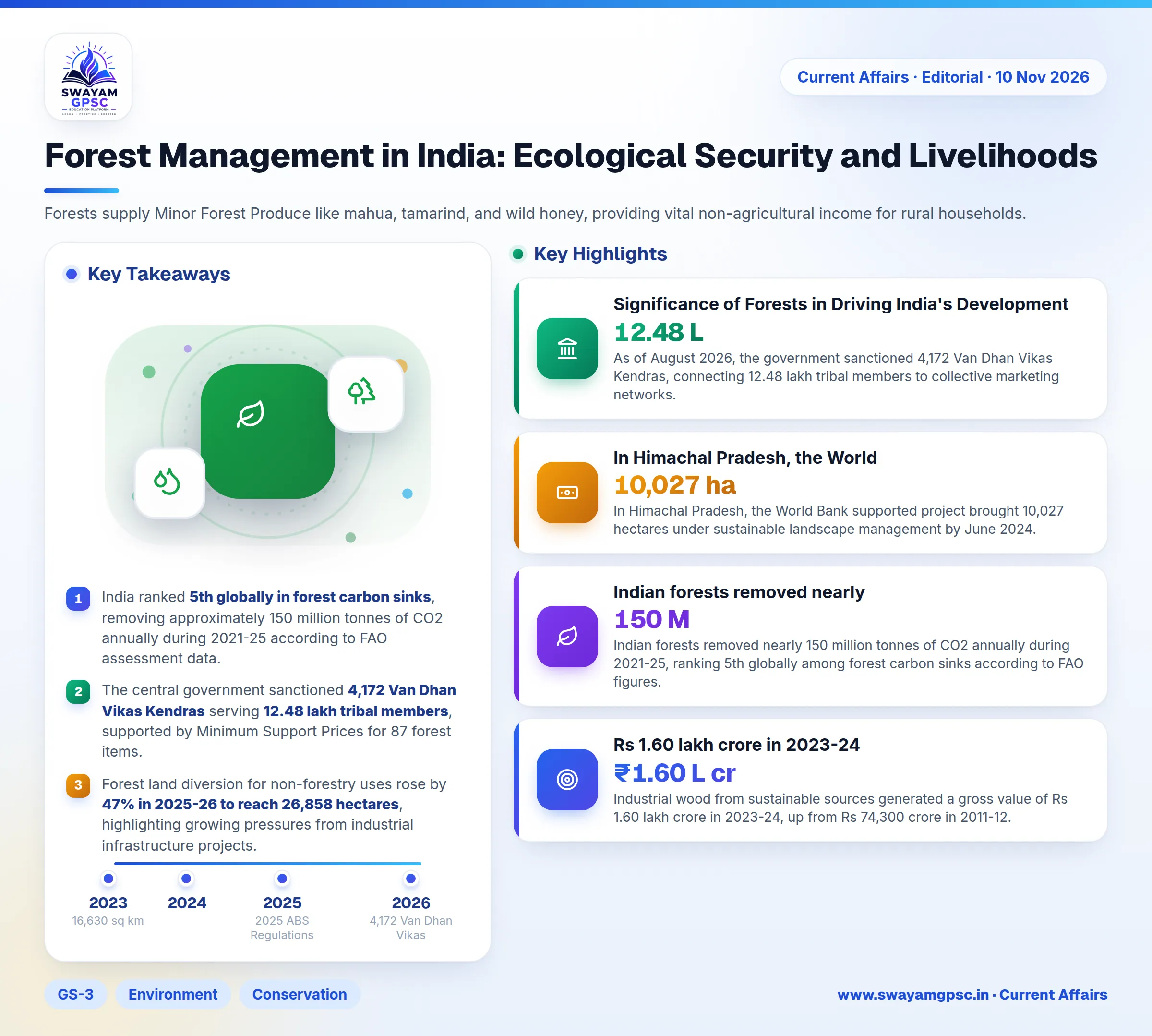
Forest Management in India: Ecological Security and Livelihoods
#GS-3 #Environment #Conservation #Forest Resources #Climate Change #GS-2 #Governance & Social Justice #Social Justice
Key takeaways
- India ranked 5th globally in forest carbon sinks, removing approximately 150 million tonnes of CO2 annually during 2021-25 according to FAO assessment data.
- The central government sanctioned 4,172 Van Dhan Vikas Kendras serving 12.48 lakh tribal members, supported by Minimum Support Prices for 87 forest items.
- Forest land diversion for non-forestry uses rose by 47% in 2025-26 to reach 26,858 hectares, highlighting growing pressures from industrial infrastructure projects.
- Over 10.45 lakh individual and community land claims remained pending under the Forest Rights Act as of August 2026, delaying local community management authority.
- The 16th Finance Commission assigned a 10% weight to forest cover in its tax devolution formula for 2026-31, using an 80:20 ratio for total area versus area gains.
Context and Significance of Forests
- Forests act as crucial carbon sinks, watershed guardians, and livelihood supports across India.
- As global climate talks at COP31 emphasize adaptation, India must balance forest conservation with human enterprise.
- Addressing accounting gaps, insecure land rights, and invasive species through community governance is essential for long-term ecological resilience.
Significance of Forests in Driving India's Development
- Forests supply Minor Forest Produce like mahua, tamarind, and wild honey, providing vital non-agricultural income for rural households.
- As of August 2026, the government sanctioned 4,172 Van Dhan Vikas Kendras, connecting 12.48 lakh tribal members to collective marketing networks.
- The central procurement framework offers guaranteed Minimum Support Prices for 87 forest products to protect gatherer earnings.
- Forested catchments reduce surface runoff, limit soil erosion, and safeguard downstream reservoirs for agricultural use.
- In Himachal Pradesh, the World Bank supported project brought 10,027 hectares under sustainable landscape management by June 2024.
- Indian forests removed nearly 150 million tonnes of CO2 annually during 2021-25, ranking 5th globally among forest carbon sinks according to FAO figures.
- Conserving natural forests protects current carbon stocks, while restoring degraded lands enhances future atmospheric carbon absorption.
- Industrial wood from sustainable sources generated a gross value of Rs 1.60 lakh crore in 2023-24, up from Rs 74,300 crore in 2011-12.
- Agroforestry and farm forestry help meet growing industrial timber demand while diversifying income streams for farmers.
- Forests conserve wild genetic resources, supporting botanical research, crop breeding, and the expanding herbal medicine industry.
- An assessment supported by the National Medicinal Plants Board identified 1,178 medicinal plant species in trade, with 242 species traded in volumes exceeding 100 tonnes annually.
- Protected forest landscapes drive regional ecotourism, creating jobs for local guides, homestays, transport providers, and artisans.
- Kaziranga National Park and Tiger Reserve hosted over 4.68 lakh visitors during the 2025-26 tourist season, showing immense economic potential.
- Periyar Tiger Reserve successfully employs local residents as forest guards and guides, linking eco-tourism directly to habitat protection.
- Coastal mangrove forests act as natural green infrastructure that buffers shoreline settlements against destructive storm surges.
- A PNAS study on the 1999 Odisha super cyclone confirmed significantly lower human mortality in villages protected by wide mangrove belts.
- The 16th Finance Commission assigned a 10% weight to the forest criterion in its horizontal tax devolution formula for 2026-31.
- The fiscal allocation formula uses an 80:20 ratio comparing existing forest cover against forest area gains, accounting for canopy density.
Key Regulatory Frameworks Related to Forest Management
- The 42nd Constitutional Amendment of 1976 transferred forests and wildlife protection to the Concurrent List under Entries 17A and 17B.
- Article 48A directs the state to safeguard environment and forests, while Article 51A(g) defines environmental protection as a fundamental citizen duty.
- The Indian Forest Act of 1927 establishes procedures for declaring reserved, protected, and village forests while regulating timber transit.
- Under Section 28 of the 1927 Act, state governments can assign reserved forest rights to local village communities under clear operational guidelines.
- The Van (Sanrakshan Evam Samvardhan) Adhiniyam of 1980 mandates prior central government approval before diverting forest land to non-forest uses.
- A March 2026 rule amendment mandates joint field inspections by senior forest officers for project proposals involving more than 40 hectares.
- The Forest Rights Act of 2006 legally recognizes individual and community land tenure for forest-dwelling Scheduled Tribes and traditional dwellers.
- In designated Scheduled Areas, PESA 1996 grants legal ownership of minor forest produce to local Gram Sabhas and Panchayats.
- The Wild Life (Protection) Act of 1972 governs protected area management, while the Environment (Protection) Act of 1986 enables notification of Eco-Sensitive Zones.
- The Compensatory Afforestation Fund Act of 2016 creates national and state CAMPA bodies, retaining 90% of funds at the state level for local restoration.
- The Biological Diversity Act of 2002, updated via 2025 ABS Regulations, governs equitable benefit-sharing from commercial biological resource use.
- The National Forest Policy of 1988 targets maintaining one-third of India's total land area under forest cover, rising to two-thirds in hilly zones.
Challenges
- Current canopy-based accounting includes timber plantations and orchards, masking the loss of diverse natural forest ecosystems.
- Out of 16,630 sq km of forest cover increase recorded between 2013 and 2023, only 440 sq km occurred inside recorded forest areas.
- India diverted 26,858 hectares of forest land for industrial use in 2025-26, marking a 47% jump over the previous financial year.
- Expanding linear infrastructure divides wildlife habitats, prompting authorities to flag 77 priority railway stretches across 14 states for mitigation.
- Over 10.45 lakh forest rights claims remained pending as of August 2026, keeping local community access rights unresolved.
- Delayed afforestation projects create long ecological time lags before newly planted trees match the ecosystem functions of cleared mature forests.
- Audit reports revealed Jharkhand had 33,021 hectares of pending afforestation work, while Rs 10,380 crore in CAMPA funds remained undisbursed nationally.
- Infrequent satellite passes and unverified alerts hamper fire response, with Uttarakhand reporting that only 12.5% of satellite alerts matched actual fires.
- Invasive alien plants spread across an estimated 15,500 sq km of natural ecosystems annually, suppressing native flora and altering soil nutrients.
- Severe staff shortages affect beat patrols, as seen in Haryana's Panchkula division where only 22 out of 105 sanctioned forest guard posts were filled.
Way Forward
- State forest departments must track sample plots to identify regeneration bottlenecks and adjust divisional working plans when native sapling survival drops.
- Planning bodies should map proposed infrastructure projects on a shared regional canvas to build wildlife crossings and protect ecological corridors.
- Districts should establish polycentric governance systems, granting pooled stewardship grants to Gram Sabhas that manage shared forest commons.
- Restoration funding should require five-year performance contracts, disbursing final payments only after independent ecological audits confirm sapling survival.
- States must adopt forecast-based financing tools, automatically releasing emergency operational funds to field teams when high fire-risk thresholds are crossed.
- Agencies should enforce biosecurity controls along infrastructure construction routes to clean equipment and prevent the introduction of invasive plant seeds.
- Forest officials should perform mass-balance audits on sawmills and wood depots, using wood anatomy testing to stop the entry of illegal timber into legal markets.
- Districts experiencing human-wildlife conflict should issue two-stage interim compensation payments, utilizing repeat-loss mapping to target preventive infrastructure funding.