Poverty Alleviation in India: Achievements, Challenges, and Future Policy Directions
#GS-2 #Governance & Social Justice #Poverty #Hunger #GS-3 #Economy #Growth #Employment #Infrastructure #Current Events #National
Key takeaways
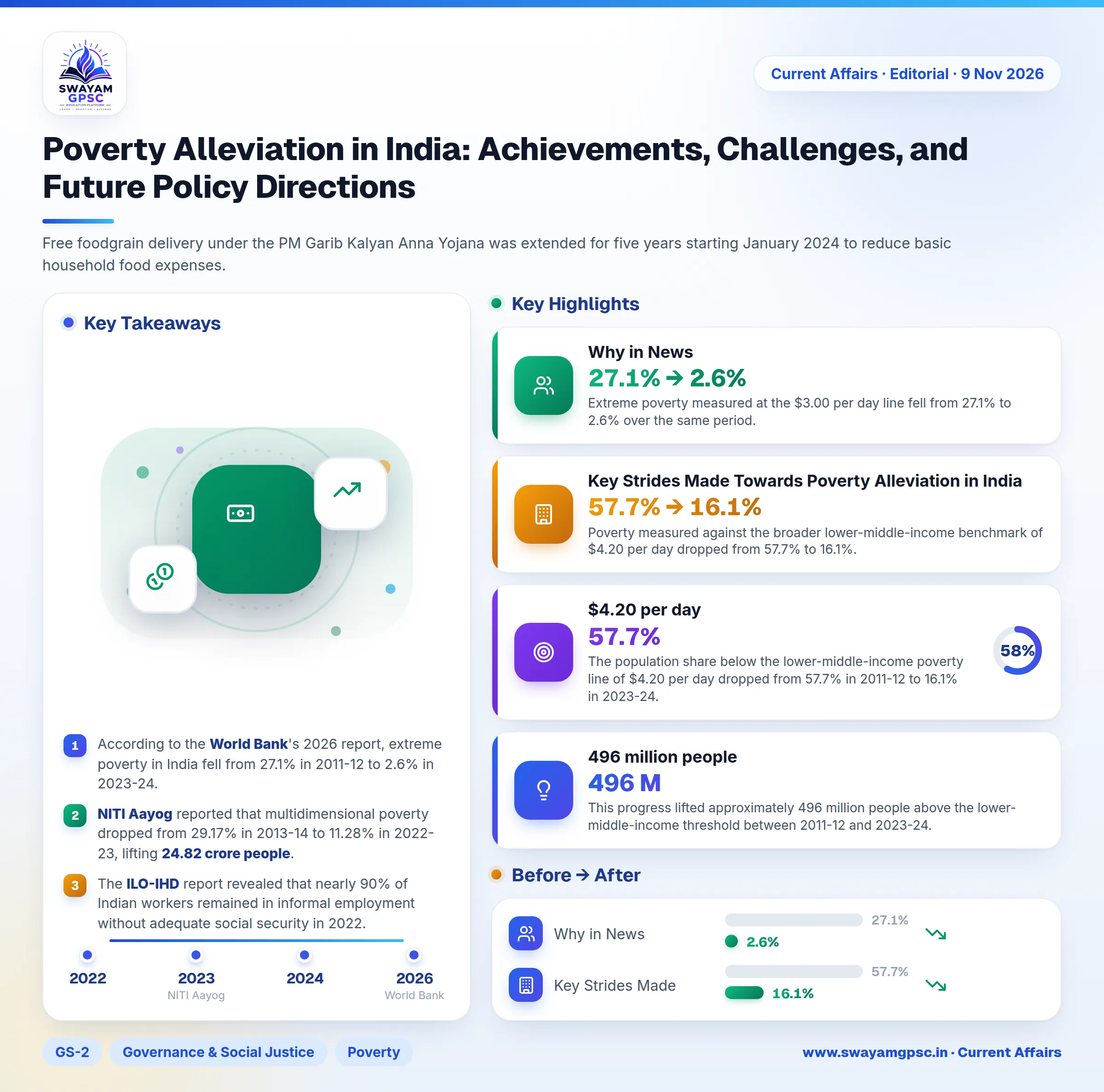
- According to the World Bank's 2026 report, extreme poverty in India fell from 27.1% in 2011-12 to 2.6% in 2023-24.
- NITI Aayog reported that multidimensional poverty dropped from 29.17% in 2013-14 to 11.28% in 2022-23, lifting 24.82 crore people.
- The ILO-IHD report revealed that nearly 90% of Indian workers remained in informal employment without adequate social security in 2022.
- PMAY-G successfully completed 3.12 crore houses out of 3.91 crore sanctioned houses by August 2026 to build rural assets.
- Under DAY-NRLM, over 10 crore rural women joined self-help groups, helping create 3.46 crore Lakhpati Didis by September 2026.
Why in News
- According to the World Bank's October 2026 Poverty and Equity Brief, India recorded a significant reduction in global poverty levels.
- The population share below the lower-middle-income poverty line of $4.20 per day dropped from 57.7% in 2011-12 to 16.1% in 2023-24.
- Extreme poverty measured at the $3.00 per day line fell from 27.1% to 2.6% over the same period.
- This progress lifted approximately 496 million people above the lower-middle-income threshold between 2011-12 and 2023-24.
- Targeted welfare programs and employment expansion drove this progress, reflecting Nelson Mandela's observation that poverty is not natural, it is man-made and it can be overcome.
- Persistent working poverty and foundational learning deficits continue to challenge long-term economic resilience, requiring targeted policy responses.
Key Strides Made Towards Poverty Alleviation in India
- The World Bank's April 2026 India Development Update confirmed that extreme poverty at $3 per person per day in 2021 purchasing-power-parity terms fell from 27.1% in 2011-12 to 2.6% in 2023-24.
- Poverty measured against the broader lower-middle-income benchmark of $4.20 per day dropped from 57.7% to 16.1%.
- NITI Aayog's 2024 discussion paper showed multidimensional poverty falling from 29.17% in 2013-14 to 11.28% in 2022-23, pulling 24.82 crore people out of poverty.
- Free foodgrain delivery under the PM Garib Kalyan Anna Yojana was extended for five years starting January 2024 to reduce basic household food expenses.
- The One Nation One Ration Card system enabled nationwide portability of food benefits, recording over 221 crore cumulative portability transactions by July 2026.
- The PM Awaas Yojana-Gramin created durable housing assets, completing 3.12 crore houses against 3.91 crore sanctioned houses by August 2026.
- Healthcare coverage under insurance or financing schemes rose to 60.2% in NFHS-6 (2023-24) compared to 41% in NFHS-5.
- The National Health Accounts 2022-23 released in 2026 reported a drop in out-of-pocket health spending from 64.2% in 2013-14 to 43.4% in 2022-23.
- The PM Jan Dhan Yojana expanded direct benefit transfer infrastructure, reaching 59.09 crore accounts with ₹3.17 lakh crore in deposits by August 2026.
- Women held 55.7% of these account deposits, while 77.8% were opened in rural or semi-urban regions.
- Under DAY-NRLM, over 10 crore rural women joined 93 lakh SHGs by September 2026, with 3.46 crore women identified as Lakhpati Didis.
- The Deen Dayal Upadhyaya Grameen Kaushalya Yojana trained 18.45 lakh candidates and placed 12.35 lakh candidates in formal jobs since inception, as reported in August 2026.
- The updated DDU-GKY 2.0 framework launched for 2025-26 focuses on industry-led training in emerging areas like EV maintenance, renewable energy, logistics, and the care economy.
Challenges
- The ILO-IHD India Employment Report 2024 indicated that nearly nine in ten employed people were informally employed in 2022, leaving workers without steady incomes.
- Poverty welfare schemes face coverage gaps because National Food Security Act entitlements rely on outdated Census 2011 demographic numbers.
- A 2026 parliamentary update noted that States and UTs registered 79.90 crore beneficiaries, which remains below the existing statutory coverage limit.
- Educational outcomes remain low, as ASER 2024 reported that only 27.1% of Standard III children in rural India could read a Standard II-level text.
- MoSPI's Time Use Survey 2024 showed women spend 289 minutes daily on unpaid domestic services compared to 88 minutes spent by men, creating gendered time poverty.
- Regional disparities persist, with NITI Aayog's National MPI Progress Review 2023 reporting multidimensional poverty at 33.76% in Bihar and 28.81% in Jharkhand versus 0.55% in Kerala.
- Urban housing programs face completion delays, with official October 2026 updates recording 1.27 crore houses sanctioned under PMAY-U and PMAY-U 2.0 against 1.01 crore completed.
- Extreme weather events cause heavy economic losses, with the World Bank's 2026 heatwave assessment estimating productivity losses equivalent to 31 million full-time jobs across South Asia.
- Household debt burden remains widespread, with NABARD's NAFIS 2021-22 report published in 2024 showing outstanding debt among 52% of surveyed rural households and 55% of agricultural households.
Way Forward
- Industrial incentives should link directly to verified job creation, real wage growth, and workplace retention in labor-intensive sectors.
- Welfare delivery mechanisms need continuous on-demand registration platforms to support households facing sudden economic setbacks or migration.
- Expanding affordable childcare facilities through local self-help groups will help reduce women's domestic burdens and support formal employment, aligning with the ILO's 2026 5R framework.
- Local governance teams should integrate early childhood nutrition and foundational learning programs to break intergenerational poverty cycles.
- Health administration must expand outpatient insurance packages and introduce temporary income-replacement grants for informal workers during medical emergencies.
- Municipalities need integrated urban planning strategies that connect low-cost rental housing, public transit, and informal work spaces.
- Disaster management systems require responsive contingency funding mechanisms triggered automatically during severe heatwaves and climate shocks.
- Capability building remains essential, reinforcing Mother Teresa's statement that poverty is not just being hungry, being deprived of education is also poverty.