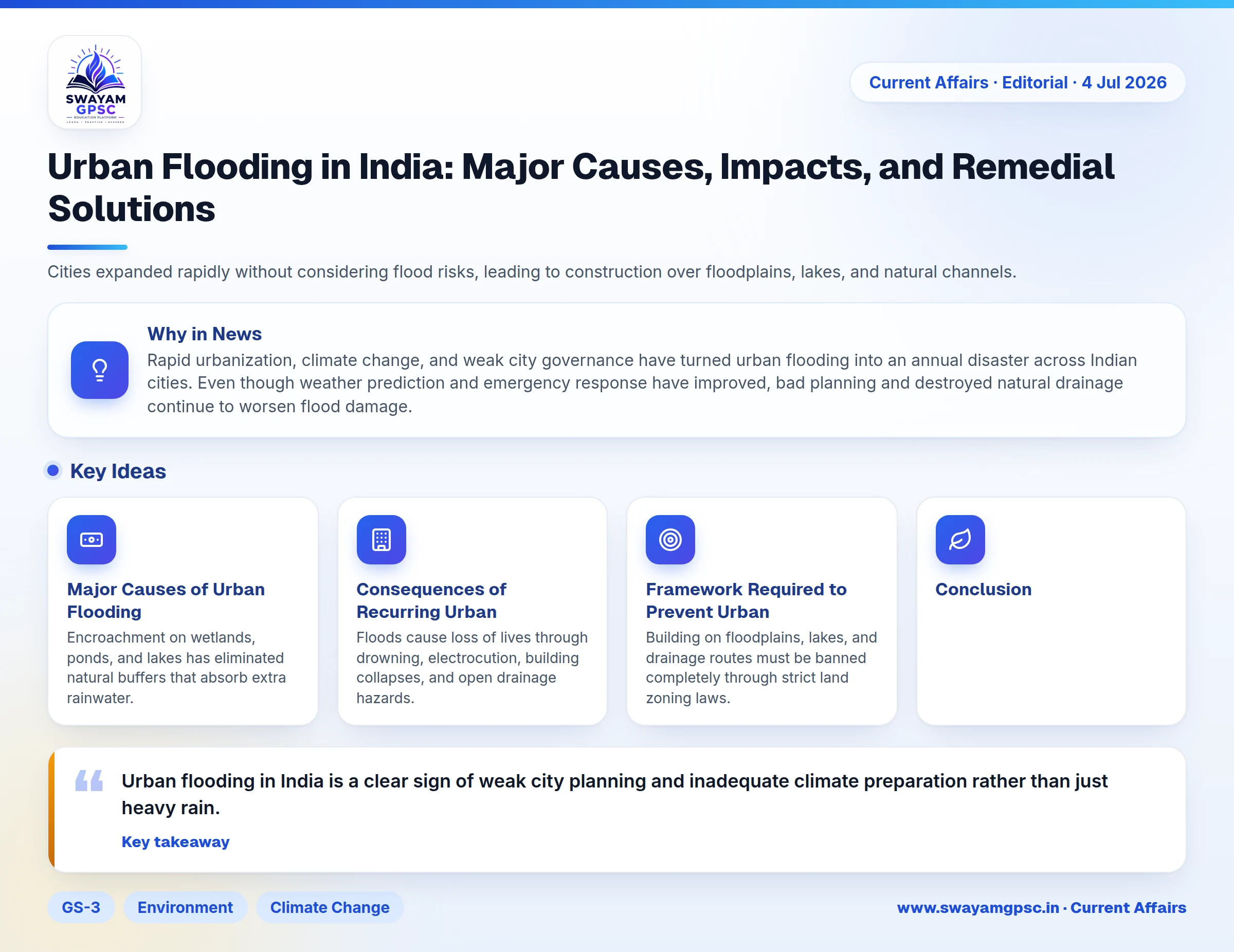
Urban Flooding in India: Major Causes, Impacts, and Remedial Solutions
#GS-3 #Environment #Climate Change #Infrastructure #Disaster Management #Disaster Preparedness #Governance & Social Justice #GS-2 #National
Why in News
- Rapid urbanization, climate change, and weak city governance have turned urban flooding into an annual disaster across Indian cities.
- Even though weather prediction and emergency response have improved, bad planning and destroyed natural drainage continue to worsen flood damage.
- To make cities resilient, India must transition from reacting after disasters strike to managing flood risks in advance.
Major Causes of Urban Flooding in India
- Cities expanded rapidly without considering flood risks, leading to construction over floodplains, lakes, and natural channels. According to the World Bank, India ranks among the fastest expanding countries in building settlements on flood-prone land.
- Encroachment on wetlands, ponds, and lakes has eliminated natural buffers that absorb extra rainwater. For example, Bengaluru lost a major portion of its connected lake network, leading to frequent urban flooding.
- Most cities rely on old stormwater drains built decades ago that cannot handle modern rainfall intensity. Recently, the Bombay High Court instructed the Brihanmumbai Municipal Corporation (BMC) to cover open manholes, highlighting serious civic gaps.
- Climate change has increased short-duration, high-intensity rain events like cloudbursts that overwhelm urban drains within hours. Data from the India Meteorological Department (IMD) shows a clear rise in extreme rainfall events across urban India.
- Covering land with concrete roads, parking lots, and buildings prevents rainwater from soaking into the ground. As a result, even brief rain spells cause severe surface runoff and widespread waterlogging.
- Municipal bodies lack financial resources, technical skills, and staff to execute long-term flood mitigation work. The 15th Finance Commission recommended strengthening municipal finances to improve civic infrastructure and disaster readiness.
- Unmanaged plastic garbage and municipal waste block drains and rainwater channels during heavy rains. Cities like Mumbai, Delhi, and Chennai face severe local flooding every year due to choked drainage channels.
- Many cities still lack localized neighborhood-level flood prediction tools and integrated emergency warning systems. This delay in early warnings prevents timely evacuations and worsens flood damage.
Consequences of Recurring Urban Flooding
- Floods cause loss of lives through drowning, electrocution, building collapses, and open drainage hazards. For instance, the Old Rajinder Nagar flooding incident (2024) exposed dangerous safety gaps in urban infrastructure.
- Submerged roads, cancelled trains, and closed airports paralyze daily commercial activity and supply chains. For example, Mumbai suburban train networks regularly freeze during heavy monsoon downpours.
- Stagnant floodwater creates breeding grounds for mosquitoes and pollutes drinking water sources. Flooded areas often suffer from disease outbreaks like dengue, malaria, leptospirosis, and gastroenteritis.
- Waterlogging weakens roads, damages bridges, and destroys underground electrical wires and public transit systems. The NDMA Urban Flood Guidelines (2010) highlight infrastructure damage as a major long-term loss for cities.
Framework Required to Prevent Urban Flooding
- City planning must integrate flood management directly into master plans instead of handling floods as temporary emergencies. The NDMA Guidelines on Urban Flooding (2010) advise making city-specific flood plans that merge drainage and land use.
- Wetlands, lakes, and natural streams must be protected and restored as essential infrastructure rather than vacant real estate. For instance, Hyderabad started the Lake Rejuvenation Programme to restore city lakes and absorb floodwater.
- Cities should adopt nature-based solutions like urban forests, rain gardens, green roofs, and porous pavements to soak up rainwater. China's Sponge City Programme shows how green design reduces flooding and recharges groundwater.
- Drainage networks must be redesigned using future climate forecasts and modern rain intensity data instead of old averages. The Central Public Health and Environmental Engineering Organisation (CPHEEO) recommends upgrading city drainage as population grows.
- Urban local bodies need financial independence and technical training to execute flood management projects effectively. The 15th Finance Commission suggested performance-based grants to strengthen municipal administration.
- Cities must deploy Artificial Intelligence, GIS mapping, IoT sensors, and local rain forecasts for real-time flood predictions. Tools like the Mausam App from IMD and the Common Alerting Protocol (CAP) help issue fast emergency alerts.
- Building on floodplains, lakes, and drainage routes must be banned completely through strict land zoning laws. For example, the Master Plan for Delhi 2041 includes blue-green infrastructure to handle climate risks.
- Cities must implement door-to-door waste collection and scientific recycling to prevent plastic from clogging storm drains. Under Swachh Bharat Mission-Urban 2.0, proper waste management is treated as a core part of flood prevention.
- New roads, bridges, and public buildings must be designed to withstand future climate extremes rather than past weather patterns. The IPCC Sixth Assessment Report (AR6) warns that extreme urban rainfall will increase worldwide.
- Municipal corporations, state disaster management teams, weather departments, and urban authorities must work together smoothly. Projects like Chennai's Integrated Storm Water Drain Project demonstrate how joint agency effort reduces urban flooding.
Conclusion
- Urban flooding in India is a clear sign of weak city planning and inadequate climate preparation rather than just heavy rain.
- By combining nature-based solutions, modern drainage, smart forecasting, and strong municipal institutions, India can make its expanding cities safe and climate-resilient.
Frequently Asked Questions
- Why has urban flooding become a recurring problem in Indian cities? Unplanned growth, encroachment on lakes, outdated drains, plastic waste blocking channels, and heavy rainfall driven by climate change cause frequent urban floods.
- What are the NDMA Guidelines on Urban Flooding? Issued in 2010, these guidelines suggest integrated city planning, saving natural water bodies, building modern drainage networks, using GIS mapping, and improving coordination among agencies.
- What are Sponge Cities? Sponge Cities use natural solutions like urban wetlands, green roofs, and porous pavements to absorb, store, and clean rainwater, which reduces flooding and raises groundwater levels.