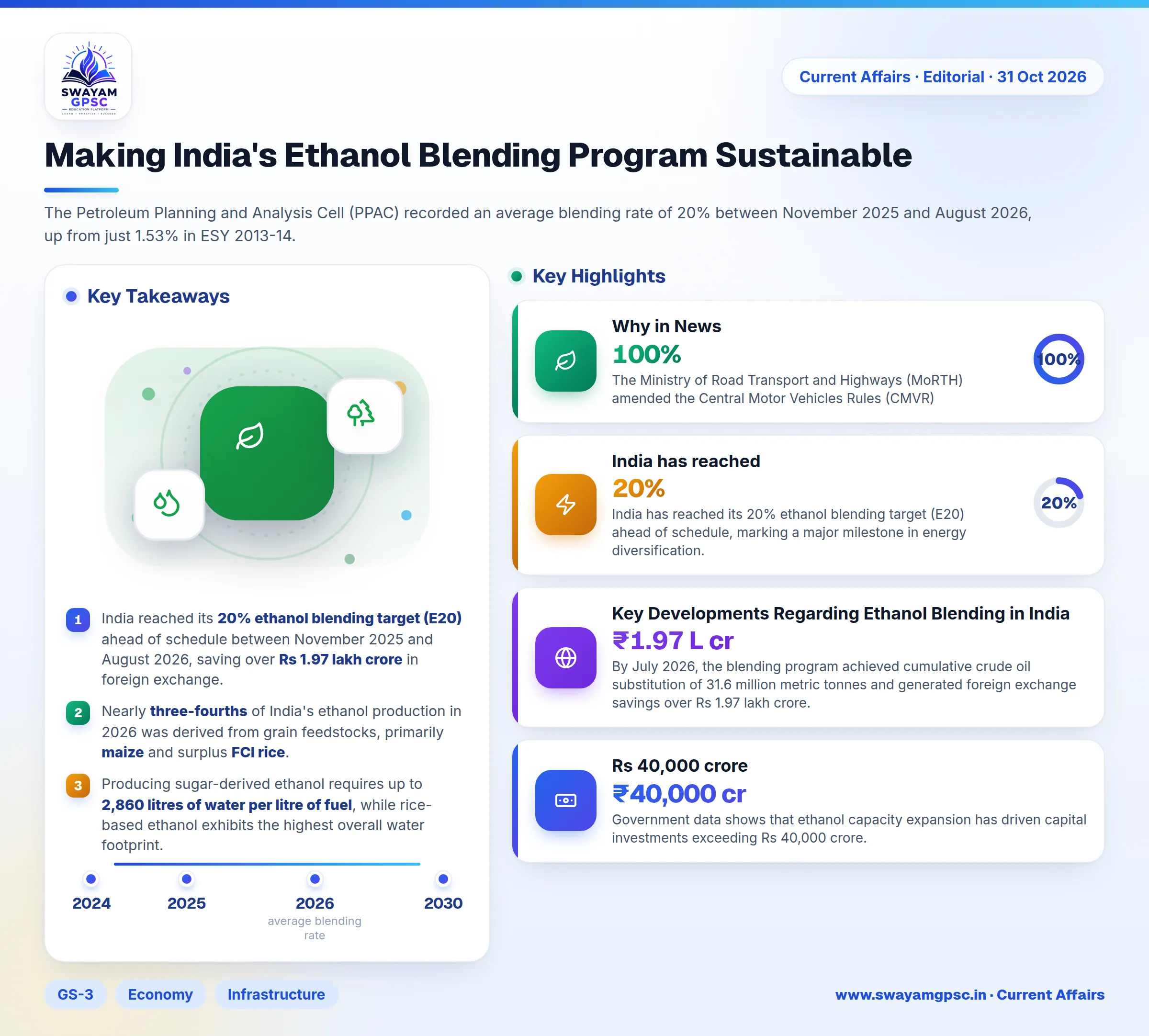
Making India's Ethanol Blending Program Sustainable
#GS-3 #Economy #Infrastructure #Science & Technology #Energy #Environment #Sustainable Development #Pollution #Renewable Energy #Environmental Pollution & Degradation
Key takeaways
- India reached its 20% ethanol blending target (E20) ahead of schedule between November 2025 and August 2026, saving over Rs 1.97 lakh crore in foreign exchange.
- Nearly three-fourths of India's ethanol production in 2026 was derived from grain feedstocks, primarily maize and surplus FCI rice.
- Producing sugar-derived ethanol requires up to 2,860 litres of water per litre of fuel, while rice-based ethanol exhibits the highest overall water footprint.
- For ESY 2024-25, FCI rice was supplied to distilleries at Rs 22.50/kg against an estimated economic cost of Rs 40.42/kg, creating a significant fiscal gap.
- To ensure sustainability, India is expanding 2G biofuel facilities under the PM JI-VAN Yojana using agricultural waste like paddy straw and bamboo.
Why in News
- The Ministry of Road Transport and Highways (MoRTH) amended the Central Motor Vehicles Rules (CMVR), 1989 to formally include E100 (100% ethanol) and E85 under official emission and testing standards for Flex-Fuel Vehicles (FFVs).
- India has reached its 20% ethanol blending target (E20) ahead of schedule, marking a major milestone in energy diversification.
- However, the program faces structural limitations, including heavy dependence on petrol displacement, significant water footprints, and ongoing food-feed-fuel trade-offs.
- To achieve true energy security, India must balance agricultural availability with crude oil import reductions while accelerating 2G biofuels and implementing lifecycle carbon accounting.
Key Developments Regarding Ethanol Blending in India
- India advanced its target of reaching a 20% ethanol blend to Ethanol Supply Year (ESY) 2025-26, moving it up from the original 2030 deadline.
- The Petroleum Planning and Analysis Cell (PPAC) recorded an average blending rate of 20% between November 2025 and August 2026, up from just 1.53% in ESY 2013-14.
- By July 2026, the blending program achieved cumulative crude oil substitution of 31.6 million metric tonnes and generated foreign exchange savings over Rs 1.97 lakh crore.
- Ethanol production has successfully expanded beyond sugarcane to include maize, damaged foodgrains, and surplus FCI rice.
- An August 2026 report showed that nearly three-fourths of India's ethanol supply came from grains, primarily maize.
- Multi-feedstock distilleries now adjust production based on raw material availability, reducing reliance on the seasonal sugarcane crush.
- The government balances food security and fuel needs by adjusting procurement prices and changing eligible feedstocks periodically.
- For ESY 2026-27, the government excluded sugarcane juice, sugar syrup, and B-heavy molasses from OMC procurement tenders to prevent sugar shortages.
- Eligible feedstocks for the new supply year now focus on C-heavy molasses, maize, damaged grains, and surplus FCI rice.
- The expanded Pradhan Mantri JI-VAN Yojana provides financial support for advanced 2G biofuel projects using lignocellulosic biomass.
- The 2024 amendment to PM JI-VAN extended the scheme to FY 2028-29 and made brownfield and bolt-on projects eligible for funding.
- Key operational 2G projects include the paddy-straw ethanol plant in Panipat and the bamboo-based biorefinery in Numaligarh.
- Automotive manufacturers are making progress with vehicle prototypes, including Toyota's electrified flex-fuel prototype and Maruti Suzuki's Wagon R flex-fuel car.
- MoRTH updated vehicle certification rules in October 2026 to include testing standards for E100 and E85 fuels.
- Oil Marketing Companies (OMCs) signed 10-year Long-Term Offtake Agreements (LTOAs) to provide financial security for dedicated ethanol plants.
- Tripartite escrow agreements between OMCs, project developers, and banks ensure smooth loan servicing from ethanol sales.
- Government data shows that ethanol capacity expansion has driven capital investments exceeding Rs 40,000 crore.
- The ethanol program has created new revenue streams for farmers, with total payments to farmers and distillers exceeding Rs 1.66 lakh crore by July 2026.
- Regular ethanol sales improve cash flows for sugar mills, helping them clear cane dues to farmers on time while establishing farmers as Urjadaatas (energy providers).
- India co-founded the Global Biofuels Alliance (GBA) in September 2023 alongside the US and Brazil to foster international cooperation, technical assistance, and standard setting.
Understanding Ethanol Blending Framework in India
- Ethanol blending involves mixing anhydrous ethyl alcohol (C2H5OH) with petrol in specific volumetric ratios such as E10 (10% ethanol) and E20 (20% ethanol).
- Bioethanol is produced through the fermentation of biological feedstocks followed by distillation and purification.
- The Ethanol Blended Petrol (EBP) Programme began in January 2003, initially launching as an E5 blend across nine states and four Union Territories.
- The Ministry of Petroleum and Natural Gas manages the program through public-sector OMCs to reduce crude imports and boost farm income.
- The National Policy on Biofuels, 2018 (amended in 2022) accelerated the 20% blending deadline to ESY 2025-26.
- The Ethanol Supply Year (ESY) operates from November to October, distinct from India's standard financial year.
- Policy incentives supporting the sector include feedstock-differentiated procurement prices, a reduced 5% GST rate on ethanol, and interest subvention schemes for distillery setup.
Challenges
- Diverting maize and rice to fuel production creates direct competition with household food security, poultry feed, and livestock industries.
- In ESY 2024-25, ethanol distilleries consumed 125.75 lakh tonnes of maize, driving up market demand significantly.
- Any potential crop failure could spark supply shortages, transmitting higher feed costs into consumer prices for eggs, meat, and milk.
- Drawn by higher procurement prices, farmers are shifting land away from pulses, oilseeds, and millets toward ethanol-linked crops.
- The Economic Survey 2025-26 highlighted that maize ethanol prices grew at an annual rate of 11.7% between FY22 and FY25, worsening competition for land and water.
- This distortion threatens to increase India's reliance on imported edible oils while undermining crop diversification efforts.
- Ethanol production consumes substantial water resources, creating severe environmental pressures in water-stressed regions.
- A 2021 NITI Aayog report indicated that producing one litre of sugar-derived ethanol requires nearly 2,860 litres of water.
- A March 2026 parliamentary report revealed that rice-based ethanol carries the highest water footprint, followed closely by maize and sugarcane.
- Because ethanol contains lower energy density than petrol, E20 fuel causes a 6-7% drop in fuel economy for older four-wheelers and 3-4% for two-wheelers.
- Vehicle owners face potential long-term damage to fuel lines, rubber seals, and engine components not calibrated for higher ethanol blends.
- Lifecycle carbon emissions vary widely based on regional farm inputs, irrigation methods, process heat, and transport distances.
- An IIM Ahmedabad study showed sugarcane ethanol emissions range from 0.34 kg CO2e/litre in Uttar Pradesh to 0.85 kg in Maharashtra and 0.68 kg in Karnataka.
- These regional differences demonstrate that uniform blending targets do not automatically guarantee consistent net carbon reductions.
- Selling subsidized FCI grain to private distilleries creates a significant fiscal gap between government procurement costs and sale prices.
- For ESY 2024-25, FCI rice was sold to ethanol producers at Rs 22.50/kg, well below FCI's economic cost of Rs 40.42/kg.
- This price difference shows that foreign exchange savings alone do not reflect the true net fiscal impact of the ethanol program.
- Rapid facility construction has led to distillery overcapacity, leaving many units underutilized and struggling with debt payments.
- A May 2026 CARE Ratings report showed OMCs absorbed only 60% of offered ethanol capacity, projecting average utilization at 65-75% over the next three years.
- Because flex-fuel vehicle adoption remains slow, surplus ethanol cannot be absorbed immediately, raising the risk of stranded distillery investments.
- Distillery operations generate high volumes of organic effluent (spent wash), creating severe water and soil pollution risks if unmanaged.
- CPCB guidelines note that unmanaged distilleries generate around 8 litres of spent wash per litre of alcohol, making strict Zero Liquid Discharge (ZLD) compliance essential.
Way Forward
- The National Biofuel Coordination Committee (NBCC) should establish an annual food-feed-fuel balance sheet to track crop yields, buffer stocks, and feed demand.
- Clear procurement adjustment rules should automatically reduce grain diversion to fuel during poor harvest seasons.
- District-level monitoring must ensure that ethanol incentives do not displace traditional crops like pulses, oilseeds, and millets.
- Distillery approvals should require strict local groundwater assessments and clear watershed extraction limits.
- Ethanol production contracts should mandate water-saving tools like drip irrigation and the Per Drop More Crop initiative.
- India should implement an independent carbon-intensity certification scheme measuring emissions in grams of CO2-equivalent per megajoule.
- OMCs should offer price premiums for lower-emission ethanol, drawing lessons from Brazil's RenovaBio framework.
- The PM JI-VAN Scheme should focus financial assistance on 2G projects utilizing agricultural residues like paddy straw and bagasse.
- Support Farmer Producer Organisations (FPOs) in building biomass collection, baling, and storage supply chains.
- The government should publish a rolling five-year ethanol demand-capacity outlook covering petrol blending, industrial usage, and aviation fuel.
- Distillery expansion should align with regional demand mapping to prevent overcapacity and unmanageable debt burdens.
- Publish an annual fiscal and sustainability report detailing public grain pricing, tax subsidies, and net environmental benefits.
- Conduct independent evaluations of the program based on the real cost per tonne of CO2 avoided.
- The Automotive Research Association of India (ARAI) and carmakers must publish vehicle compatibility, warranty, and fuel economy data.
- Fuel pumps should display clear labels and QR codes detailing ethanol blend levels to inform consumers.
- State Pollution Control Boards must enforce Zero Liquid Discharge (ZLD) rules through continuous monitoring and unannounced site inspections.
- Distilleries should adopt biomethanation and heat recovery technologies to safely process co-products like animal feed.
Conclusion
- India's ethanol blending strategy must move beyond volume targets to align energy security with agricultural and environmental sustainability.
- Transitioning to 2G non-food feedstocks, establishing watershed water budgets, and enforcing lifecycle carbon accounting are essential next steps.
- Focusing future biofuel expansion on diesel substitution will help India build a resilient, ecologically sound energy sector.