Strengthening India's Gig Economy
#GS-2 #Government Policies & Interventions #Governance & Social Justice #Current Events #National #GS-3 #Economy #Employment #Issues Relating to Development #Economic and Social Development
Key takeaways
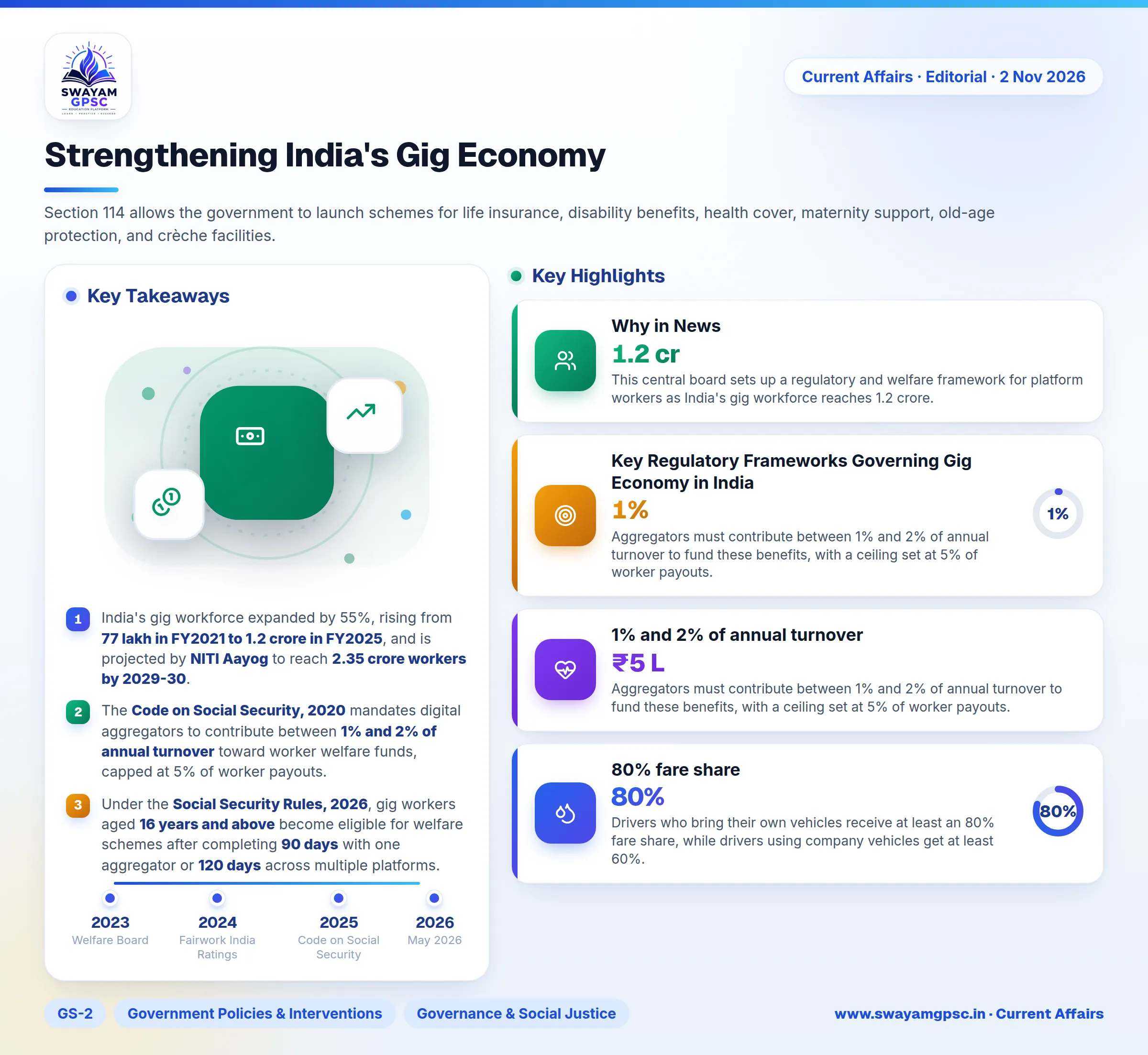
- India's gig workforce expanded by 55%, rising from 77 lakh in FY2021 to 1.2 crore in FY2025, and is projected by NITI Aayog to reach 2.35 crore workers by 2029-30.
- The Code on Social Security, 2020 mandates digital aggregators to contribute between 1% and 2% of annual turnover toward worker welfare funds, capped at 5% of worker payouts.
- Under the Social Security Rules, 2026, gig workers aged 16 years and above become eligible for welfare schemes after completing 90 days with one aggregator or 120 days across multiple platforms.
- A 2026 Janpahal-GigWA survey revealed severe welfare gaps, showing that 62.2% of gig workers lacked health insurance and 57% worked over 49 hours weekly.
- The Motor Vehicles Aggregator Guidelines, 2025 enforce minimum driver earnings of an 80% fare share for driver-owned vehicles along with ₹5 lakh health insurance cover.
Why in News
- The Union Ministry of Labour and Employment created the National Social Security Board for Gig and Platform Workers under the Code on Social Security, 2020.
- This central board sets up a regulatory and welfare framework for platform workers as India's gig workforce reaches 1.2 crore.
- The institutional setup aims to address major problems like uneven income, lack of social benefits, algorithmic management, and unsafe working conditions.
Key Regulatory Frameworks Governing Gig Economy in India
- The Code on Social Security, 2020 officially came into force in November 2025 to recognize gig workers, platform workers, and aggregators.
- Section 114 allows the government to launch schemes for life insurance, disability benefits, health cover, maternity support, old-age protection, and crèche facilities.
- Aggregators must contribute between 1% and 2% of annual turnover to fund these benefits, with a ceiling set at 5% of worker payouts.
- The Social Security (Central) Rules, 2026 took effect in May 2026 to detail how workers register and how aggregators report data.
- Under Rule 48, workers aged 16 years and above can register, get identity cards, and have their work data shared electronically by aggregators.
- Workers qualify for welfare schemes if they complete 90 days of work with one aggregator or 120 days across multiple aggregators in the previous financial year.
- Work days across different aggregators add up together, meaning workers do not need 120 separate calendar days to qualify.
- Rule 49 outlines the exact process for assessing aggregator payments and collecting interest when contributions arrive late.
- In October 2026, the Union government set up national social-security boards for unorganised workers and platform workers.
- The Board for Gig and Platform Workers has 22 members, including 5 representatives from aggregators and 5 from gig worker groups.
- This board brings together government officials, digital platforms, and worker representatives to manage welfare programs.
- The board recommends new welfare schemes, monitors program implementation, checks records, and reviews how money gets spent.
- While the board handles overall administration, individual workers receive benefits based on specific scheme eligibility rules.
- The Motor Vehicles Aggregator Guidelines, 2025 came out under Section 93 of the Motor Vehicles Act, 1988 to help states license delivery and ride services.
- These guidelines mandate ₹5 lakh health insurance, ₹10 lakh term insurance, driver training programs, and formal grievance mechanisms.
- Drivers who bring their own vehicles receive at least an 80% fare share, while drivers using company vehicles get at least 60%.
- Launched in August 2021, the e-Shram portal issues an Aadhaar-linked, 12-digit Universal Account Number (UAN) to identify unorganised workers.
- Union Budget 2025-26 announced plans to issue ID cards and extend Ayushman Bharat-PM-JAY healthcare to nearly 1 crore gig workers.
- The Rajasthan Platform Based Gig Workers Act, 2023 established a Welfare Board and tracks worker fee transactions using the CTIMS system.
- The Karnataka Platform Based Gig Workers Act, 2025 mandates fair contracts, algorithmic transparency, safety standards, and 14 days' notice before account deactivation.
- The Karnataka law also collects a 1-5% welfare fee on worker payouts, monitored through the PWFVS system.
- Bihar's Gig and Platform-Based Workers Legislation, 2025 offers ₹4 lakh assistance for accidental death on duty and 90-day maternity assistance at minimum wage rates.
Overview of the Gig Economy
- The gig economy relies on single tasks, short projects, or temporary assignments where workers earn money per completed job.
- This sector includes ride-hailing drivers, delivery agents, home maintenance workers, and freelance professionals.
- Section 2(35) of the Code on Social Security, 2020 defines gig workers as individuals earning outside traditional employer-employee relationships.
- Sections 2(60) and 2(61) of the same code provide distinct legal definitions for platform work and platform workers.
- Platform workers receive jobs through smartphone apps, while non-platform gig workers find short-term work through traditional personal arrangements.
- According to the Economic Survey 2025-26, India's gig workforce grew from 77 lakh in FY2021 to 1.2 crore in FY2025, marking a 55% expansion.
- A 2022 NITI Aayog report projects that India will have 2.35 crore gig workers by 2029-30, representing 4.1% of total nationwide employment.
- The 2022 NITI Aayog report also found that gig work comprises 47% medium-skilled jobs, 22% high-skilled roles, and 31% low-skilled tasks.
Contribution of the Gig Economy in India's Development Journey
- Gig platforms create vast job opportunities for workers with different skill levels across delivery, ride-hailing, home care, and freelancing.
- The Economic Survey 2025-26 records that the gig workforce expanded from 77 lakh in FY2021 to 1.2 crore in FY2025, growing by 55%.
- By matching workers with scattered customer demand, platforms lower job search costs and provide flexible source of extra earnings.
- Gig delivery networks allow small restaurants and cloud kitchens to expand customer reach without building expensive private delivery fleets.
- In May 2026, Swiggy reported partnering with over 2.7 lakh restaurants across more than 720 cities, boosting local business growth.
- Platform-based tutoring and beauty services offer flexible schedules that help women earn income alongside household responsibilities.
- Urban Company's March 2026 Udaan report showed support for 1,800 women professionals, including vehicle training for 1,100 and vehicle purchases by 700 women.
- The March 2026 report showed that women professionals with their own two-wheelers earned 14% higher average net monthly income.
- Platforms help professionalize local trades by offering structured technical training, quality checks, and recognized credentials.
- In February 2026, Urban Company operated a training network with over 300 full-time trainers and issued Skill India-certified digital credentials with NSDC.
- Experienced gig workers can move up into trainer roles, proving that platform work can build long-term career skills.
- Online freelance platforms allow Indian programmers, designers, and consultants to sell services to international clients without moving abroad.
- A 2021 Oxford-ILO Online Labour Observatory report showed that nearly one in three remote platform workers in its global study lived in India.
- Cross-border digital services let local talent earn foreign currency and build global professional networks from home.
- App-based taxi and auto services handle first-mile and last-mile travel, helping people reach transit hubs and workplaces conveniently.
- In May 2025, Uber integrated with ONDC to offer Delhi Metro ticket bookings using UPI payments directly inside its application.
- Uber recorded 11.6 billion kilometres of travel across India in 2025, showing how app logistics link with Digital Public Infrastructure (DPI).
- Delivery fleets speed up electric vehicle adoption by creating steady demand for EV leasing, battery swapping, and charging stations.
- An April 2026 shareholder letter from Eternal showed its active EV delivery fleet grew from 52,000 in March 2025 to over 1 lakh in March 2026.
- Eternal reported that nearly 25% of its monthly delivery partners in the Delhi NCR region used electric vehicles by March 2026.
Challenges
- Gig workers face unpredictable task-based pay without guaranteed minimum hours, while paying for their own fuel, vehicle maintenance, and phone data.
- An IDinsight study of 2,547 delivery drivers showed that vehicle and operational costs ate up 32% of earnings, leaving ₹18,761 in average monthly net income.
- Sudden reductions in delivery bonuses or customer orders strain family finances, especially for workers relying on one main app.
- Algorithms automatically control job distribution, bonus payments, customer ratings, and account access, putting workers at a major information disadvantage.
- Workers rarely get clear explanations when app bookings drop or accounts face sudden suspension.
- The Fairwork India Ratings 2024 evaluated 11 platforms and found that only 7 provided clear appeal channels for disciplinary actions.
- Formal laws and insurance policies do not always result in real medical support or fast claim settlements for injured workers.
- A September 2026 Janpahal-Gig Workers Association survey of 1,000 workers across 10 cities revealed that 62.2% lacked health insurance and 44.2% lacked accident cover.
- The September 2026 survey found that over 80% of workers who tried filing an insurance claim found the process extremely difficult.
- Low per-task payouts force workers to put in long daily shifts, increasing physical fatigue and road accident risks.
- The 2026 Janpahal-GigWA survey showed that over 57% of workers worked more than 49 hours weekly, while 23.4% worked over 70 hours.
- The 2026 survey also noted that 59.3% of platform workers received no safety resources or training from their platforms.
- Outdoor delivery workers frequently lack access to basic working facilities like clean drinking water, shaded rest areas, and public toilets.
- A July 2026 HeatWatch report on 100 women platform workers in Delhi-NCR revealed that 86% suffered heat-related health issues and 71% saw earnings fall in summer.
- Extreme summer heat lowers worker productivity and cuts daily income right when workers need to stop for medical rest.
- Irregular earnings and lack of property collateral prevent platform workers from qualifying for low-cost bank loans.
- An August 2026 ILO-NCAER brief warned against platforms controlling job distribution, daily payouts, credit financing, and insurance together.
- When work assignments drop while loan repayments stay fixed, workers risk falling into deep debt cycles.
- Scattered workplaces make it difficult for gig workers to unionize and negotiate effectively for better rates and working conditions.
- The Fairwork India Ratings 2024 gave zero points for fair representation to all 11 assessed platforms for failing to recognize worker associations.
- Without formal bargaining channels, workers must rely on individual complaints or public strikes to address workplace grievances.
Way Forward
- India should establish minimum net-earning rules that account for mandatory expenses like fuel, vehicle repairs, and phone data.
- Apps must show clear breakdowns of base pay, bonus incentives, fee deductions, net earnings, waiting pay, and cancellation fees.
- Labor authorities must classify workers based on actual managerial control rather than formal contracts, following ILO's 2026 platform-work standard.
- The government should build a portable social-security system that links worker accounts across different states and digital platforms.
- Aggregators should transfer welfare contributions using standard APIs, giving workers clear multilingual statements showing their fund balances.
- Social security rules must support migrant workers, mothers, and seasonal workers with easy registration and fixed claim resolution deadlines.
- Platforms should give clear written reasons for task allocations, rating changes, incentive calculations, and payment deductions.
- Platforms must establish mandatory human review options before deactivating worker accounts, letting workers submit counter-evidence.
- A secure portable work-history profile could help workers carry verified experience metrics across competing apps.
- City municipal bodies and aggregators should build physical rest hubs with drinking water, clean toilets, shade, and phone chargers.
- Extreme heat warnings must trigger mandatory paid rest breaks, flexible delivery targets, and protection against cancellation penalties.
- India can utilize findings from the ILO's 'Safe in India' project to build standardized workplace safety practices.
- Regulated banks should offer vehicle and equipment loans by checking worker earnings data with user consent.
- Loan products should provide clear interest rates, flexible repayment periods during income dips, and freedom to select outside lenders.
- The August 2026 ILO-NCAER brief recommends creating regulatory sandboxes to test financial products without tying workers to single platforms.
- The NSDC, Sector Skill Councils, and apps should build Recognition of Prior Learning programs with portable digital skill certificates.
- Skill training should help delivery workers move into EV servicing, appliance repair, logistics supervision, and office management.
- Freelance training modules must cover international contract terms, export payment setups, cyber safety, and responsible AI tools.
- Inclusion programs should offer affordable vehicle leasing, basic digital literacy, and safe transit facilities for female workers.
- Women workers need access to community childcare centers, flexible shift choices, maternity support, and strong protection against harassment.
- Apps should provide special equipment and flexible task categories suited for workers with physical disabilities.
- India should build formal discussion forums between worker groups, digital platforms, and state governments to negotiate pay and safety rules.
- Independent ombudsmen should resolve worker complaints quickly without exposing workers to account suspensions or retaliation.
- The government should support worker-owned platform cooperatives by offering technology access, business management training, and low-cost credit.
Conclusion
- India must balance technological platform growth with robust, mandatory social protection for every gig worker.
- Operationalizing portable welfare accounts, ensuring transparent algorithms, and setting up climate-resilient rest infrastructure are essential steps.
- Enforcing fair net-earning standards and worker representation will convert temporary gig work into a stable pathway for sustainable economic growth.