Air Pollution Control in India
#GS-2 #Governance & Social Justice #Good Governance #GS-3 #Environment #Pollution #Sustainable Development #Government Policies & Interventions #Environmental Pollution & Degradation
Key takeaways
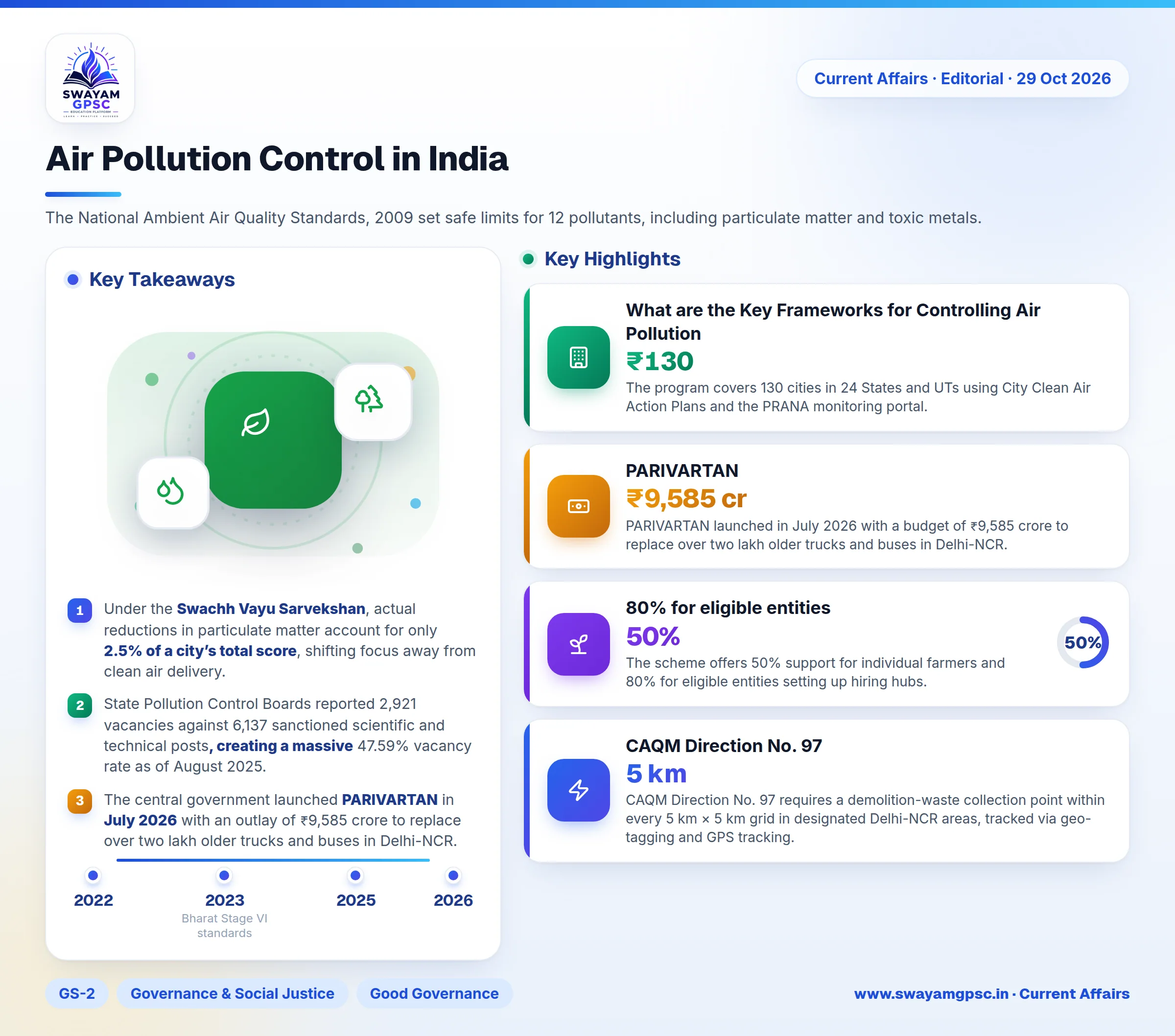
- Under the Swachh Vayu Sarvekshan, actual reductions in particulate matter account for only 2.5% of a city’s total score, shifting focus away from clean air delivery.
- State Pollution Control Boards reported 2,921 vacancies against 6,137 sanctioned scientific and technical posts, creating a massive 47.59% vacancy rate as of August 2025.
- The central government launched PARIVARTAN in July 2026 with an outlay of ₹9,585 crore to replace over two lakh older trucks and buses in Delhi-NCR.
- A 2025 study of Surat’s emissions market proved that trading systems achieved 20-30% lower particulate emissions while cutting abatement costs by 11%.
What are the Key Frameworks for Controlling Air Pollution in India?
- The Air (Prevention and Control of Pollution) Act, 1981 works alongside the Environment (Protection) Act, 1986 to form the main legal basis for managing emissions.
- The CPCB, State Pollution Control Boards, and Pollution Control Committees handle rule-making and enforcement within their regions.
- Industrial emission limits are set through formal operating conditions, turning pollution control into a mandatory duty rather than an optional choice.
- The National Ambient Air Quality Standards, 2009 set safe limits for 12 pollutants, including particulate matter and toxic metals.
- The annual limits for PM₂.₅ and PM₁₀ are 40 and 60 µg/m³ respectively.
- The National Air Quality Monitoring Programme (NAMP) and Continuous Ambient Air Quality Monitoring Stations tracked pollution across 1,646 stations across 603 cities by March 2026.
- The National AQI sorts health risks into six categories using eight pollutants, while the SAMEER app shares live data and takes citizen complaints.
- Launched in 2019, the National Clean Air Programme (NCAP) coordinates city and state actions against transport, industrial, and dust pollution.
- The program covers 130 cities in 24 States and UTs using City Clean Air Action Plans and the PRANA monitoring portal.
- Official data shows 108 cities recorded lower annual PM₁₀ concentrations in 2025-26 than in 2017-18, though only 14 reached the annual standard.
- The Commission for Air Quality Management (CAQM) Act, 2021 manages regional airshed pollution across the NCR and adjoining areas.
- The Graded Response Action Plan scales up restrictions through four stages: Stage I at AQI 201-300, Stage II at 301-400, Stage III at 401-450, and Stage IV above 450.
- Nationwide Bharat Stage VI standards started in 2020 for new vehicles, while Real Driving Emission conformity requirements began in 2023.
- PARIVARTAN launched in July 2026 with a budget of ₹9,585 crore to replace over two lakh older trucks and buses in Delhi-NCR.
- Online Continuous Emission Monitoring Systems (OCEMS) send live factory data to regulators, and the CPCB mandates these systems across 17 highly polluting industry categories.
- By July 2026, 11,108 industries in NCAP cities shifted to cleaner fuels like natural gas, LPG, and biogas.
- The Crop Residue Management scheme has run since 2018-19 to stop open burning by funding machinery and Custom Hiring Centres.
- The scheme offers 50% support for individual farmers and 80% for eligible entities setting up hiring hubs.
- The Environment (Construction and Demolition) Waste Management Rules, 2025 took effect in April 2026 to improve debris recycling and Extended Producer Responsibility.
- CAQM Direction No. 97 requires a demolition-waste collection point within every 5 km × 5 km grid in designated Delhi-NCR areas, tracked via geo-tagging and GPS tracking.
What are the Key Technological Developments Related to Air Pollution Control in India?
- In October 2026, IITM opened the Integrated Atmospheric Chemistry and Aerosol Toxicity Analysis Laboratory (AATAL) in Delhi.
- AATAL works with AIRWISE - Air Quality Warning and Integrated Decision Support System for Emissions to give 72-hour forecasts at a 400-metre resolution.
- CSIR-National Physical Laboratory (NPL) created an indigenous high-volume PM₁ impactor sampler that filters particles measuring one micrometre or less at 1.13 cubic metres per minute.
- In October 2026, CAQM ordered Pan-Tilt-Zoom (PTZ) camera requirements for polluting industries in the NCR by 30th November 2026 to monitor stacks and fuel points.
- Government and startup talks in October 2026 prioritized AI-based emission-violation detection and tamper-proof monitoring systems.
- The Indian Navy found that Retrofit Emission Control Devices (RECDs) made by Chakr Innovations cut hydrocarbons, carbon monoxide, and particulate matter by roughly 70%.
- In October 2026, the NHAI placed RECDs on 25 generator sets along an 8.7-kilometre section of the Dwarka Expressway.
- ICAR-IARI's Pusa Decomposer uses seven fungal species to rot crop stubble in 20-25 days, and Agrinnovate India licensed it to Star Fertilizer & Pesticide in December 2025.
- Studies show that dust suppressants sprayed on roads reduce dust levels by roughly 30% for up to six hours after application.
- CSIR-NIIST built a modular gas biotrickling filter using materials like charcoal, compost and agricultural waste to clean up volatile organic compounds (VOCs).
- Mumbai-based startup Praan displayed its MK II filterless electrostatic purifier on NITI Aayog’s Frontier Tech platform in July 2026, handling an airflow of 1,300 cubic feet per minute.
What are the Key Issues Associated with Air Pollution Control in India?
- State Pollution Control Boards faced 2,921 vacancies against 6,137 sanctioned scientific and technical posts, leaving a vacancy rate of 47.59% as of August 2025.
- A World Bank report from June 2026 noted that over half of India’s PM₂.₅ forms secondarily through chemical reactions involving gases like ammonia and sulfur dioxide.
- Cities used only 70.5% of available NCAP grants, leaving about 29.5% unutilized on the PRANA portal as of July 2026.
- CAQM proposed 46 additional continuous monitoring stations across Delhi-NCR in May 2026 to fix widespread data gaps.
- A September 2026 CAQM review found severe camera failures in Haryana, with working webfeeds at only 4 of 168 sites in Faridabad, 6 of 691 in Gurugram North, and 5 of 484 in Gurugram South.
- In Punjab, wheat stubble fires rose to 8,986 incidents between 1st April and 14th May 2026, compared to 6,474 during the same period in 2025.
- A 2025 parliamentary report revealed that Delhi's trial smog tower cut pollution by only ~20% within a 200-400 meter radius, raising questions about its high cost and long-term utility.
What Measures are Required to Control Air Pollution Effectively in India?
- India must set up interstate clean-air compacts featuring five-year emission targets and joint funding for shared airsheds.
- State governments should build dedicated environmental engineering cadres and use independent third-party audits to stop false reporting.
- A Gujarat randomised evaluation proved that independent audits made inspectors 80% less likely to submit false pollution readings.
- Industrial clusters should adopt particulate-emissions trading systems, as a 2025 study of Surat’s emissions market showed 20-30% lower particulate emissions and 11% lower costs.
- City transit plans must prioritize electric buses, better walking paths, and remote roadside vehicle screening.
- An ICCT-led Delhi-Gurugram campaign tested about 112,000 vehicles between December 2022 and April 2023 to prove the value of real-world on-road emission checks.
- Agricultural policies must offer guaranteed purchase agreements for biomass and provide easy access to machinery to stop stubble burning.