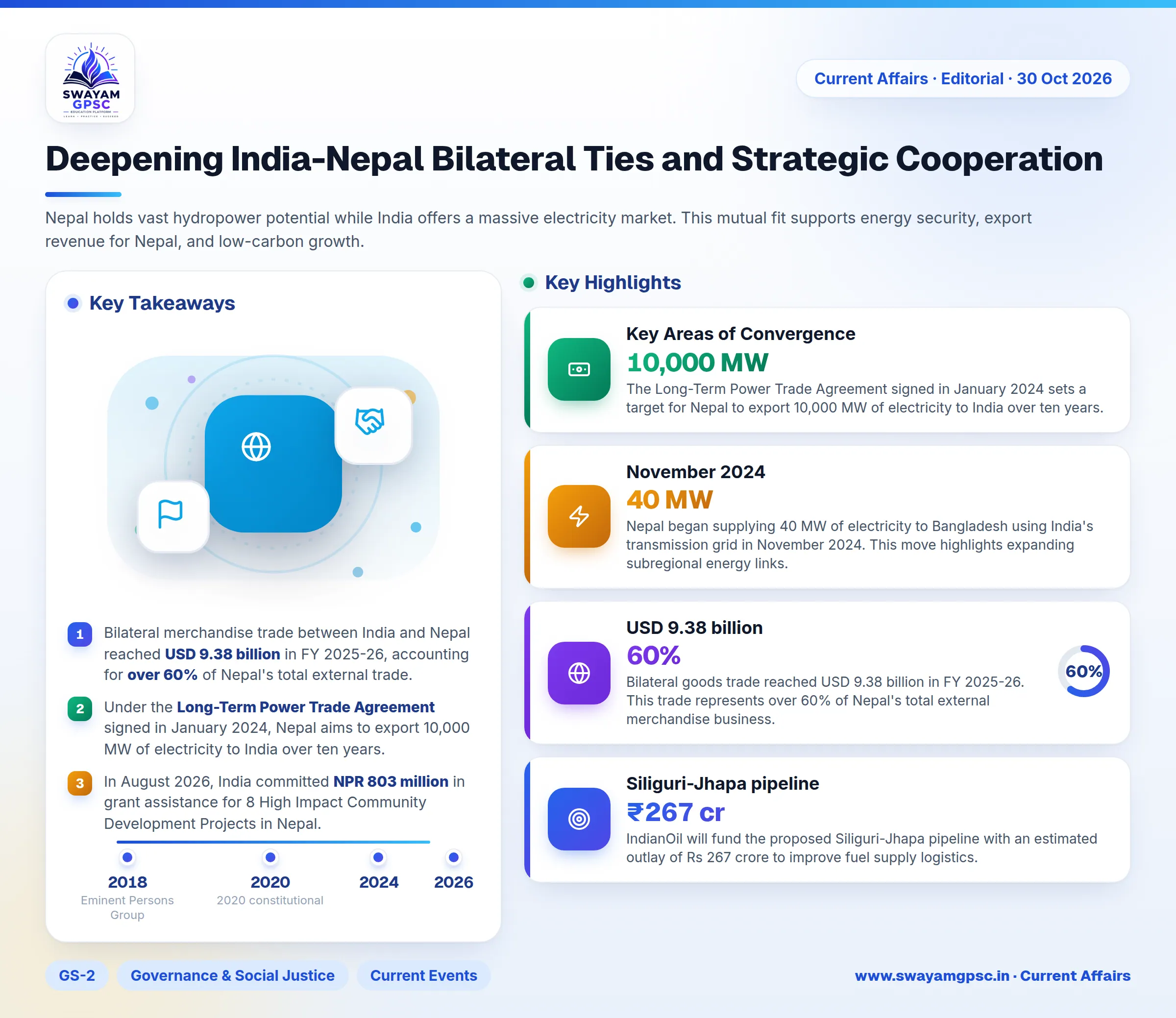
Deepening India-Nepal Bilateral Ties and Strategic Cooperation
#GS-2 #Governance & Social Justice #Current Events #National #International
Key takeaways
- Bilateral merchandise trade between India and Nepal reached USD 9.38 billion in FY 2025-26, accounting for over 60% of Nepal's total external trade.
- Under the Long-Term Power Trade Agreement signed in January 2024, Nepal aims to export 10,000 MW of electricity to India over ten years.
- In August 2026, India committed NPR 803 million in grant assistance for 8 High Impact Community Development Projects in Nepal.
- Nepal registered a large merchandise trade deficit of NPR 951 billion with India during FY 2025-26.
- The proposed Siliguri-Jhapa petroleum pipeline will be constructed with an estimated investment of Rs 267 crore funded by IndianOil.
Why in News
- Shared problems like drug trafficking, cybercrime, terrorism, and natural disasters affect both India and Nepal. These common risks show why stronger cooperation between the two neighbors is necessary.
- Open borders, shared cultural heritage, and deep economic dependence form the core of India-Nepal connections. However, boundary disputes, trade imbalances, and strategic sensitivities continue to create friction.
- India and Nepal must expand cooperation in energy, transport, trade, and disaster management. Active dialogue remains essential to settle long-standing differences effectively.
Key Areas of Convergence
- Nepal holds vast hydropower potential while India offers a massive electricity market. This mutual fit supports energy security, export revenue for Nepal, and low-carbon growth.
- The Long-Term Power Trade Agreement signed in January 2024 sets a target for Nepal to export 10,000 MW of electricity to India over ten years.
- Nepal began supplying 40 MW of electricity to Bangladesh using India's transmission grid in November 2024. This move highlights expanding subregional energy links.
- Bilateral goods trade reached USD 9.38 billion in FY 2025-26. This trade represents over 60% of Nepal's total external merchandise business.
- Transport connections are expanding through rail links like Jaynagar-Bijalpura and Jogbani-Nepal Customs Yard, along with integrated check posts at Birgunj, Biratnagar, and Nepalgunj.
- IndianOil will fund the proposed Siliguri-Jhapa pipeline with an estimated outlay of Rs 267 crore to improve fuel supply logistics.
- Military forces from both nations train together during Exercise SURYAKIRAN, focusing on mountain counterterrorism, medical aid, and drone technology.
- In June 2026, both sides finalized internal checks for the Mutual Legal Assistance Agreement in Criminal Matters to fight cross-border crime together.
- A digital payment linkage launched in June 2026 connects India's UPI with Nepal's National Payments Interface (NPI) for instant cross-border transfers.
- Digital India BHASHINI partnered with Kathmandu University to create a voice-based language translation system for regional dialects.
- In August 2026, India agreed to grant NPR 803 million to finance 8 High Impact Community Development Projects in Nepal.
- These funded initiatives include upgrading the B.P. Koirala Institute of Health Sciences in Dharan and building local farm markets in Bhojpur.
- India provides Rs 900 crore in grant support for river training and flood control along the Kamala, Bagmati, and Lalbakeya rivers.
- Shared Hindu and Buddhist heritage connects spiritual hubs like Janakpur-Ayodhya and Lumbini-Bodh Gaya-Sarnath. India also handed over 12 completed cultural projects in June 2026 following post-earthquake rebuilding efforts.
Key Areas of Divergence
- Disagreements persist over regions such as Kalapani-Limpiyadhura-Lipulekh and Susta due to differing mapping histories and claims.
- Nepal added these disputed northwestern territories into its official map through a 2020 constitutional amendment, which India rejected.
- Fresh friction occurred in May 2026 over pilgrim travel to Kailash Mansarovar via Lipulekh, with India asserting its historical usage rights.
- Nepal frequently requests updates to the 1950 Treaty of Peace and Friendship to reflect modern sovereign equality.
- Although an Eminent Persons Group finalized a review report in 2018, its recommendations remain unimplemented.
- Nepal signed a Framework for Belt and Road Cooperation with China in December 2024, expanding on its 2017 BRI memorandum. This growing partnership raises strategic security concerns in New Delhi.
- Nepal ran a merchandise trade deficit of NPR 951 billion with India in FY 2025-26, driving requests for easier Indian market access.
- Delays in receiving BIS certifications and strict rules-of-origin checks create non-tariff trade barriers for Nepali goods.
- The major Pancheshwar Multipurpose Project, linked to the 1996 Mahakali Treaty, remains stalled due to funding and water benefit disputes.
- Nepali hydro developers face delays in getting export permits from India for projects that involve Chinese investments or contractors.
- India's Agnipath scheme changed Gorkha military recruitment into a four-year service model, causing concerns in Nepal over job security and pensions.
- Around 90% of international flights entering Nepal rely on the single Simara entry point. India has not cleared additional routes via Janakpur, Bhairahawa, or Nepalgunj due to airspace security policies.
Way Forward
- Establish a structured two-track dialogue using Foreign Secretary meetings for boundary talks and the Boundary Working Group (BWG) for technical mapping.
- Conduct a clause-by-clause review of the 1950 Treaty of Peace and Friendship to address modern needs fairly.
- Simplify border trade by adopting digital origin certificates, faster customs clearances, and mutual testing standards.
- Build robust supply partnerships in key sectors such as tea, cardamom, textiles, and herbal products.
- Create a joint project portal to track infrastructure delays, property acquisition, and funding needs in real time.
- Publish clear step-by-step rules and timelines for approving power export requests from Nepali projects.
- Adopt modern scientific formulas to share costs and benefits fairly across major river basin projects.
- Link Nepal's BIPAD emergency platform with India's FloodWatch system to share live flood alerts with local towns.
- Enhance cross-border security against smuggling and fraud while maintaining smooth travel for ordinary citizens.
- Hold focused bilateral discussions to address Nepal's concerns regarding the Agnipath scheme for Gorkha soldiers.
- Expand youth entrepreneurship networks like the IN-SPAN Network, which inducted 25 Nepali startups in June 2026.
Conclusion
- India and Nepal must shift from historic cultural claims toward structured, equal partnerships. Implementing the HIT framework (Highways, Infoways, Transways) will help secure long-term economic and regional safety for both nations.