Transforming India's Urban Landscape and National Urbanisation Policy
#GS-1 #Indian Society #Urbanization #Population and Associated Issues #Poverty and Developmental Issues #GS-2 #Governance & Social Justice #Good Governance #GS-3 #Infrastructure #Environment #Climate Change
Key takeaways
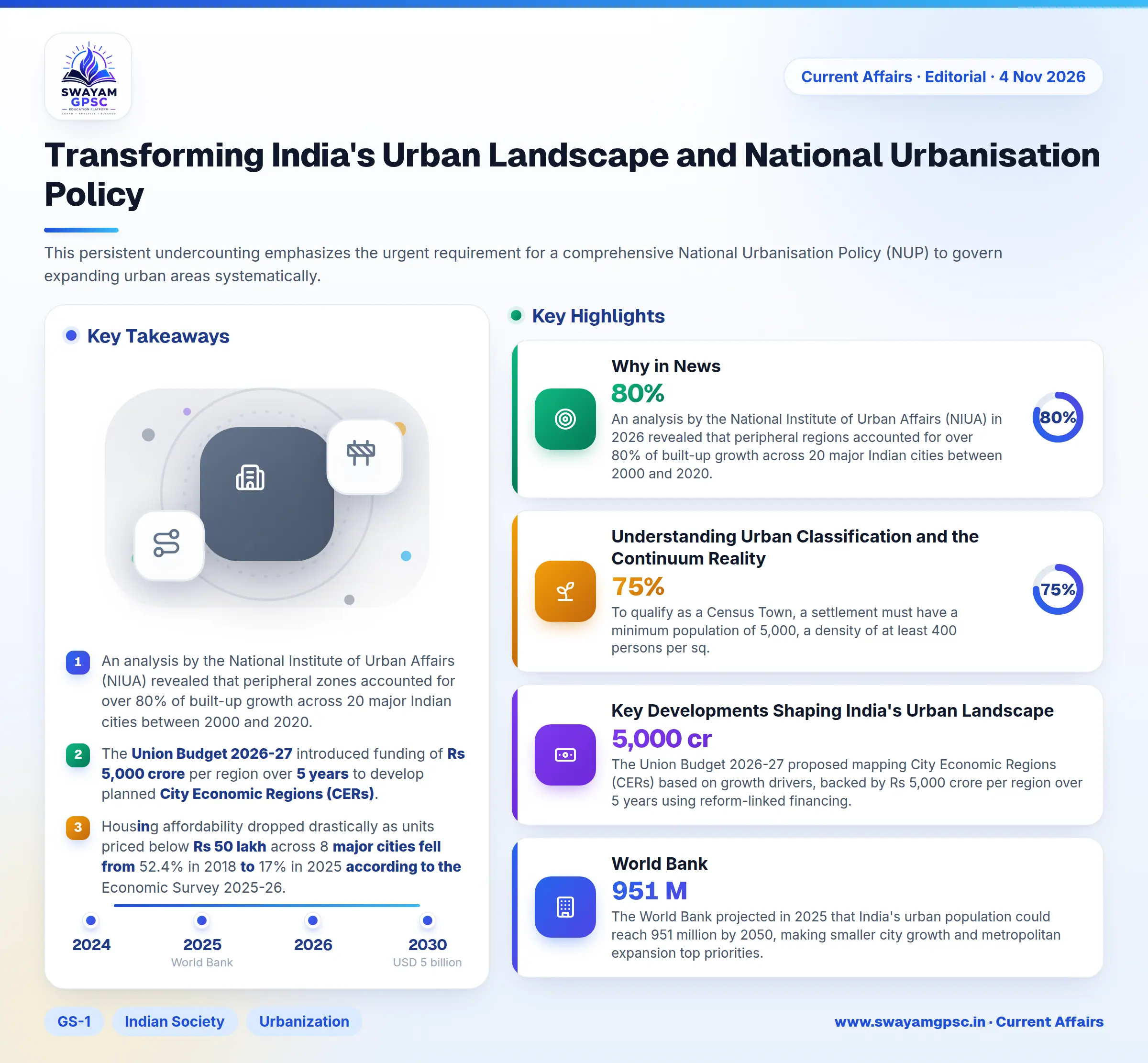
- An analysis by the National Institute of Urban Affairs (NIUA) revealed that peripheral zones accounted for over 80% of built-up growth across 20 major Indian cities between 2000 and 2020.
- The Union Budget 2026-27 introduced funding of Rs 5,000 crore per region over 5 years to develop planned City Economic Regions (CERs).
- Housing affordability dropped drastically as units priced below Rs 50 lakh across 8 major cities fell from 52.4% in 2018 to 17% in 2025 according to the Economic Survey 2025-26.
- Municipal waste processing achieved major progress under SBM-U 2.0, rising from 16% in 2014 to 81% in 2026 while reclaiming 9,000 acres of land.
- The World Bank projected that India's urban population will reach 951 million by 2050, requiring targeted investments in transit and municipal infrastructure.
Why in News
- Rapid urban expansion across India is moving far beyond official city borders into surrounding peri-urban zones.
- This fast expansion creates a growing gap between regional economic growth and administrative governance.
- An analysis by the National Institute of Urban Affairs (NIUA) in 2026 revealed that peripheral regions accounted for over 80% of built-up growth across 20 major Indian cities between 2000 and 2020.
- India's upcoming Census will retain the 2011 urban classification criteria after a 16-year gap, which could lead to significant undercounting of urban population levels.
- This persistent undercounting emphasizes the urgent requirement for a comprehensive National Urbanisation Policy (NUP) to govern expanding urban areas systematically.
Understanding Urban Classification and the Continuum Reality
- The proposed National Urbanisation Policy (NUP) provides a single framework to govern rapidly growing urban and peri-urban areas across the country.
- It focuses on moving away from rigid rural-urban divisions toward managing functional urban regions by linking land use, infrastructure, economic activities, and environmental goals.
- Statutory Towns are settlements formally recognized by state governments under municipal legislation, including Municipal Corporations, Municipalities, and Nagar Panchayats, regardless of population size.
- Census Towns are settlements governed as rural Gram Panchayats that meet three specific demographic criteria.
- To qualify as a Census Town, a settlement must have a minimum population of 5,000, a density of at least 400 persons per sq. km, and over 75% of its male main workforce engaged in non-agricultural work.
Key Developments Shaping India's Urban Landscape
- Urban growth policy now recognizes city-regions, peri-urban spaces, and Tier-II and Tier-III centers as connected economic spaces rather than isolated entities.
- The Union Budget 2026-27 proposed mapping City Economic Regions (CERs) based on growth drivers, backed by Rs 5,000 crore per region over 5 years using reform-linked financing.
- The World Bank projected in 2025 that India's urban population could reach 951 million by 2050, making smaller city growth and metropolitan expansion top priorities.
- Urban transit is moving toward regional commuting systems, multimodal integration, and transit-oriented development (TOD) projects.
- The 82.15-km Delhi-Ghaziabad-Meerut Namo Bharat corridor became fully operational in February 2026, incorporating 23 km of shared infrastructure with the Meerut Metro.
- A parliamentary report in August 2026 confirmed that the corridor connects with 3 metro lines, 2 railway stations, and 4 bus terminals, alongside notified TOD zones in Ghaziabad and Meerut.
- Urban housing policies now link shelter delivery with targeted support and direct property ownership for women.
- An update from MoHUA in October 2026 showed over 1.27 crore houses sanctioned under PMAY-U and PMAY-U 2.0, with 1.01 crore units already completed.
- Sanctions under PMAY-U 2.0 reached 20.80 lakh, with 97% registered under women's names or joint ownership.
- Infrastructure focus is shifting from basic water delivery to comprehensive sewerage networks, septage treatment, and recycled water reuse.
- A government review in 2026 recorded 2.53 crore urban tap connections under AMRUT and AMRUT 2.0, backed by Rs 2.79 lakh crore in approved projects.
- To promote a circular water economy, authorities established Water Resource Recovery Cells across 25 states and Union Territories under the Jal Hi AMRIT program.
- Urban sanitation policy now covers complete solid-waste processing, source segregation, and old dumpsite clearing.
- At the May 2026 review of SBM-U 2.0, MoHUA stated that municipal waste processing jumped from 16% in 2014 to 81% in 2026.
- The review also confirmed the clearing of 65% of legacy waste out of 26 crore tonnes, reclaiming around 9,000 acres of land.
- Cities are deploying Integrated Command and Control Centres (ICCCs), SCADA systems, sensor networks, and intelligent transport tools to manage daily operations.
- A parliamentary reply in July 2026 noted that ICCCs are active across all 100 Smart Cities, monitoring over 17,000 km of water pipelines alongside RFID-tracked waste vehicles.
- Urban project financing now combines state aid with municipal bonds, bank loans, public-private partnerships, and credit enhancements.
- Operational guidelines for the Urban Challenge Fund in April 2026 offered Rs 1 lakh crore in central assistance, capping aid at 25% of project costs while requiring 50% from market borrowings.
- Municipal bond activity expanded geographically, with SEBI logging Rs 50-crore bond issues by Agra, Prayagraj, and Varanasi in 2025.
- City planning is actively integrating heat action plans, flood mitigation, and general climate resilience into project designs.
- A July 2026 parliamentary report listed active Heat Action Plans in 64 cities and pilot heat assessments in 12 urban centers including Bengaluru, Bhopal, Jodhpur, and Visakhapatnam.
- By August 2026, central authorities approved urban flood management programs covering 7 cities under Phase I and 11 cities under Phase II.
Successful Urban Transformation Models in India
- Indore links waste segregation directly with organic processing using its 550-tonne-per-day GOBARdhan Bio-CNG facility built through a public-private partnership.
- This Bio-CNG plant generates clean fuel for local city buses while supplying organic manure for farming.
- Surat operates 4 tertiary treatment facilities with a combined capacity of 116 million litres per day to supply recycled wastewater for industrial and municipal tasks.
- A September 2026 official review noted that Surat's circular water framework greatly reduces municipal demand for fresh water.
- Launched in 2023, the Kochi Water Metro uses electric-hybrid boats to connect island populations to the mainland.
- Official records showed 79.3 lakh total passenger trips on the Kochi Water Metro by October 2026.
- Pune introduced street design rules that prioritize space for pedestrians, non-motorized transport, and cyclists over private cars.
- Data from the ITDP highlights that Pune transformed over 100 km of city roads, including major stretches like JM Road and DP Road.
Challenges Facing India's Urban Landscape
- Unplanned peripheral growth outpaces civic master planning, leading to real estate development without basic roads, water, or drainage systems.
- An August 2026 parliamentary report revealed that only 292 out of 461 AMRUT cities finalized GIS master plans, while only 93 out of 875 Class-II towns completed theirs.
- Rising real estate prices and limited public housing options push lower-income households away from central employment districts.
- The Economic Survey 2025-26 cited Knight Frank-NAREDCO research showing that housing units priced below Rs 50 lakh across 8 top cities dropped from 52.4% in 2018 to 17% in 2025.
- Inadequate public bus fleets and poor last-mile transit force citizens to rely on personal vehicles, increasing traffic congestion.
- The Economic Survey 2025-26 reported that urban India operates roughly 47,650 buses, with nearly 61% concentrated in just 9 megacities.
- Conflicting mandates among municipal bodies, development agencies, and state water boards cause severe accountability gaps.
- An urban governance study by NITI Aayog in April 2026 reviewed CAG audits across 18 states and found that cities hold full control over only 4 out of 18 municipal duties on average.
- Cities struggle with weak internal revenue collection, low property tax generation, and heavy reliance on state government transfers.
- The 16th Finance Commission noted that major municipal corporations covering 50% of urban residents generated almost 80% of all local tax revenue.
- The RBI Municipal Finances Report 2024 confirmed that local tax receipts fail to cover operational expenditures in most surveyed cities.
- Expanding water distribution networks does not guarantee reliable supply, clean drinking water, or proper sewage processing.
- A 2025 World Bank-ADB study recorded non-revenue water loss rates of 50% in Ludhiana, 47% in Shimla, and 40% in Chennai, adding that only 56% of urban Indians had safe sanitation in 2024.
- Severe air pollution damages public health and raises medical expenses for urban households across major metropolitan zones.
- A CREA analysis in January 2026 evaluated 2025 air data and revealed that 190 out of 229 monitored cities breached safe national PM10 levels, with Delhi averaging 197 ug/m3 against the 60 ug/m3 standard.
- Unplanned concrete construction and loss of natural water bodies worsen local heat conditions and intensify severe flood hazards.
- A 2025 World Bank urban report noted that urban heat island effects elevate inner-city temperatures by 3 to 4 degrees Celsius over surrounding areas.
- The report estimated that proactive flood adaptation measures could prevent annual urban flood damage worth USD 5 billion by 2030.
Way Forward
- State governments should issue building permits only after independent audits verify adequate local water, power, transit, and drainage systems.
- Cities should test community land trusts near employment zones to separate collective land ownership from housing units, keeping housing affordable for lower-income groups.
- Authorities should measure transit investments by how easily residents reach job centers, schools, and hospitals rather than just tracking road length.
- State administrations must mandate clear service agreements that define exact duties, maintenance schedules, and public complaint channels for all urban utility agencies.
- Every major infrastructure build requires a dedicated lifetime maintenance fund established prior to official project launching.
- Municipalities ought to draw up neighborhood water budgets to balance localized water consumption with rainwater harvest, groundwater recharge, and recycled water use.
- Clean air funds must focus direct spending on heavily polluted zones, busy transit routes, and industrial pockets rather than broad city averages.
- Municipal bodies should enforce strict environmental criteria on new construction projects, requiring dedicated rainwater storage and urban green cover to control heat and flooding.