India's Renewable Energy Transition: Progress, Challenges, and Road Ahead
#GS-3 #Economy #Infrastructure #Environment #Climate Change #Growth & Development #Renewable Energy #Environmental Pollution & Degradation
Key takeaways
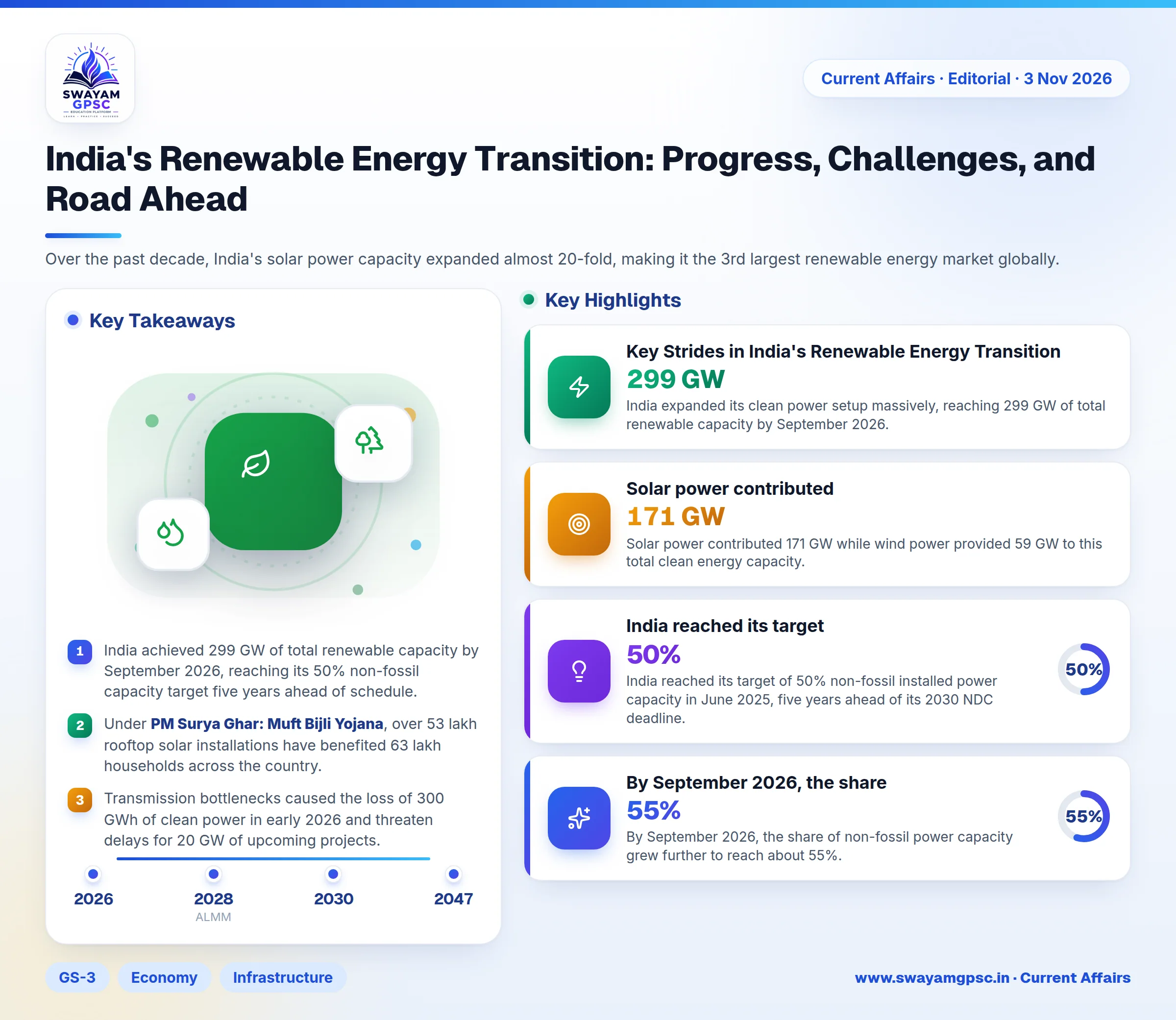
- India achieved 299 GW of total renewable capacity by September 2026, reaching its 50% non-fossil capacity target five years ahead of schedule.
- Under PM Surya Ghar: Muft Bijli Yojana, over 53 lakh rooftop solar installations have benefited 63 lakh households across the country.
- Transmission bottlenecks caused the loss of 300 GWh of clean power in early 2026 and threaten delays for 20 GW of upcoming projects.
- To handle solar and wind power fluctuations, India requires 47.24 GW of battery storage and 26.69 GW of pumped hydro storage by 2031-32.
- Solar panel waste is projected to reach 11.2 million tonnes by 2047, highlighting the urgent need for a viable recycling ecosystem.
Why in News
- India's growing economy and rising power demands are driving a fast shift toward clean energy.
- The country has become a global model for installing renewable power and building strong electricity grids.
- The Prime Minister recently noted that clean energy is the true foundation of future national energy security.
- Over the past decade, India's solar power capacity expanded almost 20-fold, making it the 3rd largest renewable energy market globally.
- However, severe power grid bottlenecks, funding risks, and supply issues still slow down smooth operations.
- To keep up green growth, India must urgently expand energy storage systems and update local regulations.
Key Strides in India's Renewable Energy Transition
- India expanded its clean power setup massively, reaching 299 GW of total renewable capacity by September 2026.
- Solar power contributed 171 GW while wind power provided 59 GW to this total clean energy capacity.
- India reached its target of 50% non-fossil installed power capacity in June 2025, five years ahead of its 2030 NDC deadline.
- By September 2026, the share of non-fossil power capacity grew further to reach about 55%.
- This progress shows a major structural shift, where non-fossil sources include nuclear energy alongside regular renewables.
- Under PM Surya Ghar: Muft Bijli Yojana, rooftop solar adoption moved beyond big power companies directly to ordinary homes.
- By October 2026, about 53 lakh rooftop solar systems were installed, helping 63 lakh households cut power bills.
- Through financial aid, the scheme turns electricity users into active power producers who can sell extra power back.
- Under PM-KUSUM, solar power reached farms through standalone solar pumps and solar-powered grid pumps.
- By October 2026, farmers installed nearly 12 lakh standalone solar pumps and solarised 17 lakh grid pumps.
- This scheme helped over 30 lakh farmers reduce their dependency on costly diesel pumps.
- India expanded its solar manufacturing base, achieving 192 GW of module capacity and 30 GW of cell capacity by June 2026.
- Government policies like Production Linked Incentives (PLI) and the Approved List of Models and Manufacturers (ALMM) boosted local production.
- In March 2026, MNRE added solar ingots and wafers to the ALMM framework, with rules applying from June 2028.
- These policy moves help build raw component manufacturing inside India rather than relying only on final module assembly.
- India added 2.67 GW/7.79 GWh of Battery Energy Storage Systems and 12,139 circuit kilometres of transmission lines during FY2025-26.
- Projects like the Green Energy Corridor and better weather forecasting help the grid manage shifting clean energy supplies smoothly.
- These upgrades keep the power grid stable and allow green power to reach high-demand areas reliably.
- Under the National Green Hydrogen Mission, clean electricity is being linked to heavy industries like fertilisers, refining, and shipping.
- By October 2026, Indian firms signed agreements for 5.56 lakh tonnes of green hydrogen yearly, with 70% targeted for export.
- As a key example, ACME signed a major green ammonia export deal with Japan's IHI Corporation.
- India expanded its green gas sector, recording 217 active Compressed Biogas (CBG) plants and 357 under-construction plants by August 2026.
- The government approved the GOBARdhan scheme in August 2026 with a budget of Rs 23,731 crore to support circular bioenergy.
- This framework turns farm waste into clean fuel, though success requires careful management to prevent methane gas leaks.
- New Green Energy Open Access rules allow commercial power users with demand over 100 kW to buy clean energy easily.
- India added 15 GW of commercial and industrial clean energy in FY2025-26, up from 10 GW the previous year.
- specialized green power markets now allow businesses to purchase clean power directly through daily stock exchanges.
Challenges
- Renewable power plants are growing faster than the Inter-State Transmission System (ISTS) grid infrastructure.
- Concentrating projects in states like Rajasthan and Gujarat causes heavy grid congestion and delays connections.
- Data shows that transmission limits wasted 300 GWh of clean power in early 2026 and delayed 20 GW of projects.
- Solar power drops at night and wind power varies with seasons, requiring costly storage and flexible back-up power.
- Official forecasts show India needs 47.24 GW/236 GWh of battery storage and 26.69 GW/175 GWh of pumped hydro storage by 2031-32.
- Building this essential storage capacity will require huge investments of Rs 3.49 lakh crore and Rs 1.29 lakh crore.
- High upfront setup costs make green energy projects very sensitive to interest rates and slow loan repayments.
- The IEA noted that clean energy borrowing costs in India are 80% higher than in advanced nations.
- State electricity distribution companies owed over USD 9 billion in unpaid dues in March 2025, increasing financial risk for developers.
- Winning government power auctions does not guarantee that companies can quickly sign binding power agreements.
- Complex auction rules and expectations of lower future prices created an unsigned power agreement backlog exceeding 40 GW.
- An IEEFA study reported that 8.5 GW of power tenders went unsold in 2024 due to weak interest.
- Making solar modules locally does not stop reliance on foreign suppliers for raw wafers, polysilicon, and machinery.
- A CEEW study found Indian solar cell production costs were 40% higher than Chinese production costs.
- Indian clean-tech firms spend only 0.1% of revenue on R&D, compared to 2% spent by Chinese competitors.
- Large solar and wind parks often face land conflicts with farmers, local herdsmen, and protected wildlife areas.
- Court cases over saving the endangered Great Indian Bustard in Rajasthan required changing power line routes.
- High upfront costs, structural building limits, and complex rules stop low-income families from adopting rooftop solar.
- A CEEW survey showed high-income homes adopted rooftop solar at 10 times the rate of low-income homes.
- About 41% of poor families live in weak houses that cannot safely support heavy solar panels.
- In addition, 68% of interested families said they did not know how to start the solar application process.
- Retiring old solar panels will create massive electronic waste that current systems cannot handle safely.
- Projections show India will generate 11.2 million tonnes of solar panel waste by 2047.
- Formal solar panel recyclers currently lose Rs 10,000 to Rs 12,000 per tonne, making clean recycling financially unviable.
Way Forward
- India should mandate unified delivery contracts between power producers, grid operators, and buyers to set shared completion dates.
- Under this setup, any party causing project delays must pay financial penalties to keep clean energy investments on track.
- Power companies should buy climate-tested supply guarantees to keep electricity steady during cloudy or low-wind days.
- Independent agencies should issue resilience ratings for green power plants based on their ability to survive floods, heatwaves, and cyberattacks.
- Banks should offer lower loan interest rates to power projects that achieve high resilience scores.
- The government should create clear rules that guarantee consumers a fair cash share when power companies manage their home batteries.
- Large clean power projects must audit their supply chains and secure rights to repair equipment locally.
- Projects using common public land should set up local benefit trusts to support landless workers, tenants, and women.
- Developers should pay a refundable recycling deposit for new solar parks to ensure old panels are safely recycled in the future.