UPSC Editorial Analysis: Preventive detention
#GS-2 #Governance & Social Justice #Good Governance #Constitution #Judiciary #Indian Polity & Constitution
Key takeaways
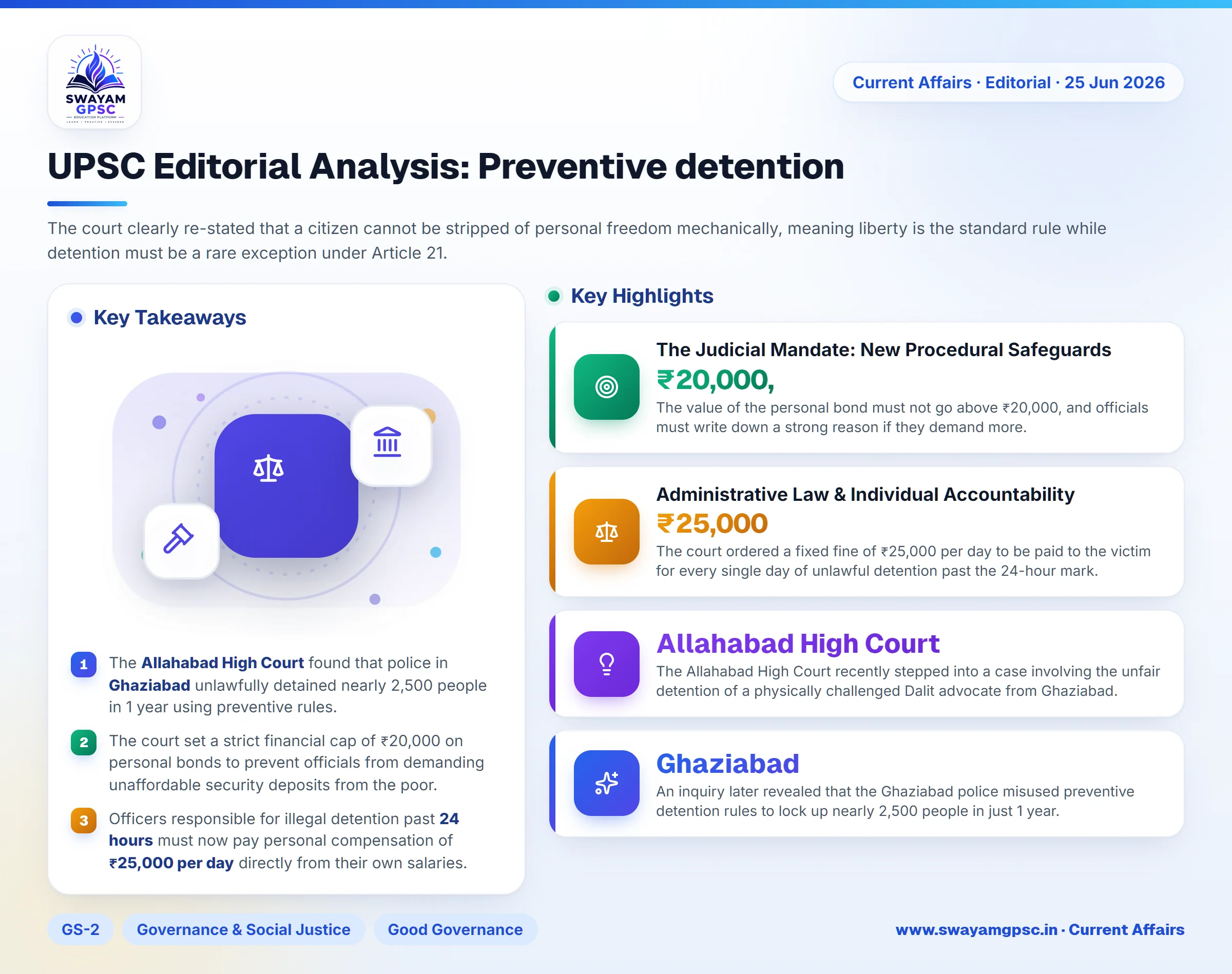
- The Allahabad High Court found that police in Ghaziabad unlawfully detained nearly 2,500 people in 1 year using preventive rules.
- The court set a strict financial cap of ₹20,000 on personal bonds to prevent officials from demanding unaffordable security deposits from the poor.
- Officers responsible for illegal detention past 24 hours must now pay personal compensation of ₹25,000 per day directly from their own salaries.
- Preventive detention powers under old laws have moved to Sections 126 and 170 of the BNSS to ensure they are never used as pre-trial punishment.
Why in News
- The Allahabad High Court recently stepped into a case involving the unfair detention of a physically challenged Dalit advocate from Ghaziabad.
- Even though the advocate was ready to submit a legal bond as the law demands, the police locked him up following a small fight over building a gate.
- An inquiry later revealed that the Ghaziabad police misused preventive detention rules to lock up nearly 2,500 people in just 1 year.
- Officials regularly demanded costly financial guarantees that poor and marginalized detainees could not pay, forcing them into unfair prison terms.
Preventive detention
- Preventive detention lets the state hold someone without a trial just because they suspect that person might commit a crime later, acting as a cautious measure rather than punishment.
Constitutional and Statutory Dimensions
- The court clearly re-stated that a citizen cannot be stripped of personal freedom mechanically, meaning liberty is the standard rule while detention must be a rare exception under Article 21.
- The victim background as a disabled Dalit citizen shows how deep-seated system biases leave vulnerable groups exposed to state overreach under Article 14 & 15.
- Preventive detention powers used under old Sections 107 and 151 of the old CrPC now fall under Sections 126 and 170 of the BNSS.
- The judiciary made it clear that preventive rules only exist to stop an immediate fight, and they cannot serve as a tool for pre-trial punishment.
The Judicial Mandate: New Procedural Safeguards
- Detained people should primarily be asked to sign a personal bond instead of routine financial demands or asset deposits.
- The value of the personal bond must not go above ₹20,000, and officials must write down a strong reason if they demand more.
- If a person refuses to sign a bond, this refusal must be recorded through written text and video methods before jail is considered.
- Holding any person past the strict 24-hour limit without bringing them before a magistrate amounts to illegal confinement.
Administrative Law & Individual Accountability
- The court changed past practices where the government paid for rights violations from public money, demanding personal accountability instead.
- The court ordered a fixed fine of ₹25,000 per day to be paid to the victim for every single day of unlawful detention past the 24-hour mark.
- This fine money will not come from public taxes, but directly out of the salaries of the guilty executive magistrates or police officers.
- Responsible officials must also face departmental inquiries for failing in their duty under service rules.
Ethical Dimensions
- This case shows a major ethical failure where legal powers meant to keep the peace were used to trouble a citizen.
- When law enforcers break the rules to hit arbitrary targets, it breaks the core social contract between the citizen and the state.
- Public servants must choose empathy and care when dealing with vulnerable groups instead of chasing administrative shortcuts.
Way Forward
- Executive magistrates and police commissioners need immediate training on preventive law under the BNSS to understand that detention needs real proof of threat.
- The use of video recording during preventive custody must be set up across all states to stop undocumented lockup harassment.
- The Ministry of Home Affairs should adopt these high court rules as a national standard operating procedure to protect constitutional guarantees.
Conclusion
- As India deals with its updated criminal justice system, this ruling draws a firm line that the state duty to keep public peace can never override personal freedom.