Deep-Sea Mining: Balancing Mineral Security with Ocean Conservation
#GS-3 #Environment #Economy #Science & Technology #Sustainable Development #Government Policies & Interventions #Water Resources
Key takeaways
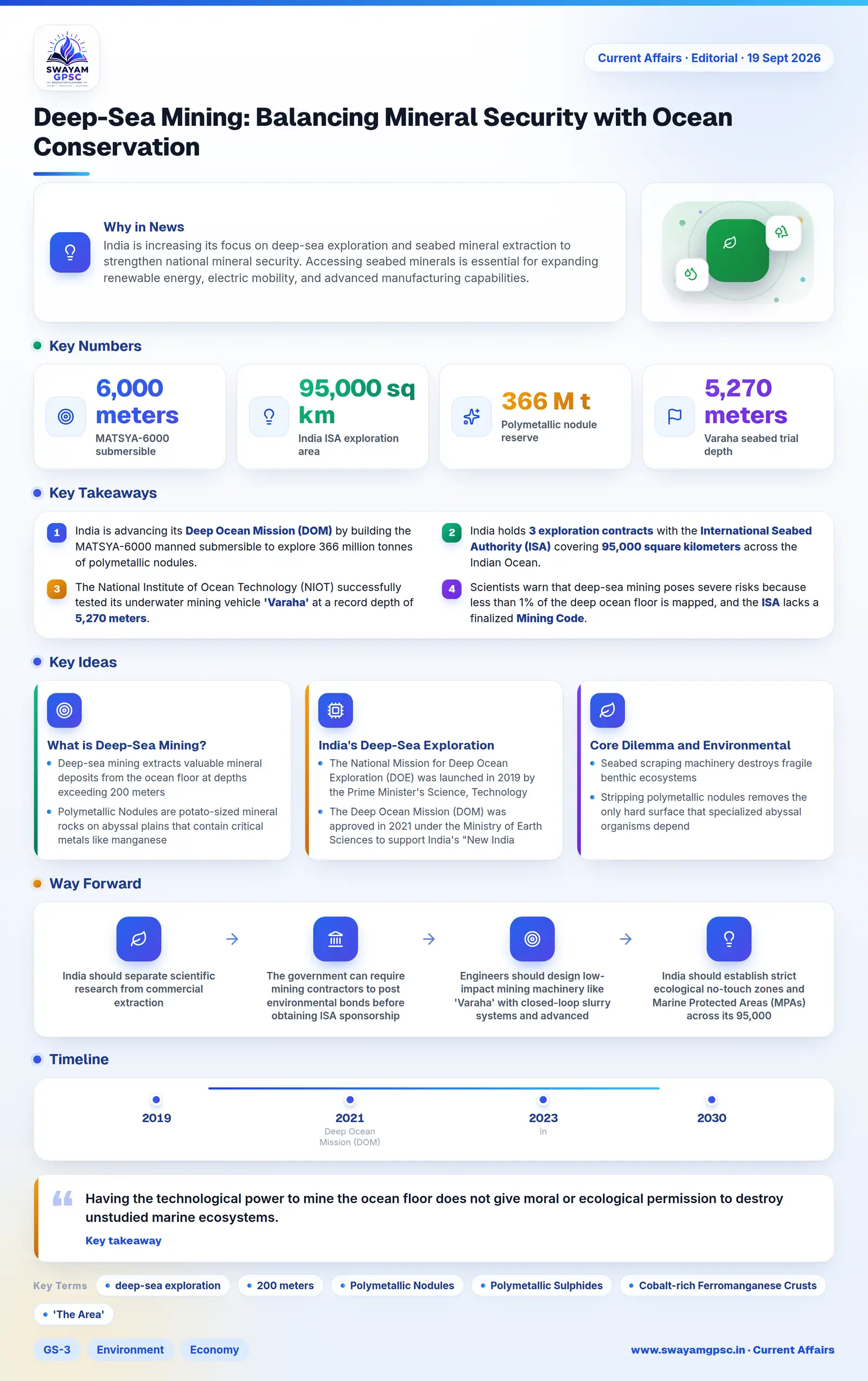
- India is advancing its Deep Ocean Mission (DOM) by building the MATSYA-6000 manned submersible to explore 366 million tonnes of polymetallic nodules.
- India holds 3 exploration contracts with the International Seabed Authority (ISA) covering 95,000 square kilometers across the Indian Ocean.
- The National Institute of Ocean Technology (NIOT) successfully tested its underwater mining vehicle 'Varaha' at a record depth of 5,270 meters.
- Scientists warn that deep-sea mining poses severe risks because less than 1% of the deep ocean floor is mapped, and the ISA lacks a finalized Mining Code.
- India can reduce reliance on seabed extraction by promoting battery recycling through Mission LiFE and expanding sodium-ion energy storage technologies.
Why in News
- India is increasing its focus on deep-sea exploration and seabed mineral extraction to strengthen national mineral security.
- Accessing seabed minerals is essential for expanding renewable energy, electric mobility, and advanced manufacturing capabilities.
- Because ocean depths remain scientifically unexplored and ecologically fragile, large-scale seabed disturbance creates serious environmental concerns.
What is Deep-Sea Mining?
- Deep-sea mining extracts valuable mineral deposits from the ocean floor at depths exceeding 200 meters, often reaching 3,000 to 6,000 meters.
- Polymetallic Nodules are potato-sized mineral rocks on abyssal plains that contain critical metals like manganese, nickel, cobalt, and copper.
- Polymetallic Sulphides form around underwater hydrothermal vents and hold rich concentrations of copper, zinc, gold, and silver.
- Cobalt-rich Ferromanganese Crusts develop on the sloped sides of underwater mountains known as seamounts.
- Under the United Nations Convention on the Law of the Sea (UNCLOS, 1982), international ocean waters beyond national Exclusive Economic Zones are defined as 'The Area'.
- UNCLOS Part XI formally declares 'The Area' and its mineral resources as the "common heritage of mankind".
- The International Seabed Authority (ISA), headquartered in Kingston, Jamaica, is the UN organization responsible for regulating seabed activities in 'The Area'.
India's Deep-Sea Exploration Initiatives
- The National Mission for Deep Ocean Exploration (DOE) was launched in 2019 by the Prime Minister's Science, Technology, and Innovation Advisory Council (PM-STIAC).
- The Deep Ocean Mission (DOM) was approved in 2021 under the Ministry of Earth Sciences to support India's "New India 2030" vision and the Blue Economy.
- Under the Samudrayaan Project, India is building MATSYA-6000, an indigenous manned submersible designed to carry 3 aquanuts down to 6,000 meters.
- Engineers targeted a 6,000-meter depth capability because rich polymetallic nodule fields lie at 5,000 meters in the Central Indian Ocean Basin.
- The National Institute of Ocean Technology (NIOT) successfully tested its crawler mining vehicle 'Varaha' on the seabed at a depth of 5,270 meters.
- India holds 3 ISA exploration contracts covering 95,000 square kilometers across the Central Indian Ocean Basin (CIOB), Central Indian Ridge (CIR), and Carlsberg Ridge.
- Ocean surveys show that India's allocated exploration zone contains an estimated 366 million tonnes of polymetallic nodules.
- Scientific research across 19 seamounts catalogued around 1,300 deep-sea species, including 23 species newly discovered by scientists.
- Parliament amended the Offshore Areas Mineral (Development and Regulation) Act (OAMDR) in August 2023 to regulate seabed mining in national waters.
Core Dilemma and Environmental Challenges
- Having the technological power to mine the ocean floor does not give moral or ecological permission to destroy unstudied marine ecosystems.
- Seabed scraping machinery destroys fragile benthic ecosystems, where slow-growing species like deep-sea sponges and corals require centuries to recover.
- Stripping polymetallic nodules removes the only hard surface that specialized abyssal organisms depend on for survival.
- Heavy extraction equipment creates massive underwater sediment plumes that travel hundreds of kilometers, choking filter feeders and blocking sunlight.
- Mining wastewater releases toxic heavy metals into the water column, which can bioaccumulate through marine food chains and contaminate global seafood.
- Machinery noise and artificial lighting disrupt marine mammals and deep-sea creatures reliant on bioluminescence for communication and hunting.
- Disturbing seabed sediments risks releasing stored carbon into the ocean, reducing its capacity to act as a vital global carbon sink.
- Deep-sea ecosystems recover at extremely slow rates, making ecological damage practically permanent and impossible to reverse through standard management.
- Extracting minerals from the ocean floor simply transfers the environmental impacts of human consumption from land to sensitive marine habitats.
Regulatory Vacuum and Global Debates
- Although the International Seabed Authority (ISA) has issued over 30 exploration contracts, it has not finalized the binding "Mining Code" for commercial extraction.
- In 2021, the Pacific island nation of Nauru invoked a legal rule forcing the ISA to consider commercial exploitation applications within two years.
- The global community is sharply divided, with dozens of countries demanding a precautionary pause while major industrial economies push forward with mining.
- Because scientists have thoroughly mapped less than 1% of the deep ocean, industrial mining risks causing the extinction of species before discovery.
Way Forward
- India should separate scientific research from commercial extraction, keeping its Deep Ocean Mission focused on mapping marine biodiversity.
- The government can require mining contractors to post environmental bonds before obtaining ISA sponsorship to ensure funds exist for ecological cleanup.
- Engineers should design low-impact mining machinery like 'Varaha' with closed-loop slurry systems and advanced modeling to prevent sediment plumes.
- India should establish strict ecological no-touch zones and Marine Protected Areas (MPAs) across its 95,000 square kilometer exploration area.
- National mineral security targets should prioritize circular economy strategies under Mission LiFE, including urban mining and battery recycling.
- Investing in alternative battery chemistries like sodium-ion and lithium iron phosphate (LFP) can reduce industrial demand for seabed nickel and cobalt.
- India should use its voice at the ISA Council to insist that commercial mining licenses remain paused until robust environmental rules are legally binding.
- Institutes like NIOT must develop non-destructive observation tools, such as autonomous ocean sensors, to study deep waters without dredging the seabed.
Conclusion
- Rather than treating the ocean floor as an extractive supply depot, India can champion deep-sea stewardship that values marine biodiversity as natural capital.
- By guiding technological power with ecological responsibility, India can establish a worldwide benchmark for sustainable ocean governance.