Formalisation of India's Informal Economy
#GS-3 #Economy #Employment #Inclusive Growth #Governance & Social Justice #Social Justice #Vulnerable Sections
Key takeaways
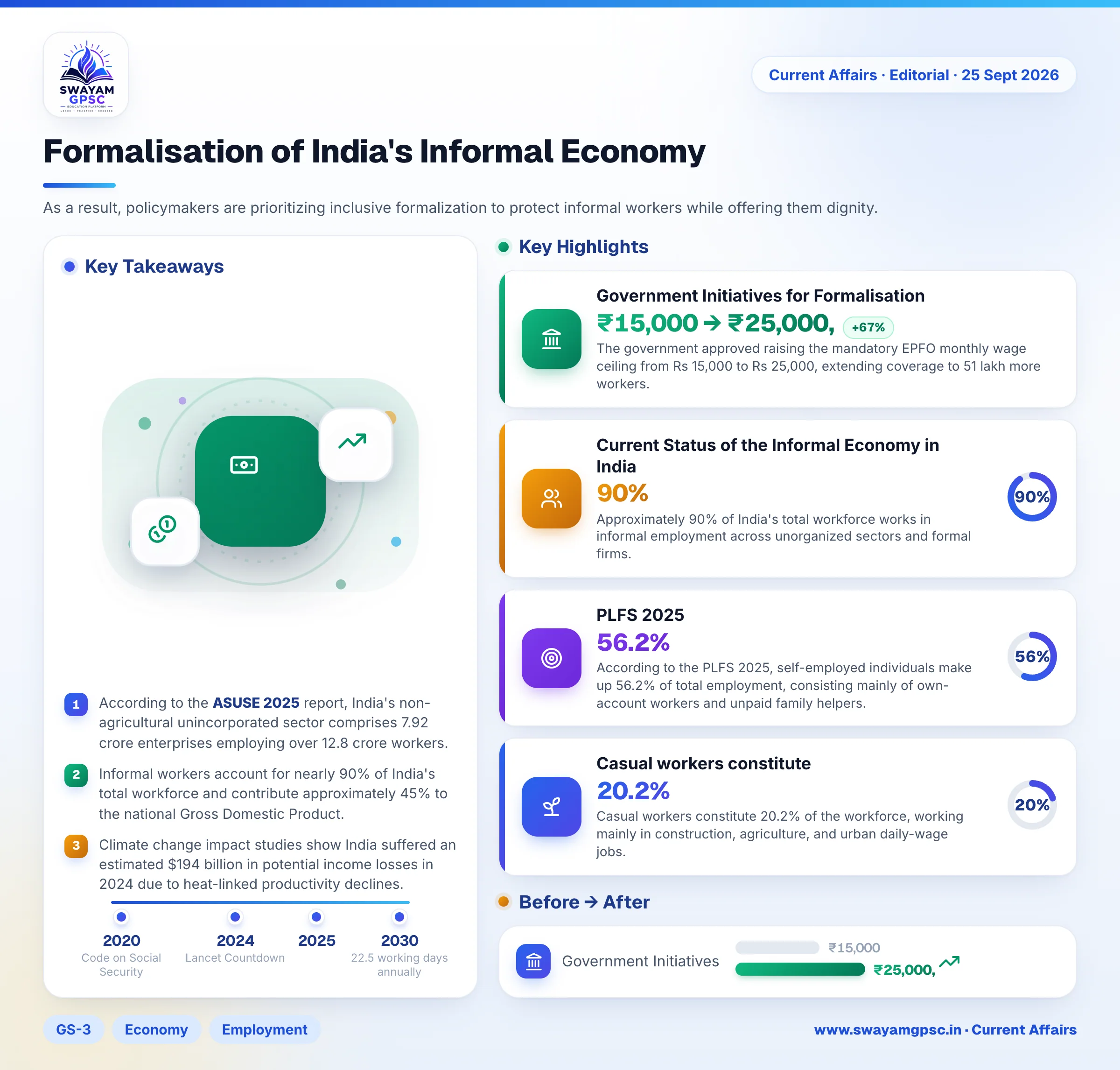
- According to the ASUSE 2025 report, India's non-agricultural unincorporated sector comprises 7.92 crore enterprises employing over 12.8 crore workers.
- Informal workers account for nearly 90% of India's total workforce and contribute approximately 45% to the national Gross Domestic Product.
- Climate change impact studies show India suffered an estimated $194 billion in potential income losses in 2024 due to heat-linked productivity declines.
- Key government formalization initiatives include the e-Shram portal with over 31.78 crore registered workers and the Womaniya initiative on GeM generating over Rs 28,000 crore in public orders.
Why in News
- The National Statistical Office (NSO) released the Annual Survey of Unincorporated Sector Enterprises (ASUSE) 2025.
- This report provides the first district-level estimates of India's unincorporated business sector.
- India's informal economy remains the largest employment provider, but workers face low productivity, limited social security, and low financial access.
- As a result, policymakers are prioritizing inclusive formalization to protect informal workers while offering them dignity.
Understanding the Informal Economy
- The informal economy includes all economic activities by workers and businesses that lack sufficient legal or institutional coverage.
- These businesses operate outside official tax systems, municipal registration networks, and standard labor laws.
- The International Labour Organization (ILO) defines the informal sector through enterprise ownership rules set during the 15th ICLS 1993.
- Informal enterprises are household-owned businesses without a separate legal identity that operate below specific size thresholds.
- The ILO defines informal employment through job characteristics established at the 17th ICLS 2003.
- Informal employment refers to jobs without statutory social security, written contracts, paid leave, or labor law protections.
Key Characteristics of the Informal Sector
- Enterprise owners and their businesses share a single legal identity, placing personal assets at direct financial risk.
- Operations rely heavily on labor-intensive methods, traditional skills, and micro-capital rather than modern machinery.
- Businesses function without audited double-entry accounting, relying mainly on cash transactions or unrecorded digital ledgers.
- Workers lack mandatory access to provident funds, health insurance, gratuity, and paid maternity or sick leave.
- Oral work agreements create job insecurity, arbitrary dismissals, and an absence of formal notice periods.
- Daily wages, piece-rate earnings, and seasonal fluctuations lead to highly unstable household cash flows.
- Firms often operate below tax registration limits or within regulatory grey zones regarding labor laws and licensing.
- Limited collateral restricts access to commercial bank loans, driving business owners toward microfinance or informal moneylenders.
Current Status of the Informal Economy in India
- Approximately 90% of India's total workforce works in informal employment across unorganized sectors and formal firms.
- According to the PLFS 2025, self-employed individuals make up 56.2% of total employment, consisting mainly of own-account workers and unpaid family helpers.
- Casual workers constitute 20.2% of the workforce, working mainly in construction, agriculture, and urban daily-wage jobs.
- Regular salaried workers account for 23.6% of employment, though many lack written contracts or social security benefits.
- Data from ASUSE 2025 shows that India has nearly 7.92 crore unincorporated non-agricultural enterprises.
- These non-agricultural unincorporated enterprises employ over 12.8 crore workers across the country.
- Own Account Enterprises that operate without hired labor form the majority of these business units.
- The informal sector generates approximately 45% of India's total Gross Domestic Product.
- Over 31.78 crore unorganized workers have registered on the e-Shram portal, receiving Universal Account Numbers (UAN) for social security delivery.
- The share of informal establishments using the internet rose from 26.7% in ASUSE 2023-24 to 39.4% in ASUSE 2025.
Emerging Trends in the Informal Economy
- The rapid growth of app-based aggregators in delivery, ride-hailing, and home services created a distinct gig workforce.
- While gig work offers flexible hours, it introduces algorithmic management where workers lack minimum wage guarantees and health protection.
- Widespread adoption of UPI and QR codes creates digital transaction histories for micro-enterprises.
- These transaction records enable cash-flow credit scoring, helping schemes like PM SVANidhi extend collateral-free micro-loans to street vendors.
- Formal companies increasingly use fixed-term contracts, staffing agencies, and gig workers to reduce wage bills and pension liabilities.
- Digital platforms like e-Shram link unorganized workers directly to welfare schemes like PM-SYM pension via direct benefit transfers.
Difference Between Formal and Informal Economy
- Formal firms register with official statutory bodies and tax networks like GST, while informal units remain unregistered and operate below legal thresholds.
- Formal workers receive statutory social security like EPF and ESI, whereas informal workers lack mandatory employer-paid benefits and paid leave.
- Formal jobs offer legally binding written contracts with notice periods, while informal employment relies on verbal agreements with high firing risks.
- Formal wages follow statutory minimum wage rules, while informal wages fluctuate based on market supply, daily rates, or piece-rate systems.
- Formal businesses use capital-intensive machinery to generate higher Gross Value Added per worker, whereas informal units rely on low-productivity traditional technology.
- Formal companies secure institutional bank credit using audited balance sheets, while informal units depend on moneylenders or personal savings due to credit barriers.
- Formal firms pay corporate income tax and GST, while informal units operate mostly outside direct tax regimes due to low revenues and cash transactions.
Major Issues Facing India's Informal Economy
- A low capital-to-labor ratio keeps informal worker productivity far lower than that of the formal sector.
- For example, powerloom operators in Surat use second-hand looms that operate at 20% to 30% of the efficiency of air-jet looms in formal mills.
- Platform aggregators classify workers as independent partners, avoiding traditional employer obligations under Indian labor law.
- Dynamic pricing, arbitrary penalty deductions, and unilateral payout cuts keep gig workers in a state of income insecurity.
- The gig workforce is projected to reach 1.2 crore workers, yet the Fairwork India Ratings showed major platforms scored 0 out of 10 on basic fairness parameters.
- Micro-enterprises face an institutional credit shortage, with the RBI estimating an unmet MSME credit gap of around Rs 80 lakh crore.
- While PM SVANidhi offers basic micro-credit to street vendors, moving up to larger commercial bank loans remains difficult without physical collateral.
- Outdoor informal workers face extreme heat stress caused by climate change, leading to severe income losses and health risks.
- Data from the Lancet Countdown shows India suffered an estimated $194 billion in potential income losses in 2024 due to heat-related productivity declines.
- By 2030, outdoor informal workers are projected to lose an average of 22.5 working days annually to heat stress.
- Strict compliance rules can act as a regressive tax, encouraging firms to remain small to avoid regulatory oversight.
- Over 99% of informal manufacturing and service units operate as micro-enterprises with fewer than 10 workers.
- According to PLFS data, over 70% of non-agricultural informal wage earners work without a written employment contract.
Government Initiatives for Formalisation
- The Code on Social Security (2020) unifies nine central labor laws to extend protection to unorganized and gig workers.
- Digital aggregators must contribute 1% to 2% of their annual turnover to a dedicated Aggregator Social Security Fund.
- The government approved raising the mandatory EPFO monthly wage ceiling from Rs 15,000 to Rs 25,000, extending coverage to 51 lakh more workers.
- The Ministry of MSME launched the Udyam Assist Platform (UAP) to give informal units MSME status and access to Priority Sector Lending (PSL) without immediate GST registration.
- The Account Aggregator (AA) ecosystem allows micro-merchants to share bank statement data digitally, enabling cash-flow-based lending without physical collateral.
- The PM SVANidhi scheme uses digital transaction records to give street vendors micro-loans starting at Rs 10,000 and stepping up to Rs 50,000.
- The PM Vishwakarma Scheme provides comprehensive support to traditional artisans and crafts workers following family-based skill models.
- Over 30,000 artisans under the PM Vishwakarma Scheme have joined digital portals like the Government e-Marketplace (GeM) and ONDC.
- The Public Procurement Policy for MSEs requires government bodies to buy at least 25% of their annual needs from micro and small units, including sub-targets of 4% for SC/ST owners and 3% for women owners.
- The Womaniya initiative on GeM helped over 2.1 lakh women-led units and self-help groups secure government orders worth over Rs 28,000 crore.
- Under PMKVY 4.0, Recognition of Prior Learning (RPL) certifies informal worker skills against the NSQF framework.
- Digital credentials verified through the Skill India Digital Hub (SIDH) help workers prove their qualifications and access job opportunities abroad through NSDC International.
Way Forward
- India should introduce a Glide-Path Tax Scheme offering new micro-enterprises 100% tax credits on compliance expenses for their first three years.
- A simplified single-page filing system for businesses earning under Rs 1 crore annually would eliminate regulatory burdens that cause enterprise dwarfism.
- Authorities must fully implement the Code on Social Security (2020) by setting up dedicated Gig Worker Social Security Boards.
- Introducing Algorithmic Transparency Guidelines will audit automated dispatching and penalty deductions, ensuring a basic living wage floor for gig workers.
- Constructing plug-and-play micro-industrial parks in clusters like Surat or Rajkot would give informal firms shared access to machinery and testing labs.
- Expanding the National Creche Scheme into community childcare hubs near employment centers would help female informal workers balance care duties.
- Transforming home-based female workers into formal producer groups with micro-equity funding will increase their income and market bargaining power.
- Setting a statutory procurement quota requiring 15% of sub-contracted public infrastructure materials to come from newly formalizing micro-units would incentivize registration.
- Introducing dynamic living wage indexing based on local inflation and housing costs will help adjust wage rates quarterly for casual labor.
Conclusion
- India's informal economy serves as a critical livelihood base, but productivity gaps and poor social security limit its potential.
- Combining digital tools, enterprise formalization, universal welfare, and worker rights will convert informality into sustainable economic growth.