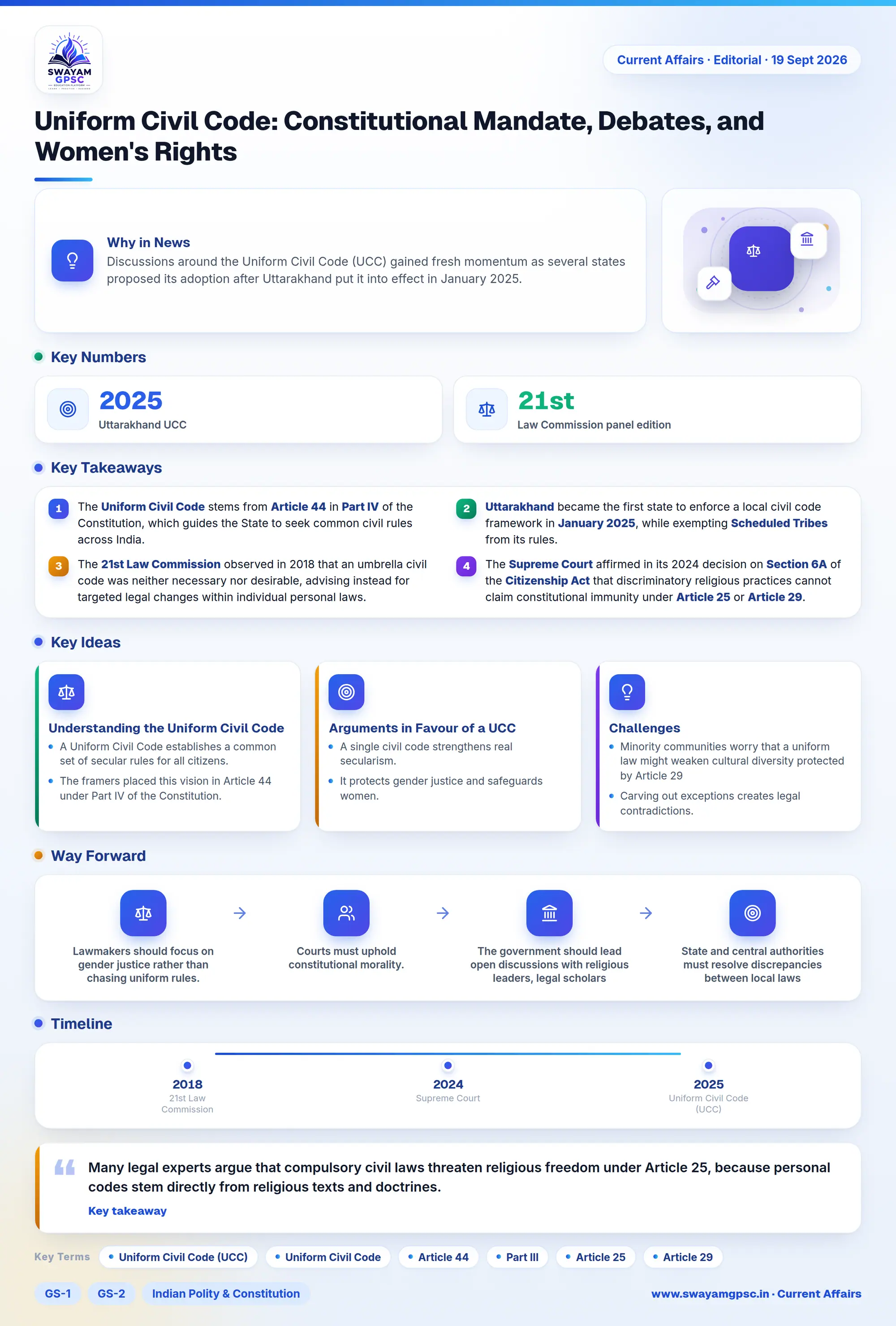
Uniform Civil Code: Constitutional Mandate, Debates, and Women's Rights
#GS-1 #GS-2 #Indian Polity & Constitution #Constitution #Judiciary #Indian Society #Women #Diversity #Current Events #National #Uniform Civil Code
Key takeaways
- The Uniform Civil Code stems from Article 44 in Part IV of the Constitution, which guides the State to seek common civil rules across India.
- Uttarakhand became the first state to enforce a local civil code framework in January 2025, while exempting Scheduled Tribes from its rules.
- The 21st Law Commission observed in 2018 that an umbrella civil code was neither necessary nor desirable, advising instead for targeted legal changes within individual personal laws.
- The Supreme Court affirmed in its 2024 decision on Section 6A of the Citizenship Act that discriminatory religious practices cannot claim constitutional immunity under Article 25 or Article 29.
Why in News
- Discussions around the Uniform Civil Code (UCC) gained fresh momentum as several states proposed its adoption after Uttarakhand put it into effect in January 2025.
Understanding the Uniform Civil Code and Constitutional Mandate
- A Uniform Civil Code establishes a common set of secular rules for all citizens. It governs civil matters like marriage, divorce, custody, adoption, alimony, and inheritance regardless of faith or community.
- The framers placed this vision in Article 44 under Part IV of the Constitution. It directs the State to strive toward securing a uniform code for all citizens across India.
- The makers of our Constitution debated whether to place this right under Part III as an enforceable guarantee or protect religious practices under freedom of conscience. They chose to place Article 44 in the Directive Principles of State Policy, making it a guiding governance principle without judicial enforcement.
Arguments in Favour of a UCC
- A single civil code strengthens real secularism. It replaces fragmented faith-based legal entitlements with one common civil law that treats every citizen equally.
- It protects gender justice and safeguards women. Traditional personal laws often contain male-centric rules on inheritance, unilateral separation, polygamy, and financial support, which a uniform code can correct.
- It creates harmony with fundamental rights. Religious freedom under Article 25 remains subject to equality guarantees under Article 14 and non-discrimination principles under Article 15.
- It simplifies India's legal structure. A unified system removes conflicting court jurisdictions and resolves prolonged inter-faith inheritance disputes.
Challenges
- Many legal experts argue that compulsory civil laws threaten religious freedom under Article 25, because personal codes stem directly from religious texts and doctrines.
- Minority communities worry that a uniform law might weaken cultural diversity protected by Article 29, which guarantees groups the right to preserve their distinct culture.
- Carving out exceptions creates legal contradictions. For instance, Uttarakhand excluded Scheduled Tribes to protect their customs, leading critics to question whether the code offers true territorial uniformity.
- Minorities, especially Muslims, fear that a common civil code might impose dominant cultural customs rather than create a neutral secular legal framework.
How a UCC Guarantees Equal Women's Rights
- It enforces a strict ban on polygamy across every community, closing legal loopholes that leave women vulnerable.
- It grants daughters identical succession and property inheritance rights as sons, ending biased ancestral asset rules.
- It establishes equal judicial grounds for divorce and annulment, requiring all communities to follow fair court procedures rather than extrajudicial methods.
- It guarantees statutory maintenance and alimony after divorce, preventing women from falling into financial distress.
- It recognizes both parents as equal natural guardians of minors, removing historical legal preferences given to fathers.
Alternative Approaches: The Law Commission Proposal
- During the Constituent Assembly debates, Dr. B.R. Ambedkar suggested making the code voluntary at first, so that only citizens who opt into it are bound by its rules.
- The 21st Law Commission stated in its 2018 consultation paper that a nationwide uniform code was neither necessary nor desirable at that time.
- The commission explained that uniformity does not automatically equal fairness. It advised against curbing cultural pluralism unless a specific practice clearly violates fundamental human rights.
- Instead of enforcing uniform rules between communities, the panel suggested securing equality within communities by removing unfair customs inside each personal law.
- It recommended step-by-step statutory changes to Hindu, Muslim, Christian, and Parsi personal laws to fix unfair rules around property succession, adoption, maintenance, and divorce.
Way Forward
- Lawmakers should focus on gender justice rather than chasing uniform rules. Reforming discriminatory rules within existing personal laws provides the most practical starting point.
- Courts must uphold constitutional morality. The Supreme Court reaffirmed in the Section 6A Citizenship Act (2024) ruling that religious practices promoting gender discrimination cannot claim shelter under Article 25 or Article 29.
- The government should lead open discussions with religious leaders, legal scholars, and women's rights groups to build broad consensus and keep reforms free from partisan politics.
- State and central authorities must resolve discrepancies between local laws, ensuring that basic civil protections do not change when a citizen crosses state lines.
Conclusion
- Balancing religious freedoms with gender fairness remains a central constitutional test for India. Whether through an overarching secular code or targeted reforms within existing personal laws, securing dignity and equal legal protection for all women is vital for Indian democracy.