Strengthening Intellectual Property Rights Ecosystem in India
#GS-3 #Science & Technology #IPR #Economy #Growth #GS-2 #Governance & Social Justice #Regulatory Bodies #Commercial Courts Act, 2015 #Patents Act, 1970 #Standard Essential Patents
Key takeaways
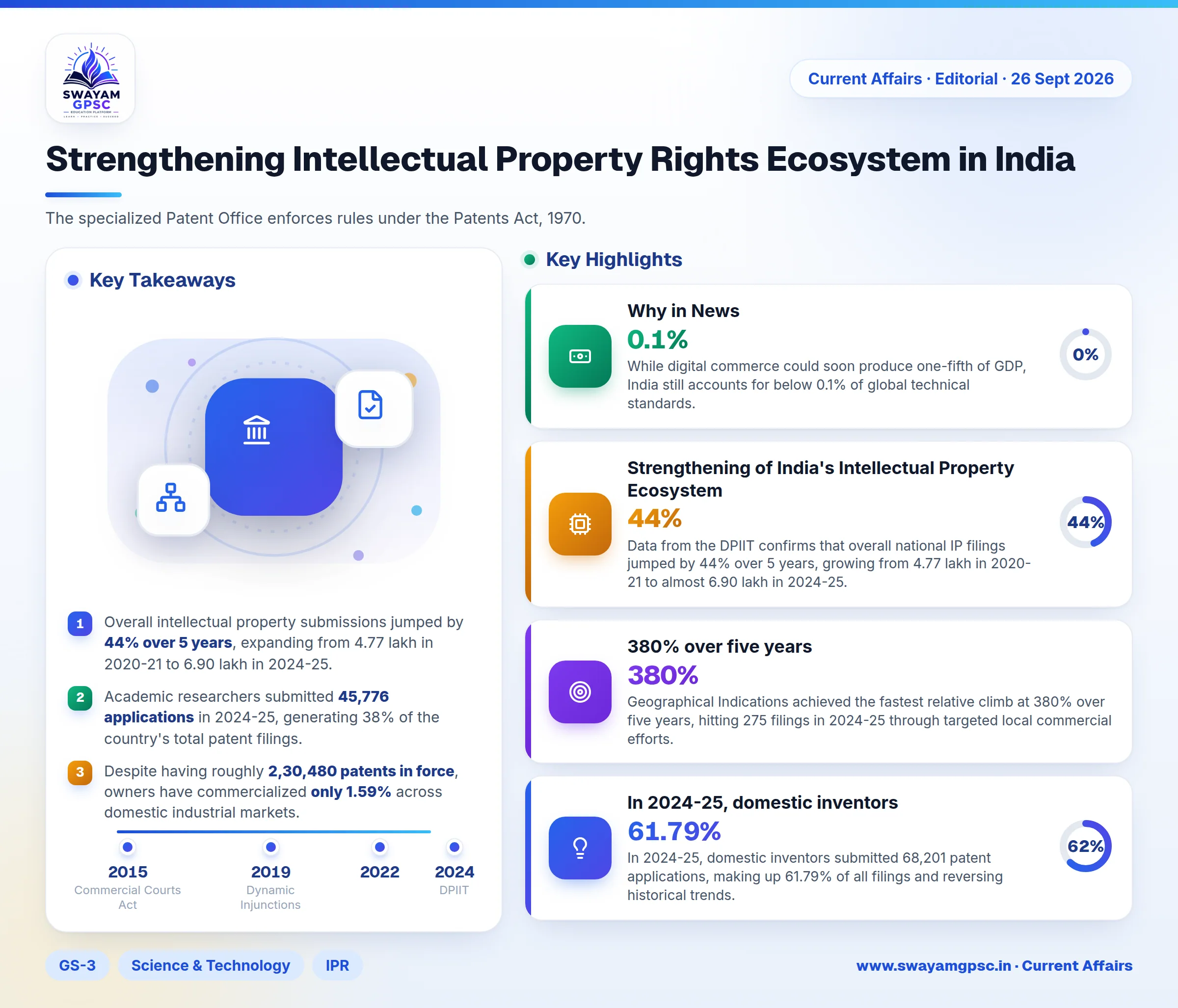
- Overall intellectual property submissions jumped by 44% over 5 years, expanding from 4.77 lakh in 2020-21 to 6.90 lakh in 2024-25.
- Academic researchers submitted 45,776 applications in 2024-25, generating 38% of the country's total patent filings.
- Despite having roughly 2,30,480 patents in force, owners have commercialized only 1.59% across domestic industrial markets.
- Unlawful trade and imitation goods cause an annual commercial loss of ₹1,05,000 crore and cost the government ₹39,000 crore in lost tax revenue.
- Domestic patent filings reached 68,201 in 2024-25, making up 61.79% of the country's total submission volume.
Why in News
- India must expand its domestic innovation, secure global patent leadership, and establish standards-setting power to turn intellectual property into a strategic tool.
- The country's fast-growing digital economy relies heavily on technical standards created abroad, requiring a quick transition toward indigenous Standard Essential Patents (SEPs).
- While digital commerce could soon produce one-fifth of GDP, India still accounts for below 0.1% of global technical standards.
- Recent increases in patent applications show solid momentum, but low commercial conversion and licensing conflicts present ongoing challenges.
Regulation of Intellectual Property Rights in India
- Under the Ministry of Commerce and Industry, the Department for Promotion of Industry and Internal Trade (DPIIT) serves as the top body managing IPR rules and working with WIPO.
- Headquartered in New Delhi, the Controller General of Patents, Designs and Trade Marks (CGPDTM) manages four distinct IP registries through offices in Kolkata, Delhi, Mumbai, and Chennai.
- The specialized Patent Office enforces rules under the Patents Act, 1970.
- The Trade Marks Registry manages brand registrations across the country under the Trade Marks Act, 1999.
- The Designs Office handles structural and aesthetic product safeguards following the Designs Act, 2000.
- The Geographical Indications Registry operates out of Chennai to implement the Geographical Indications of Goods Act, 1999.
- The Copyright Office applies the Copyright Act, 1957, overseeing registrations and statutory collection societies like the Indian Performing Right Society.
- The Ministry of Agriculture and Farmers Welfare directs the Protection of Plant Varieties and Farmers' Rights Authority (PPV&FRA) under the PPV&FR Act, 2001.
- The Ministry of Commerce and Industry runs the Semiconductor Integrated Circuits Layout-Design Registry to implement the SICLD Act, 2000.
- Major High Courts like Delhi and Madras created dedicated Intellectual Property Divisions (IPDs), relying on procedural guidelines like the Delhi High Court IPD Rules, 2022.
- Trial courts handle civil infringement actions as commercial matters under the Commercial Courts Act, 2015, applying strict case deadlines.
- In the CCI v. Ericsson & Monsanto ruling, the Supreme Court held that the Patents Act, 1970 operates as a self-contained code that takes priority over competition statutes.
- Antitrust investigations cannot replace statutory remedies inside the patent framework, directing royalty disputes toward solutions like Compulsory Licensing.
- Section 84 of the Patents Act, 1970 permits compulsory licensing applications after three years if public needs go unmet, prices remain unreasonable, or local manufacturing is absent.
- High courts issue Dynamic Injunctions to stop digital piracy networks and changing mirror websites, a precedent created in the UTV Software Communication Ltd. v. 1337X.to Case, 2019.
Strengthening of India's Intellectual Property Ecosystem
- Data from the DPIIT confirms that overall national IP filings jumped by 44% over 5 years, growing from 4.77 lakh in 2020-21 to almost 6.90 lakh in 2024-25.
- Geographical Indications achieved the fastest relative climb at 380% over five years, hitting 275 filings in 2024-25 through targeted local commercial efforts.
- In 2024-25, domestic inventors submitted 68,201 patent applications, making up 61.79% of all filings and reversing historical trends.
- International applications via the Patent Cooperation Treaty (PCT) rose from 964 in 2020-21 to 2,600 in 2024-25, reflecting outward commercial expansion.
- The registry streamlined trademark processing by replacing 74 disparate forms with just 8 consolidated forms, while adding direct rules for non-conventional marks.
- The country has secured over 800 registered GIs, protecting regional items like Assam's Majuli Mask, Kaji Nemu, and Banaras Zardozi from outside misappropriation.
- Examiners at the USPTO and EPO routinely consult the Traditional Knowledge Digital Library (TKDL) to stop global firms from patenting traditional remedies.
- Authorities introduced a 10% official fee reduction for online patent renewals lasting at least four years, speeding up complete process digitization.
- The Intellectual Property Automation System (IPAS) along with AI-driven prior-art search tools significantly lowered application wait times.
- The Start-Ups Intellectual Property Protection (SIPP) Scheme covers facilitator charges, reimbursing ₹10,000 for filing and ₹15,000 for disputed disposals.
- New enterprises filed over 4,480 patent applications in FY 2025-26 alone, bringing their cumulative volume above 19,400 submissions.
- Academic institutions submitted 45,776 applications in 2024-25, contributing 38% of the country's total patent filings.
- University-level IP cells expanded after the National Institutional Ranking Framework (NIRF) linked research funding to patent counts alongside the Kalam Program for IP Literacy and Awareness (KAPILA).
- Targeted central initiatives like the National Semiconductor Mission and the IndiaAI Mission drive new patents in microchips, electric mobility, and connected hardware.
- The domestic pharmaceutical industry continues to expand, backed by Section 3(d) of the Patents Act, 1970 which stops patent evergreening while preserving generic medicine access.
- The Patents (Amendment) Rules, 2024 cut the Request for Examination filing window from 48 months to 31 months and relaxed Form 27 commercial working filings to once every three years.
- The updated patent regulations demand a clear prima facie case before any pre-grant opposition moves forward, preventing tactical delays.
Challenges
- Out of roughly 2,30,480 patents in force, owners have commercialized only 1.59%, with broader working filings lifting this share to just 6.39%.
- Many universities file thousands of preliminary claims but register final grant conversion rates between 0% to 3%, exposing weak industrial relevance.
- The United States Trade Representative retains India on its Priority Watch List, citing enforcement issues and high tariffs on tech hardware and medical devices.
- A study by FICCI CASCADE shows illicit commerce costs companies over ₹1,05,000 crore annually and costs the treasury over ₹39,000 crore in lost tax revenue.
- Border authorities identify domestic hubs as a frequent origin point for seized illegal and imitation medical shipments.
- Under Section 3(k) of the Patents Act, 1970, software and basic algorithms cannot be patented, creating legal confusion for machine learning and cloud ventures.
- The Copyright Office created widespread confusion about human-authorship requirements after granting and then revisiting a registration for the RAGHAV AI Paint program.
- Heavy clearance targets for patent examiners risk weak approvals without thorough prior-art checks, creating future courtroom cancellations.
- Rival businesses misuse Section 25(1) by filing baseless pre-grant oppositions right before approval, delaying genuine market entries by 3 to 5 years.
- Domestic manufacturers often face expensive global court battles and foreign injunctions over Standard Essential Patents (SEPs) governed by uncertain FRAND terms.
Way Forward
- India should pass an innovation law similar to the US Bayh-Dole Act, 1980 to help public institutions commercialize research funded by state grants.
- Universities need external Technology Transfer Offices (TTOs) staffed by professional patent negotiators rather than academic instructors.
- The DPIIT and the Patent Office should provide unambiguous guidance defining technical contribution limits under Section 3(k) of the Patents Act, 1970.
- Parliament should add text and data mining fair-use exceptions to the Copyright Act, 1957 to protect machine learning models during training.
- The Bureau of Indian Standards and DPIIT must craft a national policy for Standard Essential Patents (SEPs) across fast-growing digital networks.
- Regulators need a top-down FRAND framework to stop overseas licensors from demanding royalties that eliminate manufacturer profits.
- States should create dedicated police squads equipped with cyber forensics skills to dismantle digital copyright piracy and counterfeit distribution.
- The government should upgrade the e-Customs IPR Recordation System with computer vision models to identify imitation cargo at entry ports.
- Courts should institutionalize rapid Dynamic Injunctions to disable illegal streaming sites and alternate web mirrors within 24 hours.
- Authorities should convert the TKDL into an active commercial licensing platform that enables domestic wellness businesses to license traditional formulas.
- The National Biodiversity Authority (NBA) needs to automate access and benefit-sharing mechanisms to deliver earnings to indigenous groups promptly.
- Judicial bodies should expand Commercial Courts and adopt mediation to speed up intellectual property settlements.
Conclusion
- India's intellectual property ecosystem stands at a critical point, showing high filing numbers alongside clear commercialization gaps.
- Transforming into a global technology developer requires turning academic research into market-ready assets through sound standard-setting rules.
- Enacting supportive research laws, clarifying software limits, and strengthening commercial courts will attract global capital while safeguarding domestic innovations.