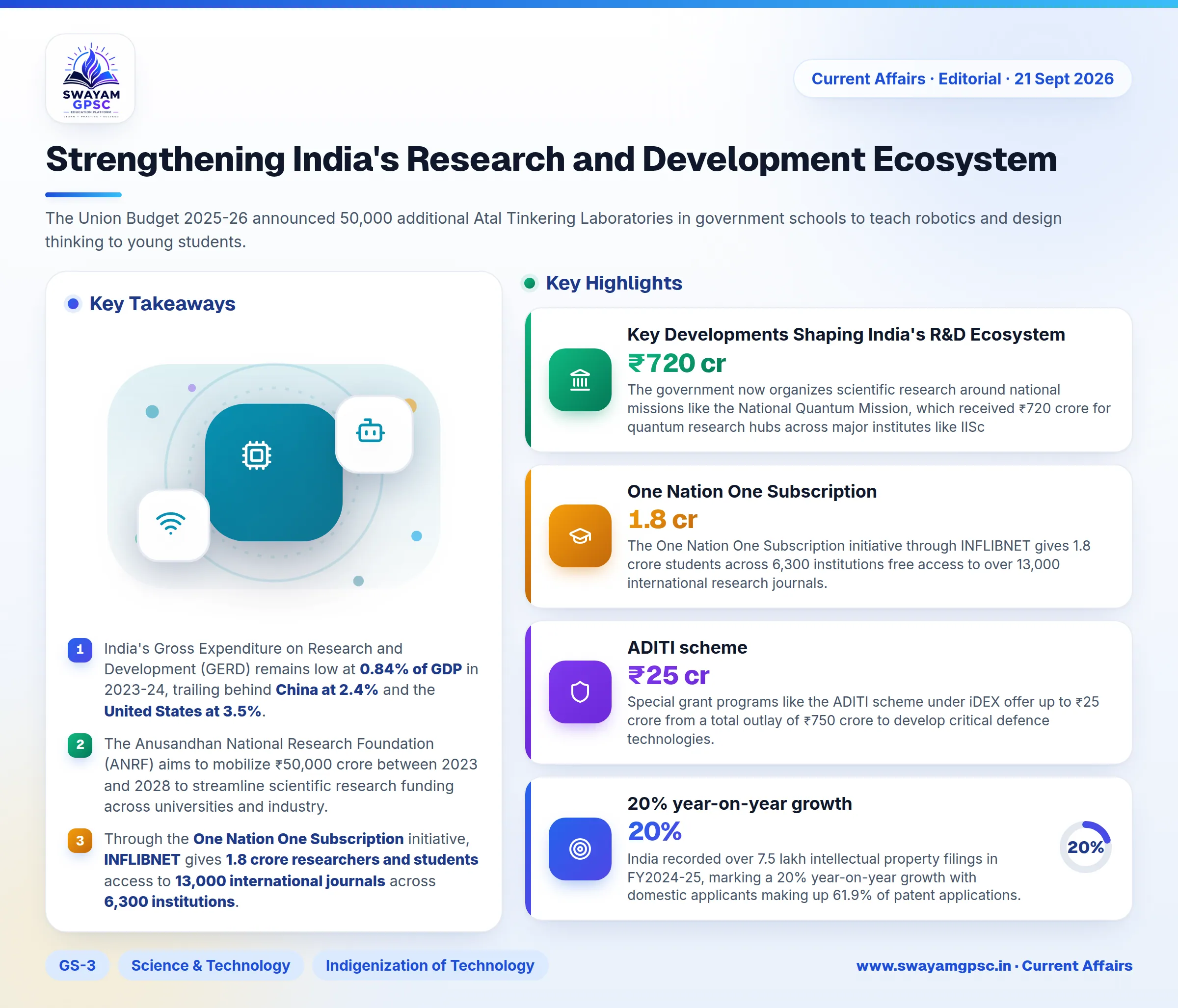
Strengthening India's Research and Development Ecosystem
#GS-3 #Science & Technology #Indigenization of Technology #GS-2 #Public Policy #Education #Governance & Social Justice #Economy #National
Key takeaways
- India's Gross Expenditure on Research and Development (GERD) remains low at 0.84% of GDP in 2023-24, trailing behind China at 2.4% and the United States at 3.5%.
- The Anusandhan National Research Foundation (ANRF) aims to mobilize ₹50,000 crore between 2023 and 2028 to streamline scientific research funding across universities and industry.
- Through the One Nation One Subscription initiative, INFLIBNET gives 1.8 crore researchers and students access to 13,000 international journals across 6,300 institutions.
- India filed 7.5 lakh intellectual property applications in FY2024-25, reflecting a 20% year-on-year growth with domestic resident applicants making up 61.9% of patent filings.
- India currently maintains 354 researchers per million population, while private venture capital directs only 15% of its funding toward deep-tech ventures.
Why in News
- India is shifting its focus from simply adopting foreign technology to creating its own innovations through specialized deep-tech missions.
- To become a global technology leader, India must build an integrated pipeline that connects laboratory research directly with commercial markets.
Key Developments Shaping India's R&D Ecosystem
- The government now organizes scientific research around national missions like the National Quantum Mission, which received ₹720 crore for quantum research hubs across major institutes like IISc, IIT Bombay, IIT Delhi, and IIT Kanpur.
- National policies such as the BioE3 Policy, MAHA-EV Mission, and National Supercomputing Mission promote indigenous capabilities in biomanufacturing, electric mobility, and high-performance computing.
- The One Nation One Subscription initiative through INFLIBNET gives 1.8 crore students across 6,300 institutions free access to over 13,000 international research journals.
- The Department of Science and Technology set up SATHI centres to allow state universities and small businesses to share expensive scientific equipment without buying duplicate devices.
- Special grant programs like the ADITI scheme under iDEX offer up to ₹25 crore from a total outlay of ₹750 crore to develop critical defence technologies.
- India recorded over 7.5 lakh intellectual property filings in FY2024-25, marking a 20% year-on-year growth with domestic applicants making up 61.9% of patent applications.
- The Anusandhan National Research Foundation Act, 2023 created the ANRF with a target budget of ₹50,000 crore for 2023-28 to guide national research across academia and industry.
- The Anusandhan National Research Foundation launched the PAIR programme, including IIT Indore's ₹100-crore SAKSHAM network, to mentor faculty across regional institutions.
- The government announced a ₹1-lakh-crore Research, Development and Innovation Scheme to help private companies finance complex, high-risk technological projects over long timelines.
- Private investors in the India Deep Tech Alliance poured ₹2,170 crore into 56 deep-tech start-ups, targeting artificial intelligence, robotics, space, and clean technology.
- The Union Budget 2025-26 announced 50,000 additional Atal Tinkering Laboratories in government schools to teach robotics and design thinking to young students.
- India funds major international scientific facilities, including approving ₹1,250 crore for constructing the Square Kilometre Array Observatory in radio astronomy.
Challenges
- India's Gross Expenditure on Research and Development (GERD) remains stagnant at 0.84% of GDP in 2023-24, falling behind China's 2.4% and the United States' 3.5%.
- Private sector research spending accounts for 45% of national R&D, but companies concentrate this money tightly in pharmaceuticals, automobiles, and software services.
- Venture capital firms direct only 15% of total investment toward deep-tech startups, leaving early-stage technology companies without needed long-term capital.
- High-quality research facilities remain concentrated in elite institutions like the IITs, IISc, and AIIMS, while State universities face staff shortages and poor funding.
- India employs only 354 researchers per million population, which is far lower than leading industrial nations that maintain thousands of scientists per million citizens.
- Universities evaluate professors mainly on published research papers rather than helping them translate theoretical discoveries into market-ready commercial products.
- Scientific research funding remains scattered across multiple ministries with slow approval processes, rigid annual deadlines, and bureaucratic paperwork.
- Academic pressure to publish leads to lower quality standards, fraudulent research papers, predatory academic journals, and data manipulation.
- Indian scientific laboratories rely heavily on foreign suppliers for high-end analytical instruments, semiconductors, specialized chemicals, and testing equipment.
Way Forward
- India should establish a legally protected ten-year R&D investment framework alongside a dedicated Basic Science Endowment to fund long-term fundamental scientific research.
- State governments should create regional research networks focused on local strengths, such as biomaterials in Kerala, precision agriculture in Punjab, and mining technology in Odisha.
- Universities should set up independent technology transfer offices to protect patents, negotiate license agreements, and share commercial revenues fairly with researchers.
- The government can act as a first buyer for domestic innovation by offering guaranteed purchase contracts to startups through an Advance Market Commitment model.
- Public agencies should launch a Sovereign Deep-Tech Scale-Up Facility that provides credit guarantees, shared testing facilities, and manufacturing foundries for early-stage startups.
- Research institutions should create flexible career options, including industry sabbaticals, joint appointments for diaspora scientists, and returning grants for female researchers.
- India must establish an independent Office of Research Integrity to enforce data ethics, punish scientific misconduct, and require data accessibility following FAIR principles.
Conclusion
- India's research ecosystem is steadily transforming from basic public research labs into a modern network of universities, deep-tech startups, and private corporations.
- India will achieve true technological autonomy when native scientific discoveries turn into affordable, globally competitive products that improve public services.