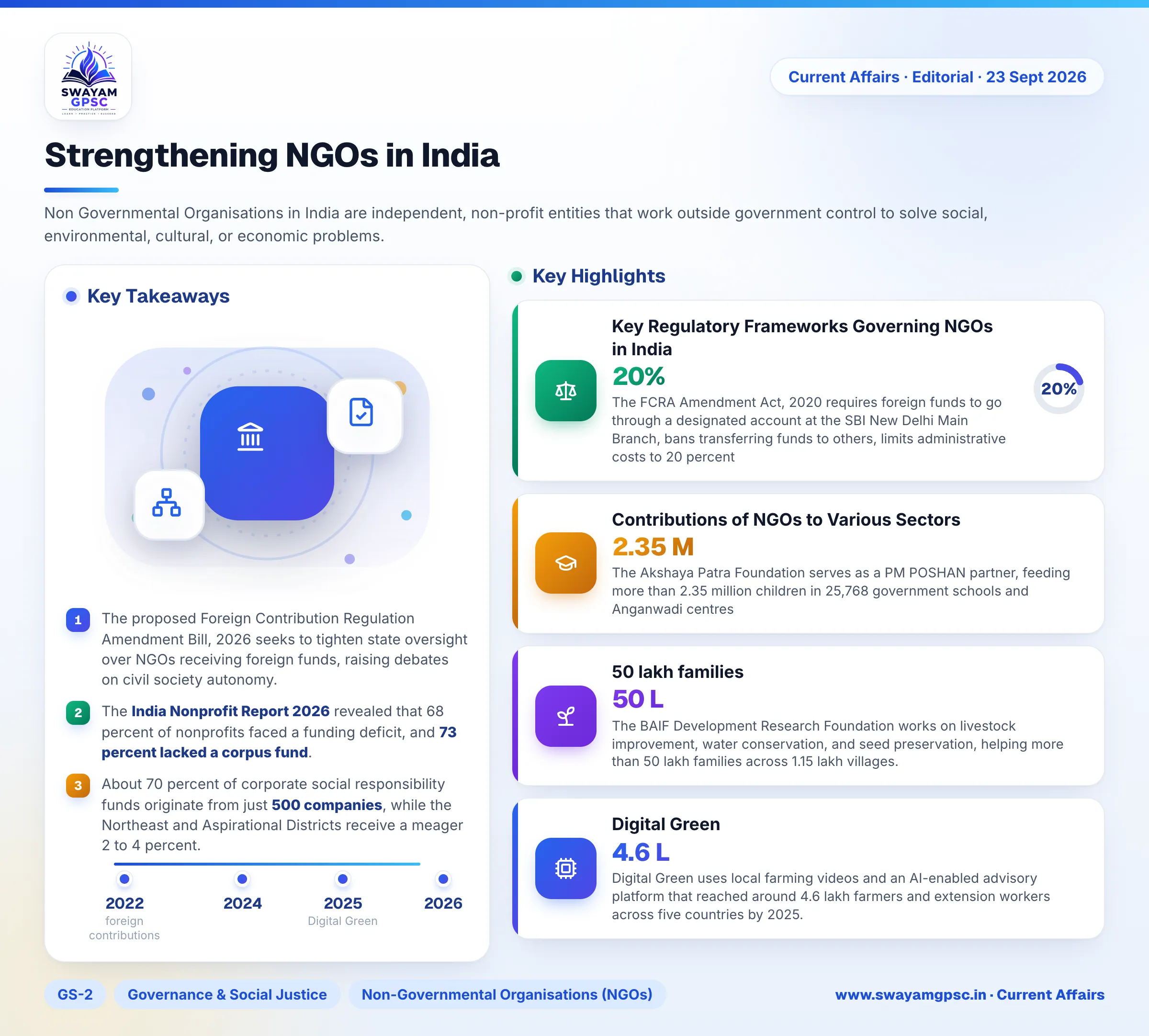
Strengthening NGOs in India
#GS-2 #Governance & Social Justice #Non-Governmental Organisations (NGOs) #Management of Social Sector/Services #Economy #Current Events #National
Key takeaways
- The proposed Foreign Contribution Regulation Amendment Bill, 2026 seeks to tighten state oversight over NGOs receiving foreign funds, raising debates on civil society autonomy.
- The India Nonprofit Report 2026 revealed that 68 percent of nonprofits faced a funding deficit, and 73 percent lacked a corpus fund.
- About 70 percent of corporate social responsibility funds originate from just 500 companies, while the Northeast and Aspirational Districts receive a meager 2 to 4 percent.
- The Akshaya Patra Foundation reached a major milestone in March 2026 by serving five billion meals across 25,768 government schools and Anganwadi centres.
Why in News
- The proposed Foreign Contribution Regulation Amendment Bill, 2026 aims to increase state control over Non Governmental Organisations (NGOs) receiving foreign money, which has triggered a major debate.
- The government defends this move by pointing to national security threats and hidden money networks.
- Critics argue that these rules threaten civil society autonomy and vital welfare institutions.
- Finding a balance between security rules and democratic freedoms is essential for inclusive national development.
What are Non-Governmental Organizations
- Non Governmental Organisations in India are independent, non-profit entities that work outside government control to solve social, environmental, cultural, or economic problems.
- They act as a bridge between marginalized communities and government welfare schemes, playing a critical role in nation-building.
- Any surplus generated by these organizations is put back into their core mission instead of being given to owners or shareholders.
- They work directly at the community level to fix problems like rural education, healthcare access, womens empowerment, child rights, and environmental conservation.
- Many NGOs act as watchdogs that raise awareness about human rights, legal aid, and policy reforms.
- They often work as first responders during natural disasters by providing immediate relief supplies, food, and rehabilitation support.
Key Regulatory Frameworks Governing NGOs in India
- NGOs get their basic authority from Article 19(1)(c) which guarantees citizens the right to form associations, while Article 19(4) allows reasonable limits for sovereignty, integrity, public order and morality.
- The Supreme Court ruled in the case of *Noel Harper versus Union of India* (2022) that receiving foreign contributions is not a fundamental right.
- Membership-based NGOs usually register as societies under the Societies Registration Act, 1860 or similar state laws.
- The Act covers literary, scientific and charitable societies and requires a governing body, rules, member records, and yearly filings.
- Asset-based charitable groups operate as public charitable or religious trusts, managed by state laws like the Maharashtra Public Trusts Act, 1950.
- These laws regulate trustees, trust property, accounts, audits, alienation of assets and change reports through a Charity Commissioner or similar office.
- The Indian Trusts Act, 1882 mainly handles private trusts and is not the main law for public charitable groups.
- Professional NGOs register under Section 8 of the Companies Act, 2013 to promote education, social welfare, environment, research, and charity.
- Profits must go toward stated goals, and dividends cannot be distributed to members.
- Section 8 companies must follow strict corporate-governance requirements, including statutory registers, board meetings, financial statements, audits, and annual filings with the Registrar of Companies.
- NGOs taking foreign donations must get FCRA registration or project-specific prior permission from the Ministry of Home Affairs.
- The FCRA Amendment Act, 2020 requires foreign funds to go through a designated account at the SBI New Delhi Main Branch, bans transferring funds to others, limits administrative costs to 20 percent, and allows deeper checks on office-bearers.
- NGOs implementing corporate social responsibility projects under Section 135 of the Companies Act, 2013 must meet specific eligibility rules.
- Eligible groups include Section 8 companies, registered public trusts and registered societies with tax registration, while independent groups usually need a three-year track record.
- Filing Form CSR-1 gives the NGO a CSR Registration Number to accept CSR funds, and companies must monitor projects to ensure real outcomes.
- NGOs wanting government grants must get a Unique ID on the NGO-DARPAN Portal, share their PAN and office details, and keep profiles updated.
- Grants are routed through the Public Financial Management System (PFMS), requiring audited accounts and Utilisation Certificates under the General Financial Rules, 2017.
- NGO-DARPAN registration is now mandatory before any Union Ministry gives out grants, ensuring digital tracking and due diligence.
- Under Section 2(h), any NGO that receives substantial financing from the government can be labeled a public authority and must follow the Right to Information Act, 2005.
- The Supreme Court clarified in *D.A.V. College Trust and Management Society versus Director of Public Instructions* (2019) that substantial financing does not need to be a majority share.
- NGOs running child-care homes need registration under the Juvenile Justice Act, 2015, and schools must follow the Right to Education Act, 2009.
- NGOs must also follow the POSH Act, 2013, EPF and ESI laws, labor codes, environmental rules, and the Digital Personal Data Protection framework.
Contributions of NGOs to Various Sectors
- NGOs bridge the last-mile delivery gap by finding vulnerable patients, stopping false rumors, and connecting people with public health centers.
- Organizations like Rotary International, UNICEF and local volunteers helped India beat polio through vaccination booths and door-to-door campaigns.
- India reported its last wild polio case in 2011 and earned a polio-free certificate in 2014.
- Prathams Annual Status of Education Report (ASER) is India's largest rural learning survey, shifting focus from school buildings to actual learning results.
- The Akshaya Patra Foundation serves as a PM POSHAN partner, feeding more than 2.35 million children in 25,768 government schools and Anganwadi centres, hitting a milestone of five billion meals in March 2026.
- NGOs organize dispersed workers into self-help groups, cooperatives, and trade unions to build financial strength.
- Groups like SEWA, Azad Foundation and Educate Girls empower women through jobs and education, while Snehalaya and Majlis Manch offer safe shelter and legal aid.
- The Mann Deshi Foundation runs mobile business schools and financial classes to help rural women grow small businesses.
- The BAIF Development Research Foundation works on livestock improvement, water conservation, and seed preservation, helping more than 50 lakh families across 1.15 lakh villages.
- Digital Green uses local farming videos and an AI-enabled advisory platform that reached around 4.6 lakh farmers and extension workers across five countries by 2025.
- The Mazdoor Kisan Shakti Sangathan (MKSS) used public hearings to expose fraud in public works, laying the groundwork for the Right to Information Act, 2005.
- The Association for Democratic Reforms (ADR) analyzes candidate affidavits, revealing that 251 MPs, or 46 percent, of the 543 winners in the 2024 Lok Sabha election faced criminal cases.
- The Foundation for Ecological Security (FES) protects common lands and village natural resources, empowering 40.38 million lives by restoring 17.66 million acres of common land across 64,976 village institutions.
- Organizations like SEEDS India and Goonj provide emergency relief and rebuild shelters after natural disasters, with SEEDS working as part of the National Platform for Disaster Risk Reduction.
- Sulabh International built more than 1.5 million household toilets and over 9,000 public toilet complexes, using a sustainable pay-and-use model for clean public sanitation.
Challenges
- Indian NGOs struggle with short-term grants while donors refuse to pay for staff salaries, technology, and internal emergency funds.
- The India Nonprofit Report 2026 revealed that 68 percent faced a funding deficit in FY2024-25, which spiked to 83 percent for micro organizations, and 73 percent had no corpus fund.
- Funding is heavily skewed toward large corporate networks, leaving small rural nonprofits at a major disadvantage.
- The Bharat NGO Report 2025 showed that 84 percent had annual budgets below 3 crore rupees, and smaller groups had only a 50 percent proposal approval rate compared to 73 percent for large groups.
- About 70 percent of CSR money comes from just 500 companies, and regions like the Northeast and Aspirational Districts receive only 2 to 4 percent of funds.
- NGOs must juggle multiple complex rules under state laws, Section 8, tax filings, CSR-1, NGO Darpan, PFMS, and FCRA.
- The FCRA Amendment Bill, 2026 adds strict rules on foreign-funded assets, raising worries about operational freedom.
- About 61 percent of NGOs lack Management Information Systems expertise, only 17 percent use licensed software, and 51 percent need help writing grant proposals.
- Donors often measure success by counting workshops held or people registered rather than tracking real improvements in health, income, or learning.
- Accountability flows upward to donors and regulators while local communities have almost no say in how projects are run.
- The growth of fake paper organizations or briefcase NGOs diverts money away from the people who genuinely need help.
- When NGOs raise valid concerns about displacement or environmental issues, it can create a trust deficit and lead to self-censorship.
Way Forward
- Create a district-wise social-needs index to link funding priorities directly with local poverty, health, and education gaps.
- Companies should voluntarily send parts of their CSR budget to Aspirational Districts, the Northeast, and regions with fewer NGOs.
- Replace rigid compliance rules with a graded regulatory framework based on an organization's size, budget, and risk profile.
- Move away from founder-driven setups toward proper board-governed institutions with independent trustees and transparent annual reports.
- Set up community beneficiary councils and hold local Jan Sunwai social audits in local languages to ensure grassroots ownership.
- Launch a National NGO Capacity and Talent Mission to train local workers in financial management, law, and cybersecurity.
- Establish an open Social Impact Evidence Registry so nonprofits can share data, successes, and failed methods openly.