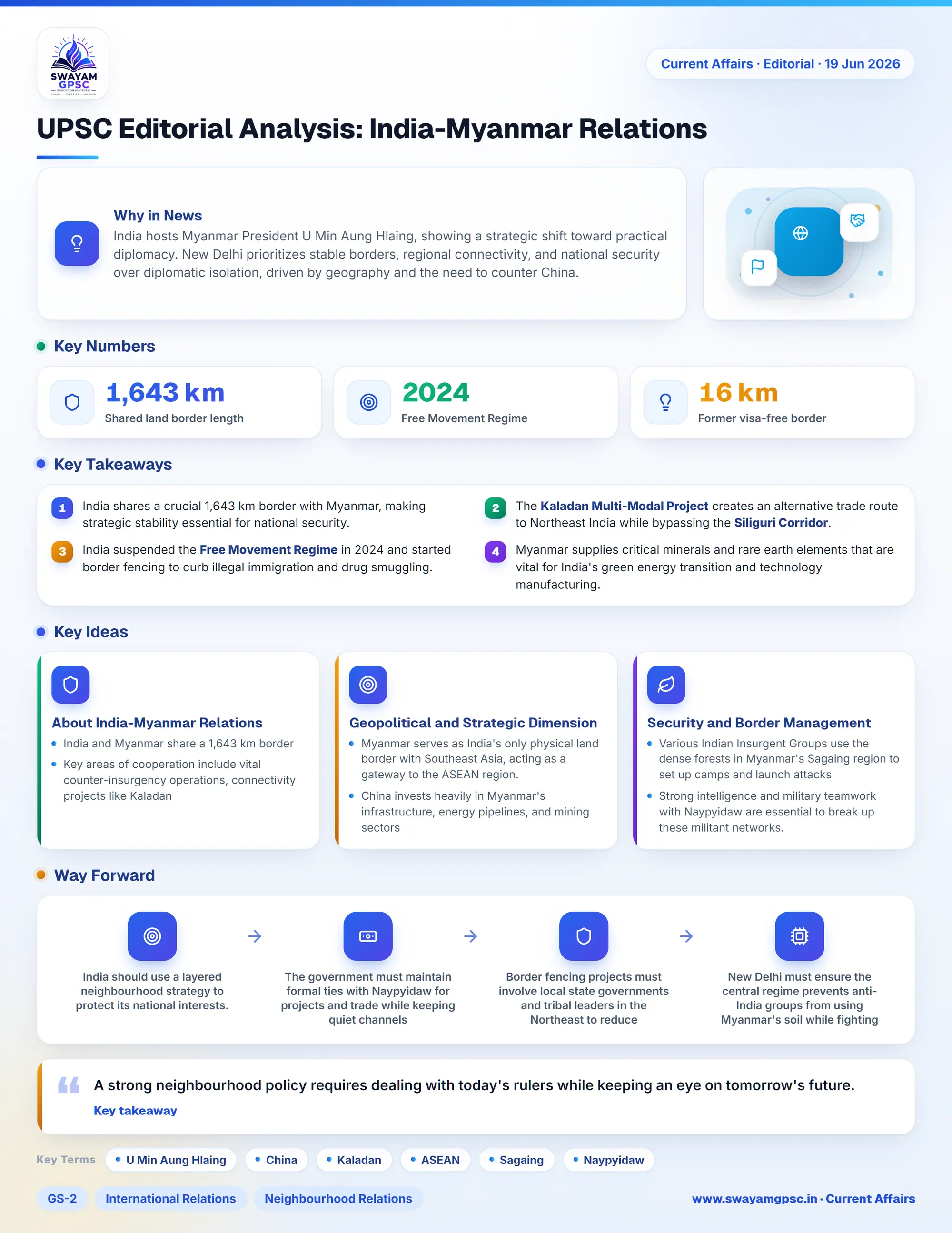
UPSC Editorial Analysis: India-Myanmar Relations
#GS-2 #International Relations #Neighbourhood Relations #Security #Infrastructure #Economy
Key takeaways
- India shares a crucial 1,643 km border with Myanmar, making strategic stability essential for national security.
- The Kaladan Multi-Modal Project creates an alternative trade route to Northeast India while bypassing the Siliguri Corridor.
- India suspended the Free Movement Regime in 2024 and started border fencing to curb illegal immigration and drug smuggling.
- Myanmar supplies critical minerals and rare earth elements that are vital for India's green energy transition and technology manufacturing.
Why in News
- India hosts Myanmar President U Min Aung Hlaing, showing a strategic shift toward practical diplomacy.
- New Delhi prioritizes stable borders, regional connectivity, and national security over diplomatic isolation, driven by geography and the need to counter China.
About India-Myanmar Relations
- India and Myanmar share a 1,643 km border, which makes strategic realism the driving force behind their bilateral ties.
- Key areas of cooperation include vital counter-insurgency operations, connectivity projects like Kaladan, and balancing China in the region.
Geopolitical and Strategic Dimension
- Myanmar serves as India's only physical land border with Southeast Asia, acting as a gateway to the ASEAN region.
- China invests heavily in Myanmar's infrastructure, energy pipelines, and mining sectors, gaining direct access to the Bay of Bengal and bypassing the Malacca Strait.
- India cannot step back from diplomatic engagement without giving China complete dominance over the region.
Security and Border Management Dimension
- Various Indian Insurgent Groups use the dense forests in Myanmar's Sagaing region to set up camps and launch attacks into India's Northeast.
- Strong intelligence and military teamwork with Naypyidaw are essential to break up these militant networks.
- Political instability in Myanmar has boosted arms smuggling, drug trade from the Golden Triangle, and organized cybercrime networks.
Economic and Infrastructure Connectivity
- The Kaladan Multi-Modal Project connects Kolkata port to Sittwe Port by sea, moves through the Kaladan River to Paletwa, and links to Mizoram by road.
- This project creates an alternative route to Northeast India, avoiding the vulnerable Siliguri Corridor, also known as the Chicken's Neck.
- The India-Myanmar-Thailand Trilateral Highway aims to connect Moreh in Manipur directly to Mae Sot in Thailand for better land trade.
- Myanmar supplies heavy rare earth elements and critical minerals, which are essential for India's green energy transition and technology manufacturing.
- The Rupee-Kyat settlement mechanism allows smooth bilateral trade without relying on Western currency clearing systems.
Socio-Cultural and Civilisational Dimension
- Deep spiritual and historical bonds connect India and Myanmar.
- President Min Aung Hlaing highlighted these shared ties by offering prayers at Bodh Gaya at the start of his state visit.
The Realism versus Idealism Dilemma
- As a democracy, India faces a tough choice when dealing with a military government.
- Boycotting the regime for moral reasons would harm immediate border security, so India chooses stability over political alignment.
Internal Political Fragmentation
- The central junta, known as the Tatmadaw, does not control the entire country.
- Ethnic Armed Organisations and People's Defence Forces actively control or fight for many areas bordering India.
- Depending only on the military junta carries long-term risks if Myanmar's political situation changes suddenly.
The Border Frontier Friction
- In 2024, India suspended the Free Movement Regime, which allowed border villagers to travel 16 km across the border without a visa, and started building a fence.
- While fencing helps stop illegal immigration and smuggling, local tribes like the Mizos and Nagas strongly oppose it because of deep family and cultural ties.
Way Forward
- India should use a layered neighbourhood strategy to protect its national interests.
- The government must maintain formal ties with Naypyidaw for projects and trade while keeping quiet channels open with ethnic groups near transit routes.
- Border fencing projects must involve local state governments and tribal leaders in the Northeast to reduce social anger.
- New Delhi must ensure the central regime prevents anti-India groups from using Myanmar's soil while fighting drug and cybercrime cartels together.
- India should send humanitarian aid directly for local healthcare, digital literacy, and heritage projects so ordinary citizens see India as a true partner.
Conclusion
- A strong neighbourhood policy requires dealing with today's rulers while keeping an eye on tomorrow's future.
- India's eastern frontier depends on diplomatic flexibility to protect security while keeping communication open across Myanmar's changing political scene.