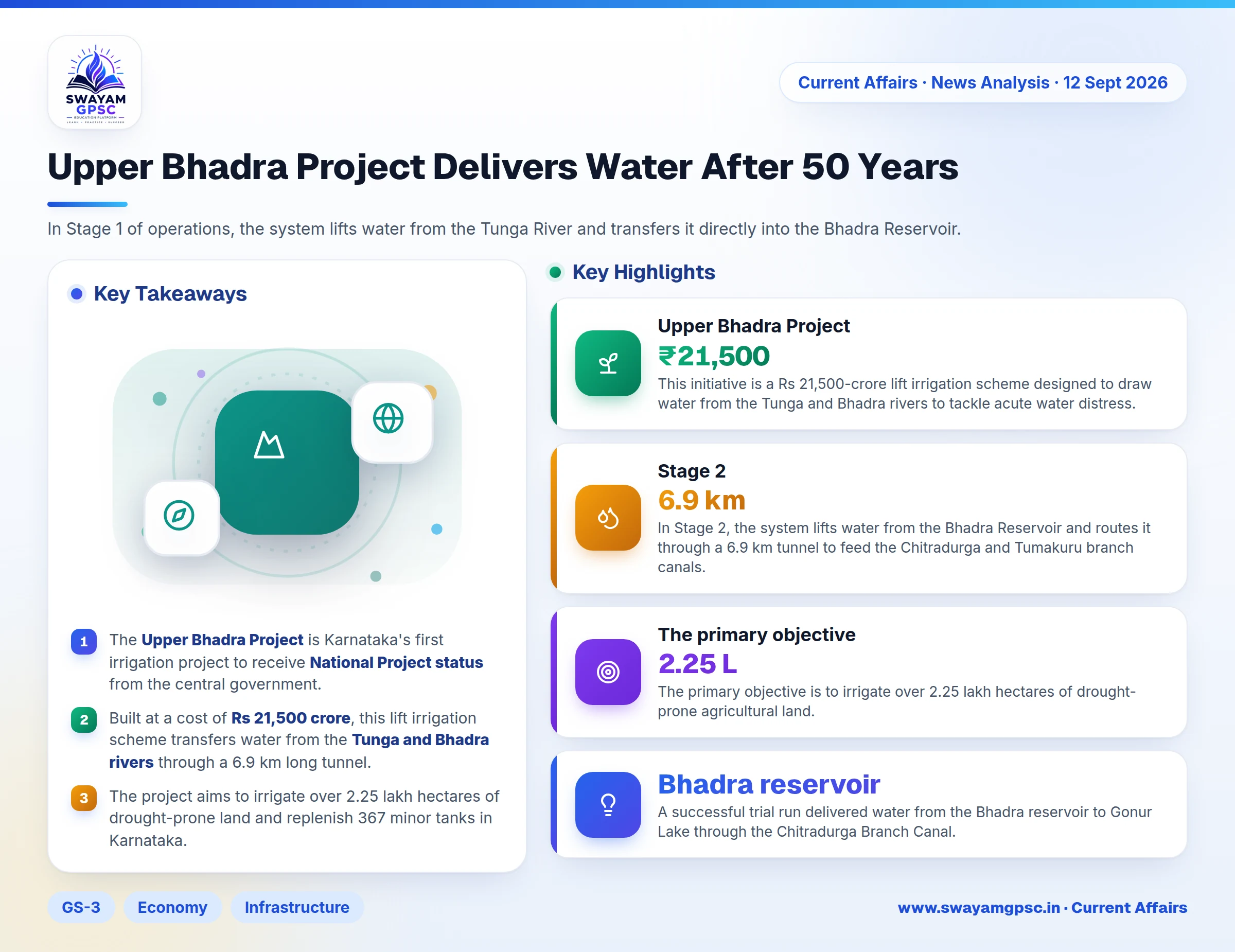
Upper Bhadra Project Delivers Water After 50 Years
#GS-3 #Economy #Infrastructure #Geography #Resources #GS-2 #Current Events #National #Upper Bhadra Project #Irrigation Projects #Water Resources
Key takeaways
- The Upper Bhadra Project is Karnataka's first irrigation project to receive National Project status from the central government.
- Built at a cost of Rs 21,500 crore, this lift irrigation scheme transfers water from the Tunga and Bhadra rivers through a 6.9 km long tunnel.
- The project aims to irrigate over 2.25 lakh hectares of drought-prone land and replenish 367 minor tanks in Karnataka.
- Water from the Bhadra reservoir reached Gonur Lake after a 50-year wait for the local population.
Why in News
- A successful trial run delivered water from the Bhadra reservoir to Gonur Lake through the Chitradurga Branch Canal.
- This achievement ended a 50-year wait for residents living in central Karnataka.
- The trial marks the operational start of the Upper Bhadra Project, which aims to solve severe water scarcity in semi-arid zones.
Upper Bhadra Project
- The central government granted National Project status to this irrigation scheme, making it the first project in Karnataka to receive this designation for central financial assistance.
- This initiative is a Rs 21,500-crore lift irrigation scheme designed to draw water from the Tunga and Bhadra rivers to tackle acute water distress.
- In Stage 1 of operations, the system lifts water from the Tunga River and transfers it directly into the Bhadra Reservoir.
- In Stage 2, the system lifts water from the Bhadra Reservoir and routes it through a 6.9 km tunnel to feed the Chitradurga and Tumakuru branch canals.
- The primary objective is to irrigate over 2.25 lakh hectares of drought-prone agricultural land.
- The project also aims to fill 367 minor irrigation tanks across Chitradurga, Davanagere, Tumakuru, and Chikkamagaluru districts.
Bhadra River
- The Bhadra River originates at Gangamoola peak in the Western Ghats and flows eastward across the Deccan Plateau.
- It joins the Tunga River at Koodli near Shivamogga to form the Tungabhadra River.
- The Tungabhadra River serves as a major tributary of the Krishna River before flowing into the Bay of Bengal.