UPI at 10: Digital Payments Revolution and Monetization Framework
#GS-3 #Economy #Banking #Infrastructure #Current Events #National #Digital Payments
Key takeaways
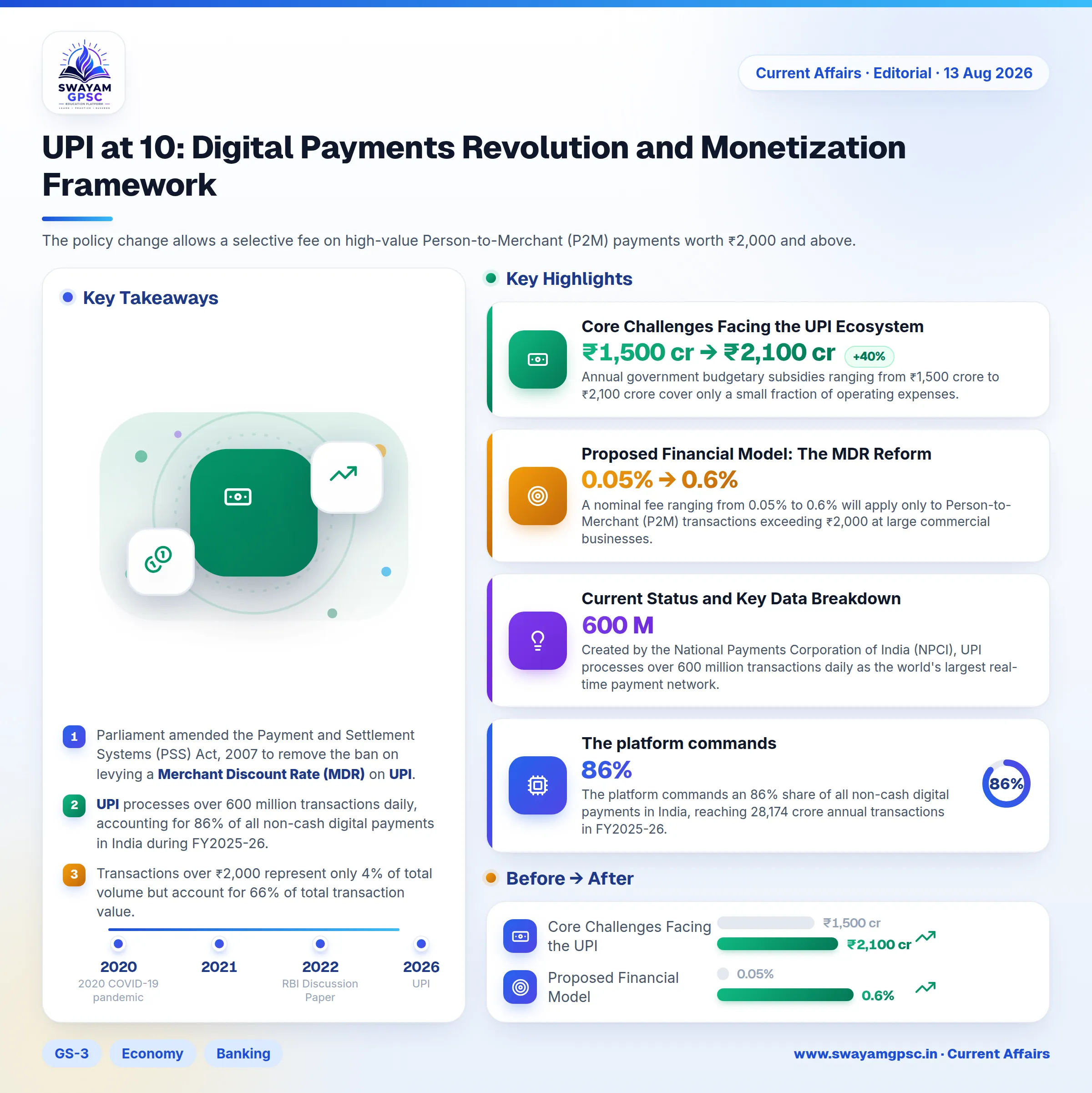
- Parliament amended the Payment and Settlement Systems (PSS) Act, 2007 to remove the ban on levying a Merchant Discount Rate (MDR) on UPI.
- UPI processes over 600 million transactions daily, accounting for 86% of all non-cash digital payments in India during FY2025-26.
- Transactions over ₹2,000 represent only 4% of total volume but account for 66% of total transaction value.
- Operating UPI technology and fraud prevention infrastructure costs the industry ₹20,000 crore annually, far exceeding government subsidies.
- The proposed reform keeps all P2P transfers and sub-₹2,000 merchant payments completely free, charging only high-value commercial transactions.
Why in News
- Parliament passed the Taxation and Other Laws (Amendment) Bill, 2026 as UPI completed a decade of operations.
- The legislation modifies Section 10A of the Payment and Settlement Systems (PSS) Act, 2007.
- This amendment removes the legal prohibition against levying a Merchant Discount Rate (MDR) on UPI and RuPay debit card payments.
- The policy change allows a selective fee on high-value Person-to-Merchant (P2M) payments worth ₹2,000 and above.
- Everyday peer-to-peer transfers and micro-payments will stay completely free for ordinary citizens.
Current Status and Key Data Breakdown
- Created by the National Payments Corporation of India (NPCI), UPI processes over 600 million transactions daily as the world's largest real-time payment network.
- The platform commands an 86% share of all non-cash digital payments in India, reaching 28,174 crore annual transactions in FY2025-26.
- More than 55 crore citizens actively use the system, supported by 703 ecosystem entities including banks and fintech providers.
- In July 2026 alone, the network handled 2,366 crore transactions valued at ₹29.9 lakh crore.
- Transactions below ₹500 account for 86% of total transaction volume, showing massive usage for daily micro-purchases.
- Payments ranging between ₹501 and ₹2,000 make up 10% of total transaction volume.
- High-value transfers above ₹2,000 represent only 4% of overall volume, but they account for 66% of total transaction value.
- Market concentration remains very high because PhonePe and Google Pay process 80% of total volume and 83% of total value.
- Public sector major SBI handles just 0.1% of overall transaction volume.
Evolution and Key Growth Drivers
- The Reserve Bank of India (RBI) laid the foundation in its 2012-13 payment vision documents by highlighting IMPS for mobile transfers.
- The pilot launch occurred in April 2016 under RBI and NPCI, leading to full operational launch in August 2016.
- The 2016 currency demonetization and the 2020 COVID-19 pandemic accelerated a nationwide shift from cash toward contactless QR payments.
- Venture capital investments into fintech firms expanded retail merchant infrastructure between 2019 and 2021.
- Following the Nandan Nilekani Committee recommendations in 2020, the government imposed a 0% MDR on UPI and RuPay cards to expand adoption.
Core Challenges Facing the UPI Ecosystem
- Operating round-the-clock technological networks, compliance systems, and cybersecurity costs the industry roughly ₹20,000 crore annually.
- Annual government budgetary subsidies ranging from ₹1,500 crore to ₹2,100 crore cover only a small fraction of operating expenses.
- Two foreign-backed applications hold over 80% market share, prompting NPCI to delay enforcing its 30% market-cap limit until December 2026.
- Traditional public and private banks have ceded payment volumes to third-party apps, losing direct commercial touchpoints with customers.
- Expanding UPI internationally faces obstacles due to high capital requirements for cross-border clearing and regulatory alignment.
Proposed Financial Model: The MDR Reform
- All Person-to-Person (P2P) transfers and personal transactions will stay 100% free for ordinary consumers.
- Small retail vendors and kirana stores with annual turnover below ₹1 crore to ₹1.5 crore will face zero merchant fees.
- A nominal fee ranging from 0.05% to 0.6% will apply only to Person-to-Merchant (P2M) transactions exceeding ₹2,000 at large commercial businesses.
- This calibrated fee structure targets the top 4% of transactions by volume while shielding 96% of everyday consumer payments.
Arguments Supporting MDR Implementation
- Continuous investment in cloud servers, software upgrades, and fraud prevention requires stable revenues for banks and payment service providers.
- Inadequate government subsidies force financial institutions to absorb losses, which starves the digital payment network of vital capital.
- Monetization ensures system reliability, reducing transaction failure rates and technical downtime during peak usage hours.
- Relying permanently on government subsidies creates an unfair fiscal burden on taxpayers who fund commercial infrastructure.
Arguments Against MDR Implementation
- Levying merchant fees might prompt small shopkeepers to push customers back toward cash to avoid charges and tax monitoring.
- Merchants might pass transaction charges onto consumers by raising retail prices or adding convenience fees.
- Any public perception of hidden charges could reduce digital payment adoption in semi-urban and rural areas.
- Micro-enterprises operating on thin profit margins may resist digital onboarding if transaction costs reduce earnings.
Multidimensional Analysis
- Free payments encouraged informal businesses to enter the banking system, so new fee structures must avoid driving them back to cash.
- Commercial viability lets fintech startups and banks build self-sustaining business models without continuous state aid.
- Zero-cost transactions built strong public trust across low-income households, so keeping transfers below ₹2,000 free protects small vendors.
- Generating commercial revenue gives banks funds to upgrade physical hardware, build backup data centers, and install AI anti-fraud tools.
- Amending the PSS Act, 2007 replaces temporary executive orders with statutory law, giving long-term certainty to financial investors.
Key Institutional Recommendations
- The Watal Committee (2016) recommended market-determined pricing for digital transactions to ensure commercial survival instead of strict price caps.
- The Nandan Nilekani Committee (2019) suggested allowing a non-zero fee structure to help acquiring banks build payment infrastructure in Tier-3 to Tier-6 towns.
- The RBI Discussion Paper (2022) emphasized that payment service providers are commercial companies that need steady revenues to maintain network safety.
Way Forward
- The government should introduce a tiered fee capped between 0.3% and 0.5% for high-value transactions, which remains lower than credit card rates of 1.5% to 2.5%.
- Consumer protection authorities must strictly enforce rules against merchants adding extra charges or convenience fees at checkout.
- Statutory guarantees must permanently protect P2P transfers and sub-₹2,000 merchant transactions from any user fees.
- A portion of fee revenue should flow into the Payment Infrastructure Development Fund (PIDF) to expand rural digital acceptance setups.
- NPCI must establish a fair revenue-sharing framework to compensate issuing banks, acquiring banks, and fintech app providers equitably.
- Empower the NPCI Steering Committee to adjust fee thresholds dynamically as operational infrastructure costs change over time.
- Transition UPI toward credit delivery by enabling pre-sanctioned credit lines via QR codes for small businesses.
- Promote bank-led platforms like BHIM to reduce market reliance on the PhonePe and Google Pay duopoly.
- Accelerate global cross-border linkages, similar to the Singapore PayNow-UPI linkage, across major remittance corridors.
Conclusion
- UPI expanded from six non-cash transactions per capita annually in 2012 to handling over 28,000 crore payments in 2026.
- Transitioning from full state subsidies to a balanced fee model on high-value transactions secures the financial health of payment providers while keeping digital banking universal and affordable.