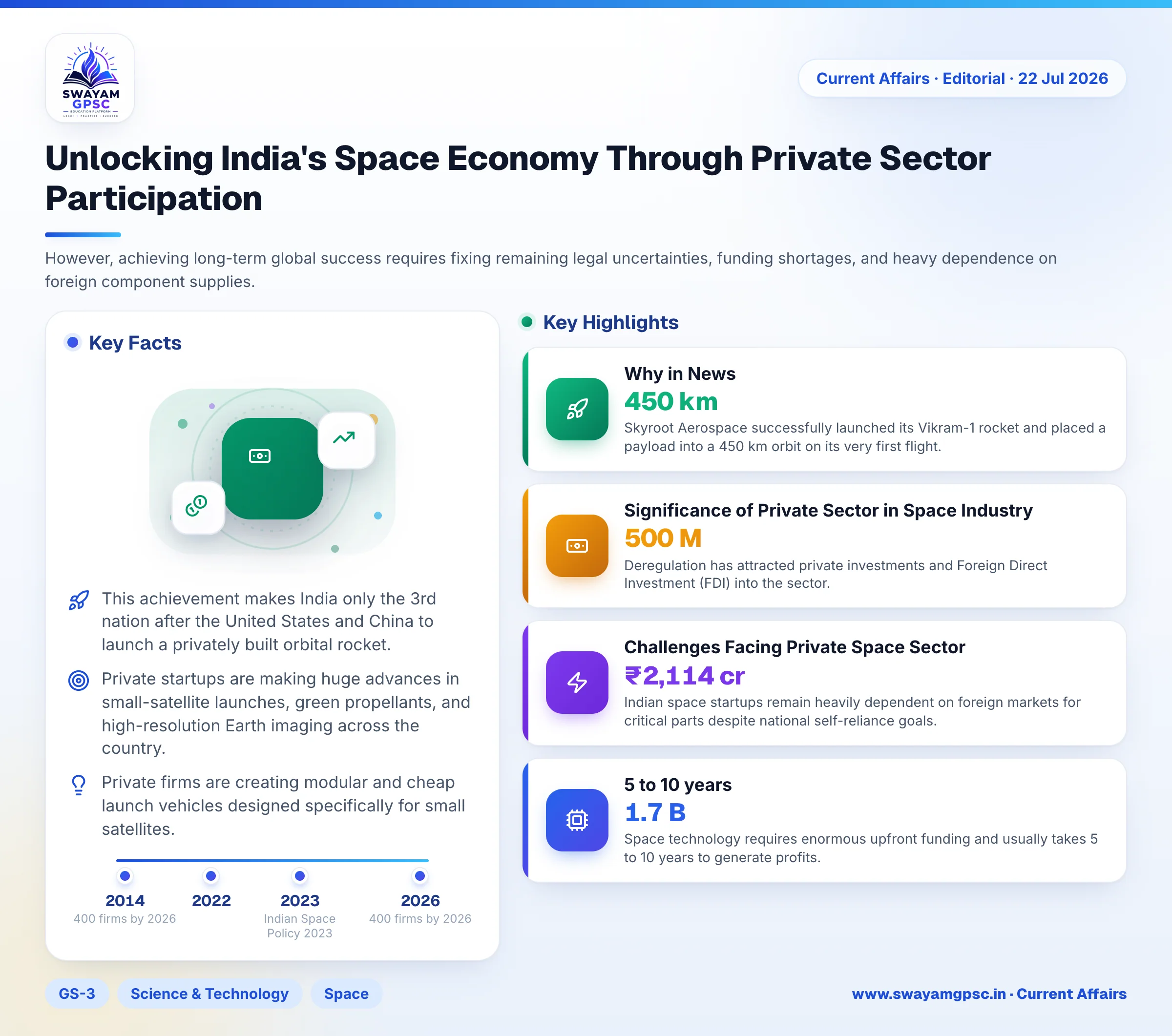
Unlocking India's Space Economy Through Private Sector Participation
#GS-3 #Science & Technology #Space #Economy #Infrastructure #Growth #Current Events #National
Why in News
- Skyroot Aerospace successfully launched its Vikram-1 rocket and placed a payload into a 450 km orbit on its very first flight.
- This achievement makes India only the 3rd nation after the United States and China to launch a privately built orbital rocket.
- Private startups are making huge advances in small-satellite launches, green propellants, and high-resolution Earth imaging across the country.
- However, achieving long-term global success requires fixing remaining legal uncertainties, funding shortages, and heavy dependence on foreign component supplies.
Significance of Private Sector in Space Industry
- Private firms are creating modular and cheap launch vehicles designed specifically for small satellites. Using 3D-printed rocket engines helps them lower production time and launch costs significantly.
- Indian startups are competing with global players like Rocket Lab to meet the rising demand for on-demand small-satellite launches. For example, Skyroot Aerospace built Vikram-1 using a carbon composite body to send payloads to Low Earth Orbit (LEO).
- Private startups are moving beyond basic satellite imaging to provide high-resolution data for agriculture, urban planning, and environmental safety. For example, Bengaluru-based Pixxel built the Firefly series satellites to monitor soil health and track methane gas leaks.
- Deregulation has attracted private investments and Foreign Direct Investment (FDI) into the sector. India had just one space startup in 2014, but that number grew to 400 firms by 2026 with total investments crossing $500 million. Additionally, IN-SPACe registered over 4,500 organisations to support private tech transfer from ISRO.
- Startups are creating clean propulsion systems and in-space satellite servicing tools. For instance, Bellatrix Aerospace designs thrusters using eco-friendly green propellants, while InspeCity works on robotic tools to refuel and repair satellites in orbit.
- Private firms are stepping up to build safety tools for monitoring dangerous space debris and controlling orbital traffic. For example, Digantara uses space sensors and software platforms to track space junk and prevent satellite collisions.
- Leaving routine launches and satellite production to private firms allows ISRO to concentrate on complex scientific missions. Entities like NewSpace India Limited (NSIL) manage daily commercial work, enabling ISRO to focus on the Gaganyaan human spaceflight program, Chandrayaan lunar probes, and the planned Bharatiya Antariksh Station.
- Private players combine cost-effective manufacturing with flexible business practices to capture foreign satellite markets. Guided by the Indian Space Policy 2023, non-government entities now operate across the space chain to make India a global hub.
- The rapid growth of commercial space companies is creating high-skilled jobs and keeping Indian talent within the country. The sector currently employs over 45,000 skilled professionals, attracting experienced engineers back from international firms and state agencies into agile startups.
Challenges Facing Private Space Sector
- India lacks a dedicated legislative Space Activities Act to legally protect and govern private businesses. Although policies like the Indian Space Policy 2023 offer guidelines, past disputes like the Antrix-Devas arbitration dispute show the need for stronger contract protections.
- Space missions carry immense risks, but India has not established a legal limit on financial liabilities for private operators. Unlike the United States under its Commercial Space Launch Amendments Act or France, Indian startups lack state-backed insurance protections against catastrophic flight failures.
- Satellite navigation, propulsion, and high-resolution imaging technologies can easily be converted into military systems or missile guidance tools. Opening these advanced technologies to multiple private players increases the risk of intellectual property theft and security leaks.
- Indian space startups remain heavily dependent on foreign markets for critical parts despite national self-reliance goals. India imports around ₹2,114 crore worth of specialized space components annually, such as space-grade semiconductors and solar cells, making companies vulnerable to supply chain disruptions like those seen during the Covid-19 pandemic.
- Moving operations to cloud-connected private networks makes space infrastructure more vulnerable to cyberattacks. Startup ground stations operating on limited budgets may lack strong defense systems, risking security disruptions like the KA-SAT satellite attack in Europe.
- Space technology requires enormous upfront funding and usually takes 5 to 10 years to generate profits. While American startups benefit from massive contracts with NASA, ISRO operates on a $1.7 billion budget compared to NASA's $25 billion, leaving local private investors hesitant to fund risky projects like Reusable Launch Vehicles (RLVs).
- Launching hundreds of private commercial satellites into low orbits increases collision risks, known as Kessler Syndrome. Although indigenous firms like Digantara offer tracking tools, India still lacks a comprehensive national system to independently monitor orbital debris.
- Launch facilities at the Satish Dhawan Space Centre, Sriharikota are currently running at full capacity, creating scheduling bottlenecks for private players. Furthermore, a domestic shortage of specialized test chambers forces startups to test hardware abroad, increasing costs compared to global competitors like Rocket Lab and Blue Origin.
Way Forward for Sustainable Growth
- IN-SPACe should launch an Orbital Slot and Spectrum Leasing Credit (OS-SLC) framework to reward clean and efficient satellite technologies. Modeled after United States Federal Communications Commission rules, startups can trade these credits to offset spectrum licensing costs.
- The government should introduce a National Space Sandbox and Regulatory Fast-Track (NSS-RFT) allowing firms to test high-risk innovations for 12 months with reduced liability. Similar to the United Kingdom Civil Aviation Authority sandbox, this will help firms like Bellatrix Aerospace test technologies faster.
- A part of the ₹1,000 crore IN-SPACe Venture Capital Fund should be turned into a sovereign co-investment fund. This fund will match private investments to protect native deep-tech companies from hostile foreign buyouts.
- The Department of Space should adopt a Technology-for-Equity swap policy by sharing ISRO patents and test sites in exchange for small equity stakes in startups. This preserves startup cash reserves while aligning government support directly with startup growth.
- India should offer Green-Space Tax Credits to companies that build debris-clearing systems or green engines on their satellites. Aligning with the World Economic Forum Space Sustainability Rating (SSR), compliant startups should receive tax breaks and launch priority.
- The government should expand the Satellite Bus-as-a-Service (SBaaS) system by mandating state-funded satellite missions to reserve dedicated payload slots for academic and startup research at discounted rates.
- Under the National Geospatial Policy 2022, the government must establish an automated Geospatial Data Clearance Gateway. This will allow trusted private firms to export satellite data globally through fast, pre-approved, and secure networks.
- Central ministries like Defense and Agriculture should be required to source 30% to 40% of their satellite data and launch services from registered private entities. This procurement quota guarantees a steady market for startups and builds financial stability.
Conclusion
- India's commercial space sector bridges national economic ambition with strategic self-reliance.
- Enacting a dedicated Space Activities Act, creating clear risk frameworks, and setting public procurement quotas will transform India into a dominant global space power.