China Proposes POWER Framework for Expanded BRICS Grouping
#GS-2 #Current Events #International #Economy #BRICS #India-China Relations
Key takeaways
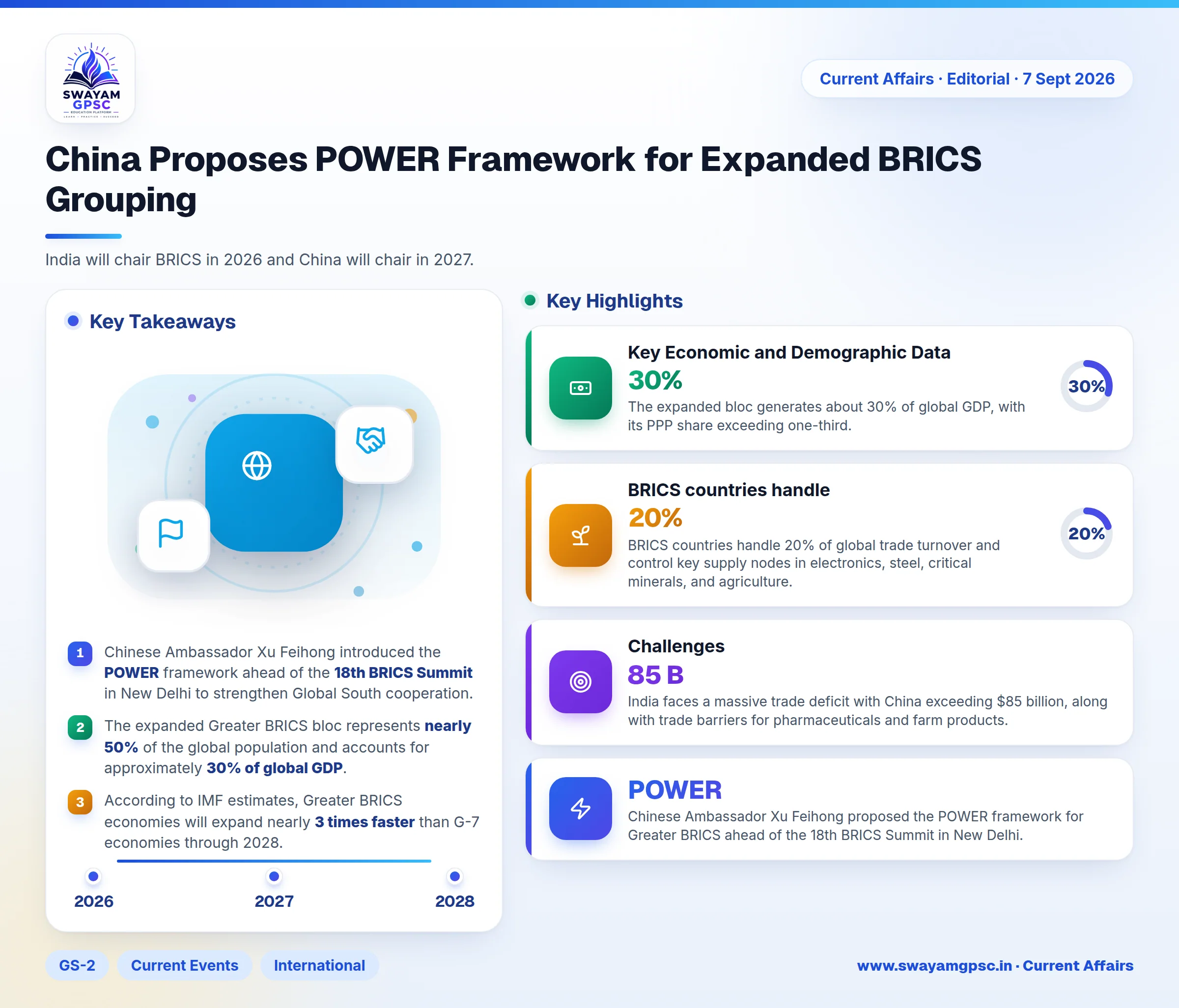
- Chinese Ambassador Xu Feihong introduced the POWER framework ahead of the 18th BRICS Summit in New Delhi to strengthen Global South cooperation.
- The expanded Greater BRICS bloc represents nearly 50% of the global population and accounts for approximately 30% of global GDP.
- According to IMF estimates, Greater BRICS economies will expand nearly 3 times faster than G-7 economies through 2028.
- India faces a heavy structural trade deficit with China exceeding $85 billion, presenting a major hurdle to bilateral economic harmony.
- India and China will hold successive BRICS presidencies in 2026 and 2027, giving both nations a key chance to drive global governance reforms.
Why in News
- Chinese Ambassador Xu Feihong proposed the POWER framework for Greater BRICS ahead of the 18th BRICS Summit in New Delhi.
- The framework calls for stronger Global South cooperation, closer India-China coordination, and collaboration on AI and supply chains.
About The BRICS POWER Framework
- The BRICS grouping evolved from an economic dialogue forum into a key multilateral platform for the Global South after its recent expansion.
- It offers a strong alternative to traditional Western-led institutions like the G-7.
- India will chair BRICS in 2026 and China will chair in 2027.
- The proposed architecture sets out five core pillars for political, financial, technological, and developmental cooperation across emerging markets.
Key Economic and Demographic Data
- Greater BRICS members represent nearly half of the global population, giving them huge domestic consumer bases and labor pools.
- The expanded bloc generates about 30% of global GDP, with its PPP share exceeding one-third.
- IMF estimates show that Greater BRICS economies will grow almost three times faster than G-7 nations through 2028.
- BRICS countries handle 20% of global trade turnover and control key supply nodes in electronics, steel, critical minerals, and agriculture.
- India and China resumed five direct commercial mainland flight routes and reopened border trade after 6 years following diplomatic consensus.
The Five Pillars of BRICS POWER
- Principle requires member states to follow the UN Charter by respecting sovereign equality, avoiding internal interference, and solving border disputes peacefully.
- Member states must counter unilateral actions by supporting initiative frameworks like Beijing's Global Security Initiative.
- Openness calls on countries to protect the WTO-led multilateral trading system and uphold non-discriminatory Most-Favoured-Nation status.
- Members should resist geopolitical decoupling and high tariffs while boosting cross-border work in infrastructure, energy, and supply chains.
- Win-Win emphasizes keeping social and economic development at the center of global talks to achieve UN Sustainable Development Goals.
- Countries should expand local-currency settlements, cross-border payment links, and credit setups to protect against currency shocks and Western sanctions.
- Engine urges the bloc to drive global economic growth by expanding cooperation in digital public infrastructure, green tech, and smart manufacturing.
- Members should share Artificial Intelligence tech through institutions like the China-BRICS AI Development and Cooperation Center.
- Responsibility focuses on using the back-to-back chairing terms of India in 2026 and China in 2027 to bring policy stability to the 10-member group.
- The alliance must push for reforms in the IMF, World Bank, and UN Security Council to give developing nations a bigger voice.
Challenges
- India views BRICS as an independent coalition for strategic autonomy, while China and Russia often treat it as an anti-Western bloc.
- India faces a massive trade deficit with China exceeding $85 billion, along with trade barriers for pharmaceuticals and farm products.
- Unresolved Line of Actual Control border disputes and river dam construction create continuous friction between India and China.
- Switching to local currencies remains hard due to strict capital controls and limited currency convertibility.
- Adding diverse Middle Eastern and African nations makes it harder to reach a consensus on security and trade issues.
Way Forward
- India and China should use their 2026 and 2027 summits to align Global South goals while maintaining peace along their shared border.
- Members should strengthen the New Development Bank and link digital payment networks like UPI with national digital currencies.
- Countries must establish transparent, human-centered governance rules for Artificial Intelligence to avoid corporate monopolies.
- The bloc should build diversified supply networks for renewable energy, fertilizers, and minerals to protect members from export controls.
- Member states must keep pushing for quota updates in the IMF and World Bank, alongside permanent UN Security Council seats.