10 Years of Flexible Inflation Targeting in India: Successes, Limitations, and the Road Ahead
#GS-3 #Economy #Monetary Policy #Inflation #Growth #Flexible Inflation Targeting #Reserve Bank of India #Consumer Price Index
Key takeaways
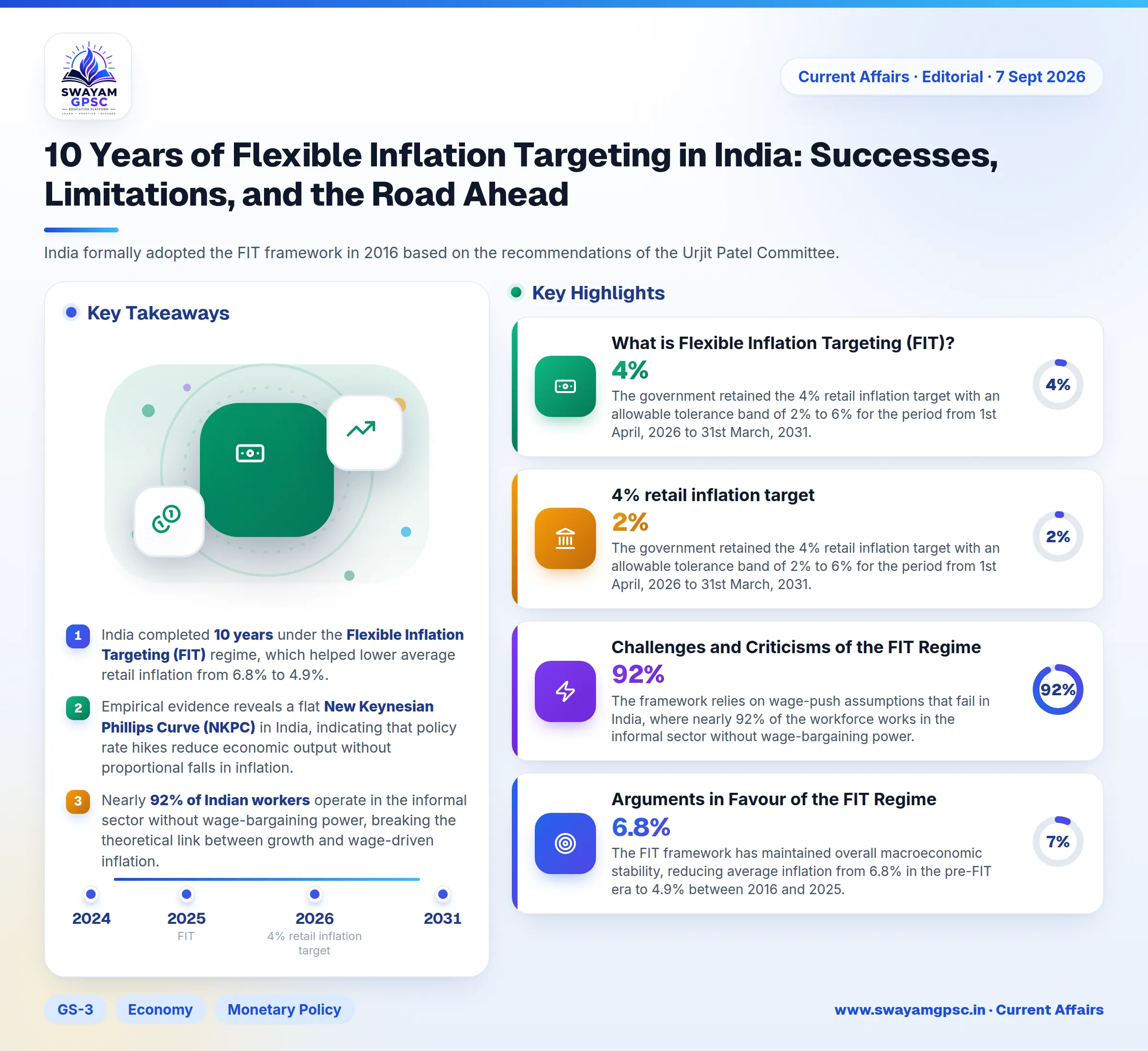
- India completed 10 years under the Flexible Inflation Targeting (FIT) regime, which helped lower average retail inflation from 6.8% to 4.9%.
- Empirical evidence reveals a flat New Keynesian Phillips Curve (NKPC) in India, indicating that policy rate hikes reduce economic output without proportional falls in inflation.
- Nearly 92% of Indian workers operate in the informal sector without wage-bargaining power, breaking the theoretical link between growth and wage-driven inflation.
- Household inflation expectations remain unanchored, consistently exceeding official Reserve Bank of India (RBI) projections by about 4 percentage points.
- Strengthening price stability requires combining monetary policy with coordinated supply-side measures, food buffer releases, and an updated Consumer Price Index (CPI) basket.
Why in News
- India has completed 10 years of implementing the Flexible Inflation Targeting (FIT) monetary framework.
- This completion has prompted significant debate among economists about whether rate hikes effectively control inflation without harming economic growth.
- A major study published in the Economic and Political Weekly (EPW) highlights critical gaps between theoretical monetary models and actual Indian market conditions.
What is Flexible Inflation Targeting (FIT)?
- Flexible Inflation Targeting (FIT) is a monetary policy system where the central bank uses policy interest rates to maintain inflation within a specified, publicly announced range while supporting economic growth.
- India formally adopted the FIT framework in 2016 based on the recommendations of the Urjit Patel Committee.
- Section 45-ZA of the amended Reserve Bank of India Act, 1934 legally mandates the central government to determine the official inflation target every 5 years in consultation with the RBI.
- The government retained the 4% retail inflation target with an allowable tolerance band of 2% to 6% for the period from 1st April, 2026 to 31st March, 2031.
- The central bank uses the Headline Consumer Price Index (CPI-Combined) with 2024 as the base year as the primary anchor to track price changes.
- If average inflation stays outside the 2% to 6% band for 3 consecutive quarters, the RBI fails its official mandate and must submit a detailed explanation report to the government.
Working Mechanism of Inflation Targeting
- The central bank influences inflation primarily through two operational channels: aggregate demand and public expectations.
- Under the aggregate demand channel, the RBI raises the repo rate when price pressures rise.
- Higher policy rates increase commercial lending costs, making consumer credit and business investments more expensive.
- Higher borrowing costs lead households and firms to delay expenditure, reducing overall market demand and cooling price increases.
- Under the expectations channel, setting an explicit numerical target anchors future price expectations among the public.
- When citizens expect general price stability, workers do not demand aggressive wage increases and firms refrain from preemptive price hikes.
The New Keynesian Phillips Curve (NKPC) Concept
- The New Keynesian Phillips Curve (NKPC) outlines the theoretical relationship between national economic output and inflation rates.
- The model assumes that rising economic output expands employment and gives workers stronger bargaining power to demand higher wages.
- Firms then increase product prices to cover these higher wage costs, generating an upward-sloping inflation curve.
- Under standard NKPC theory, monetary authorities suppress inflation by reducing output or lowering public expectations.
Challenges and Criticisms of the FIT Regime
- Empirical economic data from April 2012 to March 2026 indicates that India has a nearly flat Phillips Curve.
- A flat curve means that raising interest rates reduces national output and employment significantly without yielding a proportional reduction in inflation, raising risks of stagflation.
- The framework relies on wage-push assumptions that fail in India, where nearly 92% of the workforce works in the informal sector without wage-bargaining power.
- Because informal workers are price takers rather than price setters, economic expansion does not trigger wage-driven inflation.
- Public inflation expectations remain unanchored, with household expectations consistently exceeding central bank projections by about 4 percentage points.
- Indian inflation is largely driven by supply-side shocks such as volatile food prices, monsoon failures, and global energy price fluctuations.
- Because monetary policy is purely a demand-management tool, interest rate hikes cannot resolve agricultural supply shortages or fuel supply shocks.
- High interest rates place an unequal burden on the real economy, squeezing MSMEs and prospective homebuyers while dampening job growth in construction and manufacturing.
- The central bank also faces liquidity management friction when managing foreign exchange reserves creates surplus market liquidity that undermines high interest rate stances.
Arguments in Favour of the FIT Regime
- The FIT framework has maintained overall macroeconomic stability, reducing average inflation from 6.8% in the pre-FIT era to 4.9% between 2016 and 2025.
- Inflation performance followed an inverted-U trajectory, remaining close to the 4% target in initial and recent periods while peaking near 6% during the COVID-19 pandemic and European conflicts.
- Central bank research covering 1991 to 2023 shows that India achieves maximum economic growth when retail inflation remains near the 4% baseline target.
- Statutory backing for the Monetary Policy Committee (MPC) has enhanced institutional independence and insulated monetary decisions from fiscal pressures.
- Rate hikes prevent temporary food and energy price shocks from embedding into general core inflation and wider public inflation expectations.
- A transparent rate framework preserves real interest rate differentials against global central banks, protecting the value of the Indian Rupee and preventing capital flight.
- The flexibility built into the 2% to 6% tolerance band allows policymakers to absorb severe external shocks without abandoning medium-term price stability.
Way Forward
- The government and central bank should establish a joint food inflation response mechanism that automatically triggers buffer stock releases and import duty adjustments when food inflation hits 6% over three months.
- Policymakers should evaluate whether targeting Core Inflation provides a more stable anchor than headline CPI, which is heavily skewed by volatile food items.
- Monetary transmission should be extended to the informal economy by introducing transparent benchmark pricing for NBFCs and MFIs alongside credit guarantees for small businesses.
- The government should reintroduce liquid, retail-oriented Inflation-Indexed Bonds to provide households with a reliable inflation hedge beyond physical assets like gold.
- The MPC should establish clear quantitative triggers for second-round inflation effects before raising interest rates, minimizing unnecessary growth costs.
- Statistical authorities should update the CPI consumption basket weightings, which currently rely on an outdated 2011-12 base, to reflect modern household spending patterns where food carries a smaller weight.
- Long-term structural investments in climate-resilient cold chains, modern storage facilities, and agricultural processing are essential to prevent recurring supply shocks.