Opening DRDO Missile Production to Private Industry in India
#GS-3 #Science & Technology #Defence #GS-2 #Current Events #National #Economy #Infrastructure #Defence Production
Key takeaways
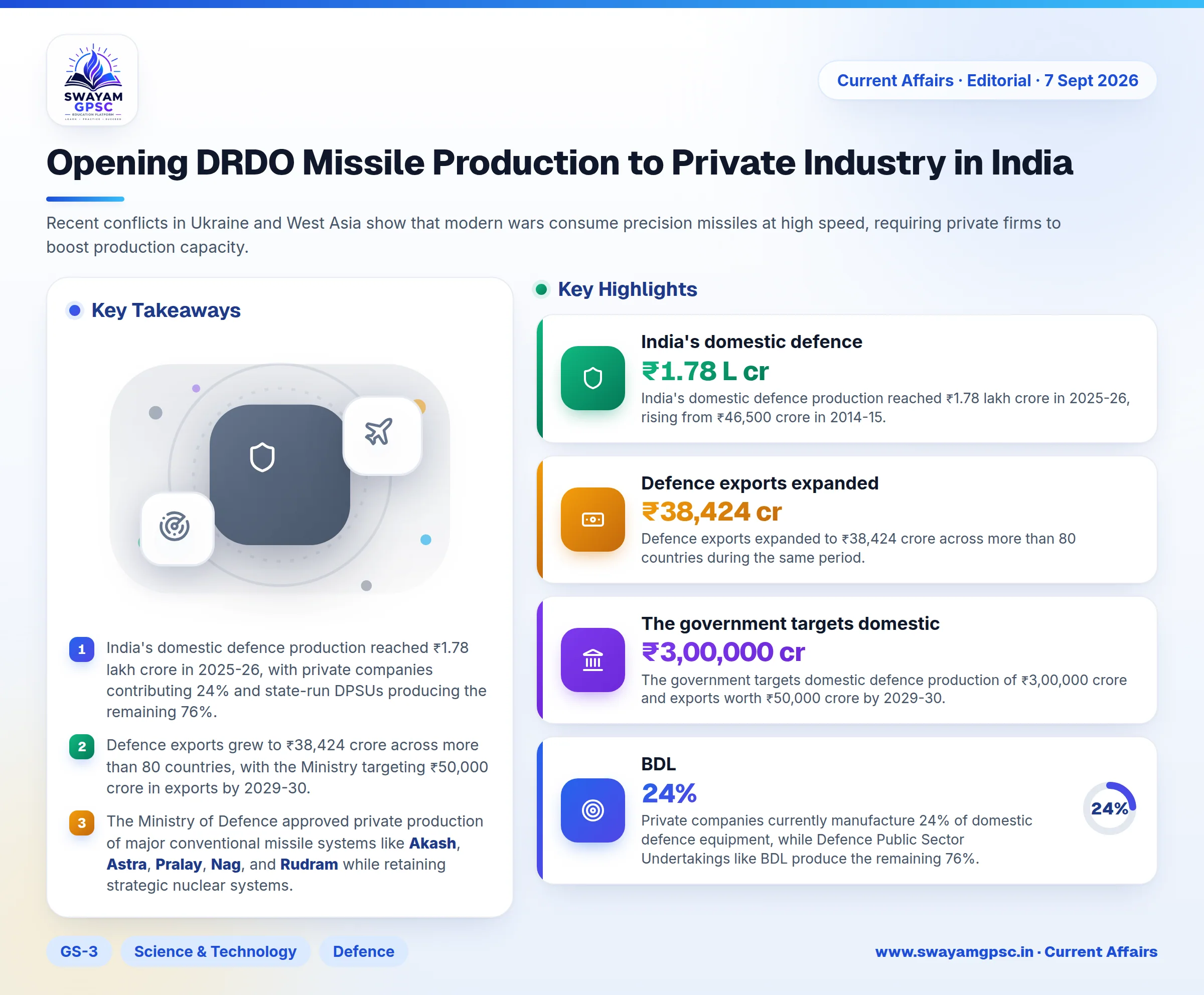
- India's domestic defence production reached ₹1.78 lakh crore in 2025-26, with private companies contributing 24% and state-run DPSUs producing the remaining 76%.
- Defence exports grew to ₹38,424 crore across more than 80 countries, with the Ministry targeting ₹50,000 crore in exports by 2029-30.
- The Ministry of Defence approved private production of major conventional missile systems like Akash, Astra, Pralay, Nag, and Rudram while retaining strategic nuclear systems.
- Indian private defence companies face high capital costs with borrowing rates of 8-11%, compared to 3-5% accessible to Western and Chinese rivals.
Why in News
- The Ministry of Defence approved the transfer of DRDO missile technologies for conventional weapons to private domestic companies.
- This policy covers systems such as Akash, Astra, Pralay, Nag, and Rudram, while keeping strategic nuclear missiles under exclusive government control.
- Transferring these manufacturing capabilities breaks government monopolies, though true strategic autonomy needs private funding in high-risk military research.
Background
- India's domestic defence production reached ₹1.78 lakh crore in 2025-26, rising from ₹46,500 crore in 2014-15.
- Defence exports expanded to ₹38,424 crore across more than 80 countries during the same period.
- The government targets domestic defence production of ₹3,00,000 crore and exports worth ₹50,000 crore by 2029-30.
- Private companies currently manufacture 24% of domestic defence equipment, while Defence Public Sector Undertakings like BDL produce the remaining 76%.
Key Dimensions of the Move
- Recent conflicts in Ukraine and West Asia show that modern wars consume precision missiles at high speed, requiring private firms to boost production capacity.
- Concentrating missile manufacturing in state units like BDL facilities in Telangana creates single targets, while regional private assembly lines offer better protection.
- Faster production schedules ensure that the Indian Army, Navy, and Air Force receive weapon refills quickly during emergencies.
- Top private weapon assemblers generate business for hundreds of smaller MSME suppliers that make micro-electronics, composite bodies, and precision actuators.
- Proven conventional missiles like Akash and Astra have high export potential in Southeast Asia, Africa, and the Middle East through private joint ventures.
- Competition among private manufacturers reduces the per-unit purchasing cost of missiles for the military compared to state-run production models.
- Transferring established weapon production frees DRDO scientists to focus on advanced tech like hypersonic vehicles, directed-energy weapons, and quantum navigation.
- Allowing private access to DRDO testing facilities lowers entry costs for new domestic aerospace companies.
Structural Limitations and Challenges
- Transfer of Technology treats private firms as simple factory assemblers rather than creative innovators who own core intellectual property.
- Major Indian corporate groups hesitate to spend high-risk capital on military research, unlike US defense giants that spend billions on original design.
- Long procurement delays under the Defence Acquisition Procedure (DAP) leave private capital idle without guaranteed multi-year order commitments.
- Indian private firms pay high interest rates of 8-11% on loans, compared to 3-5% paid by Western and Chinese rivals.
- State-owned DPSUs receive preference through nominated orders and cheap government funding, creating an uneven playing field for private competitors.
Way Forward
- India should move toward joint development where private companies invest 30-50% of research capital in exchange for shared intellectual property.
- Parliament should set up a statutory non-lapsable defence fund to give private investors confidence through guaranteed long-term procurement.
- The government needs to bring back weighted tax deductions of up to 200% on corporate spending in military research and development.
- Expanding the Defence Testing Infrastructure Scheme (DTIS) will let private companies test new weapons independently without waiting for state facilities.
- The MoD should scale up schemes like iDEX and the Technology Development Fund (TDF) to support large corporate projects instead of small component startups alone.
Conclusion
- Opening conventional missile production to private manufacturers removes major supply bottlenecks and expands industrial capacity across the country.
- Achieving real self-reliance under Aatmanirbhar Bharat requires private corporations to invest heavy capital into fundamental research rather than remaining simple assembly lines.