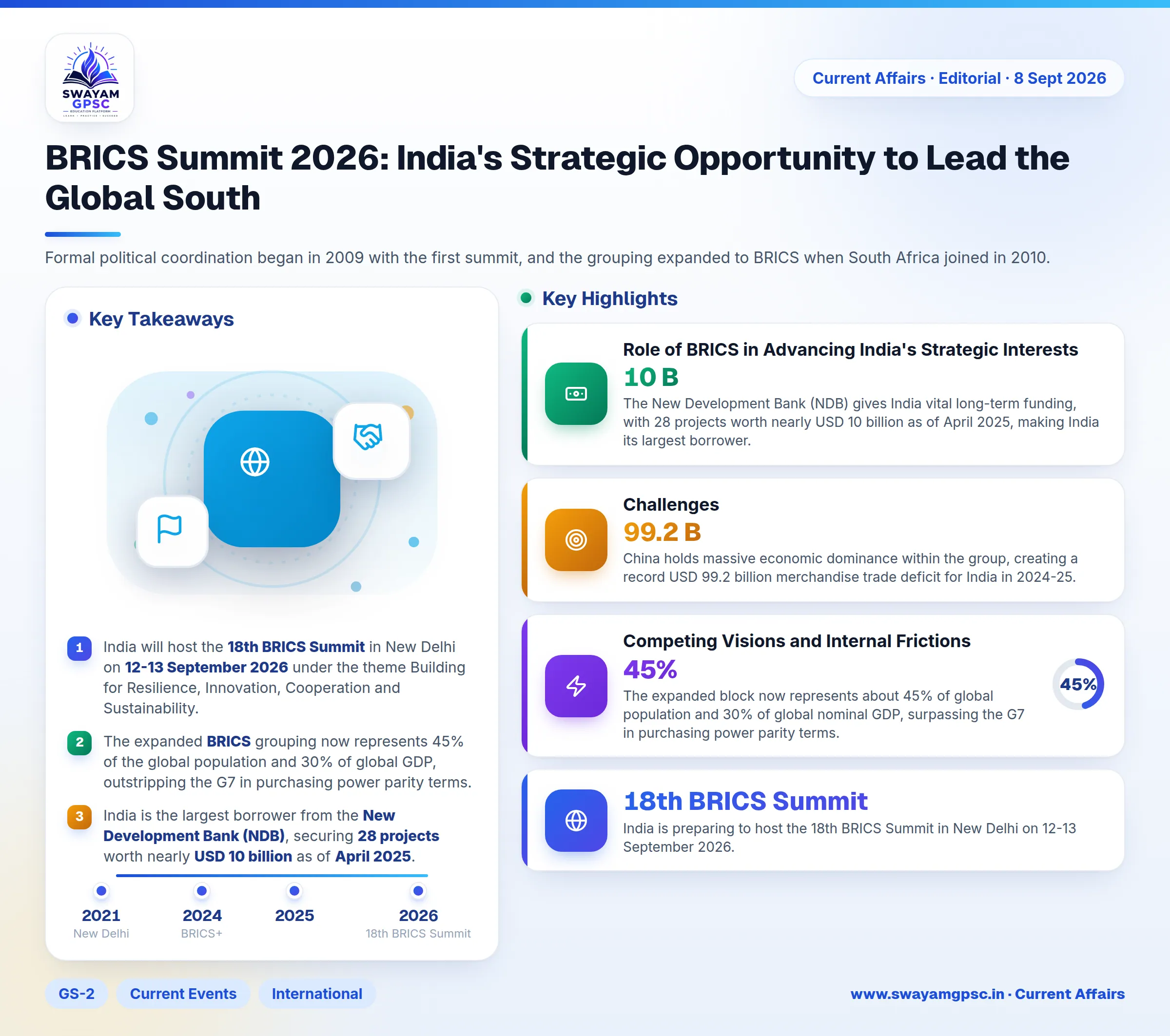
BRICS Summit 2026: India's Strategic Opportunity to Lead the Global South
#GS-2 #Current Events #International #Groupings & Agreements Involving India #Effect of Policies on India's Interests
Key takeaways
- India will host the 18th BRICS Summit in New Delhi on 12-13 September 2026 under the theme Building for Resilience, Innovation, Cooperation and Sustainability.
- The expanded BRICS grouping now represents 45% of the global population and 30% of global GDP, outstripping the G7 in purchasing power parity terms.
- India is the largest borrower from the New Development Bank (NDB), securing 28 projects worth nearly USD 10 billion as of April 2025.
- India faced a record merchandise trade deficit of USD 99.2 billion with China in 2024-25, highlighting critical strategic import dependencies.
- India advocates for a non-Western reform agenda using local currency trade and digital public infrastructure, while opposing attempts to turn BRICS into an anti-Western bloc.
Why in News
- India is preparing to host the 18th BRICS Summit in New Delhi on 12-13 September 2026.
- The summit comes at a crucial time as the grouping faces internal friction, trade imbalances, and competing geopolitical visions after its recent expansion.
- India officially assumed the BRICS chairship on 1 January 2026 under the theme Building for Resilience, Innovation, Cooperation and Sustainability.
Overview and Evolution of BRICS
- British economist Jim O'Neill from Goldman Sachs originally coined the term BRIC in 2001 to highlight four fast-growing emerging economies.
- Formal political coordination began in 2009 with the first summit, and the grouping expanded to BRICS when South Africa joined in 2010.
- The grouping expanded significantly into BRICS+ by admitting Egypt, Ethiopia, Iran, Saudi Arabia, and the UAE in January 2024, followed by Indonesia in January 2025.
- Although listed as an official member on the website, Saudi Arabia has not yet formally finalized its full membership status.
- The BRICS block operates as an informal, consensus-based forum without a founding charter, permanent secretariat, or supranational authority.
- Cooperation across the grouping rests on three main pillars: political consultations, economic cooperation, and people-to-people exchanges.
- India previously hosted summits in New Delhi in 2012, Goa in 2016, and virtually in 2021.
- At the 2012 New Delhi Summit, India proposed establishing a multilateral development bank, which led to the creation of the New Development Bank (NDB).
- The first President of the NDB was Indian banker K. V. Kamath, and the bank now operates its Indian Regional Office at GIFT City in Gujarat.
- India's 2026 chairship adopts a people-centric Humanity First approach to drive international cooperation.
Role of BRICS in Advancing India's Strategic Interests
- The BRICS forum allows India to pursue multi-alignment by engaging with major non-Western powers without joining any formal military alliance.
- The platform gives India a stronger collective voice to demand comprehensive reforms in the UN Security Council, IMF, World Bank, and WTO.
- Through BRICS, India strengthens its position as a leading voice for the Global South, addressing key issues like food security and climate finance.
- The New Development Bank (NDB) gives India vital long-term funding, with 28 projects worth nearly USD 10 billion as of April 2025, making India its largest borrower.
- These funds support key infrastructure projects like the Chennai Metro, Mumbai Metro, and the Namo Bharat high-speed rail line.
- The grouping opens wider export markets for Indian pharmaceuticals, digital services, textiles, and green energy products across member nations.
- The expanded block helps secure India's energy and critical mineral needs through access to oil, gas, lithium, cobalt, and nickel.
- India can share its successful digital public infrastructure models like Aadhaar, UPI, CoWIN, and the India Stack with partner nations.
- Trading in local currencies through bilateral swaps helps India lower reliance on the US Dollar and protect its economy from foreign exchange shocks.
Challenges
- The grouping includes diverse political systems ranging from democracies to monarchies, which often leads to generic declarations rather than actionable policies.
- China holds massive economic dominance within the group, creating a record USD 99.2 billion merchandise trade deficit for India in 2024-25.
- Because decisions require complete consensus, individual members can easily block or delay important agreements.
- A wide gap exists between ambitious summit promises and actual operational delivery on the ground.
Competing Visions and Internal Frictions
- Two competing visions exist within the expanded group: India's vision of a non-Western reformist coalition versus the China-Russia vision of an anti-Western counterweight.
- The expanded block now represents about 45% of global population and 30% of global nominal GDP, surpassing the G7 in purchasing power parity terms.
- Regional rivalries among new member states threaten to create diplomatic gridlock, resembling historical roadblocks seen in SAARC.
- China is actively building parallel international systems like the World AI Cooperation Organisation and the Digital Silk Road instead of reforming existing bodies.
- India and Brazil oppose China's push for a common BRICS clearing currency, preferring direct trade settlement in national currencies instead.
- China continues to withhold explicit support for permanent UN Security Council seats for India and Brazil despite talking about Global South unity.
Way Forward
- India should use its 2026 chairship to establish an Implementation Index with fixed deadlines to track progress on summit commitments.
- India must lead efforts to reform voting quotas at the Bretton Woods institutions while expanding local currency settlement systems.
- Member states should form a BRICS Critical Minerals Cartel to guarantee secure supply chains for lithium, cobalt, and rare earth elements.
- Rather than pushing for a premature free trade agreement, India should set up sector-specific trade facilitation groups to boost exports.
- India can establish a BRICS digital public infrastructure repository to share technology while ensuring strong cybersecurity and data privacy.
- India must build smaller issue-based coalitions like IBSA to push for democratic global governance reforms without turning BRICS into an anti-Western bloc.
- India should act as a pragmatic bridge between competing global coalitions to maintain strategic autonomy and defend its national interests.