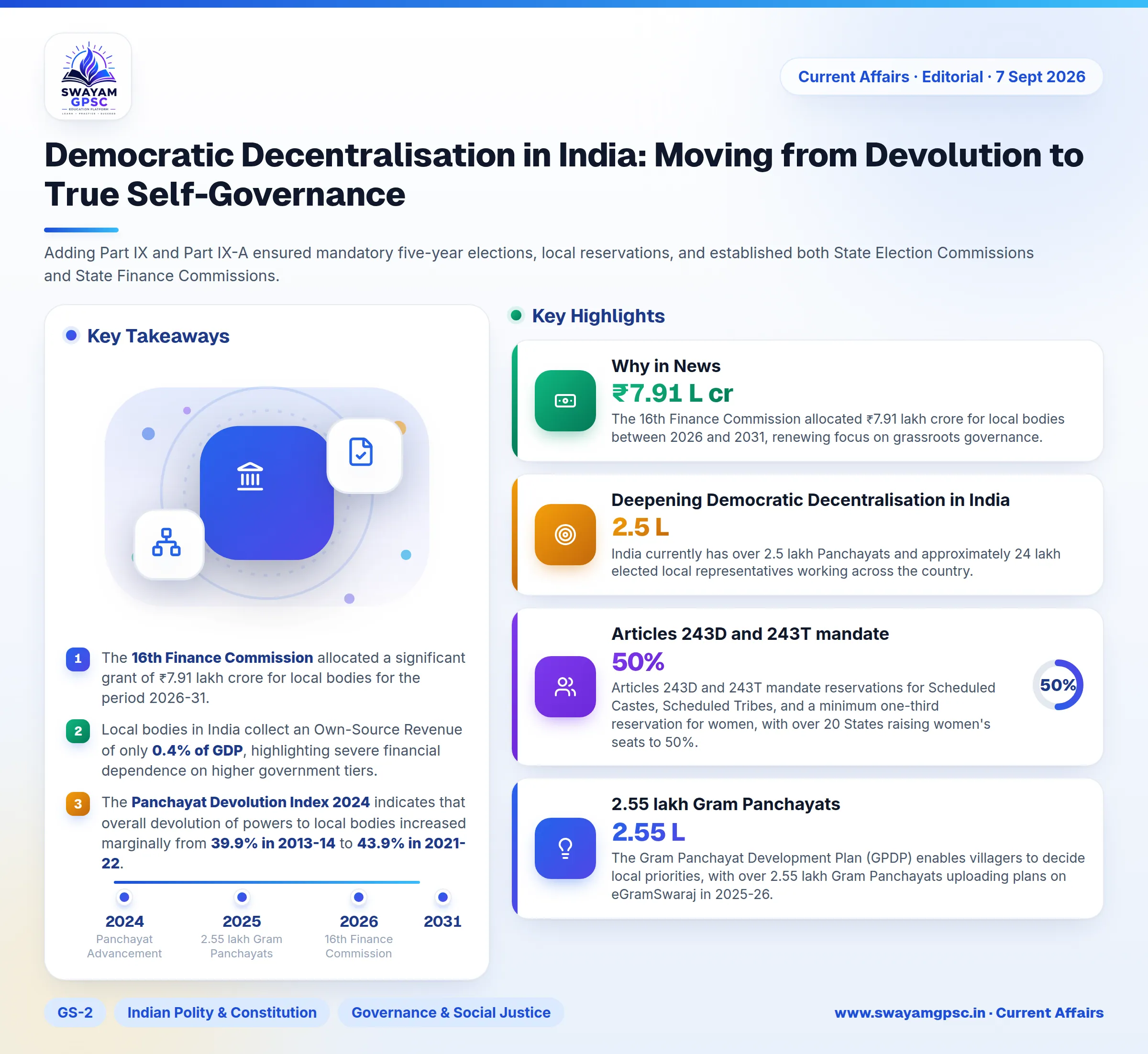
Democratic Decentralisation in India: Moving from Devolution to True Self-Governance
#GS-2 #Indian Polity & Constitution #Governance & Social Justice #Local Self Governance #Constitutional Amendments #Government Policies & Interventions
Key takeaways
- The 16th Finance Commission allocated a significant grant of ₹7.91 lakh crore for local bodies for the period 2026-31.
- Local bodies in India collect an Own-Source Revenue of only 0.4% of GDP, highlighting severe financial dependence on higher government tiers.
- The Panchayat Devolution Index 2024 indicates that overall devolution of powers to local bodies increased marginally from 39.9% in 2013-14 to 43.9% in 2021-22.
- India has created a vast grassroots democracy consisting of over 2.5 lakh Panchayats and 24 lakh elected representatives, with 50% seats reserved for women across more than 20 States.
Why in News
- The 16th Finance Commission allocated ₹7.91 lakh crore for local bodies between 2026 and 2031, renewing focus on grassroots governance.
- Although the 73rd and 74th Constitutional Amendments gave local bodies constitutional status in 1992, Panchayats and municipalities still lack complete transfer of funds, functions, and functionaries.
- This situation requires revitalizing Mahatma Gandhi's vision of Gram Swaraj, where empowered villages operate as self-governing democratic units.
Deepening Democratic Decentralisation in India
- The Community Development Programme in 1952 and the National Extension Service in 1953 initiated rural development through bureaucracy, but both lacked popular public participation.
- The Balwant Rai Mehta Committee recommended a three-tier Panchayati Raj system in 1957, leading to Rajasthan launching Panchayati Raj at Nagaur in 1959, followed by the Ashok Mehta Committee in 1978 advocating party participation and regular elections.
- The 73rd and 74th Constitutional Amendments in 1992 permanently transformed Panchayats and Municipalities into constitutional institutions of self-government.
- Adding Part IX and Part IX-A ensured mandatory five-year elections, local reservations, and established both State Election Commissions and State Finance Commissions.
- The Eleventh Schedule assigned 29 subjects to Panchayats, while the Twelfth Schedule allocated 18 functions to Municipalities.
- India currently has over 2.5 lakh Panchayats and approximately 24 lakh elected local representatives working across the country.
- The Gram Sabha serves as the primary instrument of direct democracy in India by approving local plans, monitoring spending, and holding leaders accountable.
- Articles 243D and 243T mandate reservations for Scheduled Castes, Scheduled Tribes, and a minimum one-third reservation for women, with over 20 States raising women's seats to 50%.
- The Gram Panchayat Development Plan (GPDP) enables villagers to decide local priorities, with over 2.55 lakh Gram Panchayats uploading plans on eGramSwaraj in 2025-26.
- The Panchayats (Extension to Scheduled Areas) Act, 1996 (PESA) granted tribal Gram Sabhas control over customary resources, land, and local disputes, with 8 out of 10 PESA States framing rules by December 2025.
- Digital initiatives like eGramSwaraj, Meri Panchayat, and AI-powered SabhaSaar integrated with Bhashini have automated local governance in 13 regional languages.
- The SVAMITVA Scheme utilizes drone mapping and GIS technology to issue legal property cards to rural households across India.
- Performance measurement tools like the Panchayat Advancement Index and the Panchayat Devolution Index 2024 track institutional growth and encourage competitive governance.
Challenges
- Articles 243G and 243W leave devolution discretionary for states, causing the Panchayat Devolution Index 2024 to register only a modest rise in devolution from 39.9% in 2013-14 to 43.9% in 2021-22.
- Local bodies generate an Own-Source Revenue of only 0.4% of GDP, leaving them dependent on central grants and tied state transfers.
- State governments frequently delay setting up State Finance Commissions under Articles 243I and 243Y, while ignoring their fiscal recommendations.
- State cadre administrative officials retain executive control over elected leaders, creating an authority mismatch where citizens blame elected representatives for administrative failures.
- Gram Sabhas suffer from low attendance and elite capture, which prompted a dedicated National Study on Low Participation in Gram Sabhas in 2026.
- Local elections face frequent administrative postponements, while State Election Commissions lack functional autonomy despite the State of Goa v. Fouziya Imtiaz Shaikh (2021) judgment.
- State mining, forestry, and land acquisition laws frequently conflict with PESA, reducing Gram Sabha consultation to formal administrative approval.
- Digital divides across rural Panchayats turn online portal reporting into technocratic compliance rather than genuine deliberative democracy.
- The persistence of proxy representation through Sarpanch Patis limits the real decision-making power of elected women leaders.
Way Forward
- State governments must adopt legally binding Activity Mapping Frameworks to clearly divide powers among local tiers through a structured Function-Finance-Functionary matrix.
- States should set up State Finance Commissions on a fixed national timetable and table their reports before legislatures within 6 months.
- Panchayats and municipalities need dedicated administrative cadres of accountants, engineers, and planners who report directly to elected councils.
- Gram Sabhas must follow fixed annual calendars with enforced social-diversity quorums to ensure meaningful participation of women and marginalized groups.
- Governments should strictly penalize male relative intervention, implement biometric attendance, and expand the Sashakt Panchayat Netri Abhiyan to empower female representatives.
- State governments should align mining, forestry, and land laws with PESA, integrating it with the Forest Rights Act, 2006 and District Mineral Foundation funds.
- District Planning Committees should receive professional staff to integrate rural and urban planning, following models like Odisha’s Rural-Urban Transition Policy, 2023.
- Districts should establish independent Local Government Ombudsmen and extend mandatory social audits across all local development projects.