ISRO's New Space Model: Expanding Private Participation Without Privatisation
#GS-3 #Science & Technology #Space #Economy #Infrastructure #Growth #Current Events #National
Key takeaways
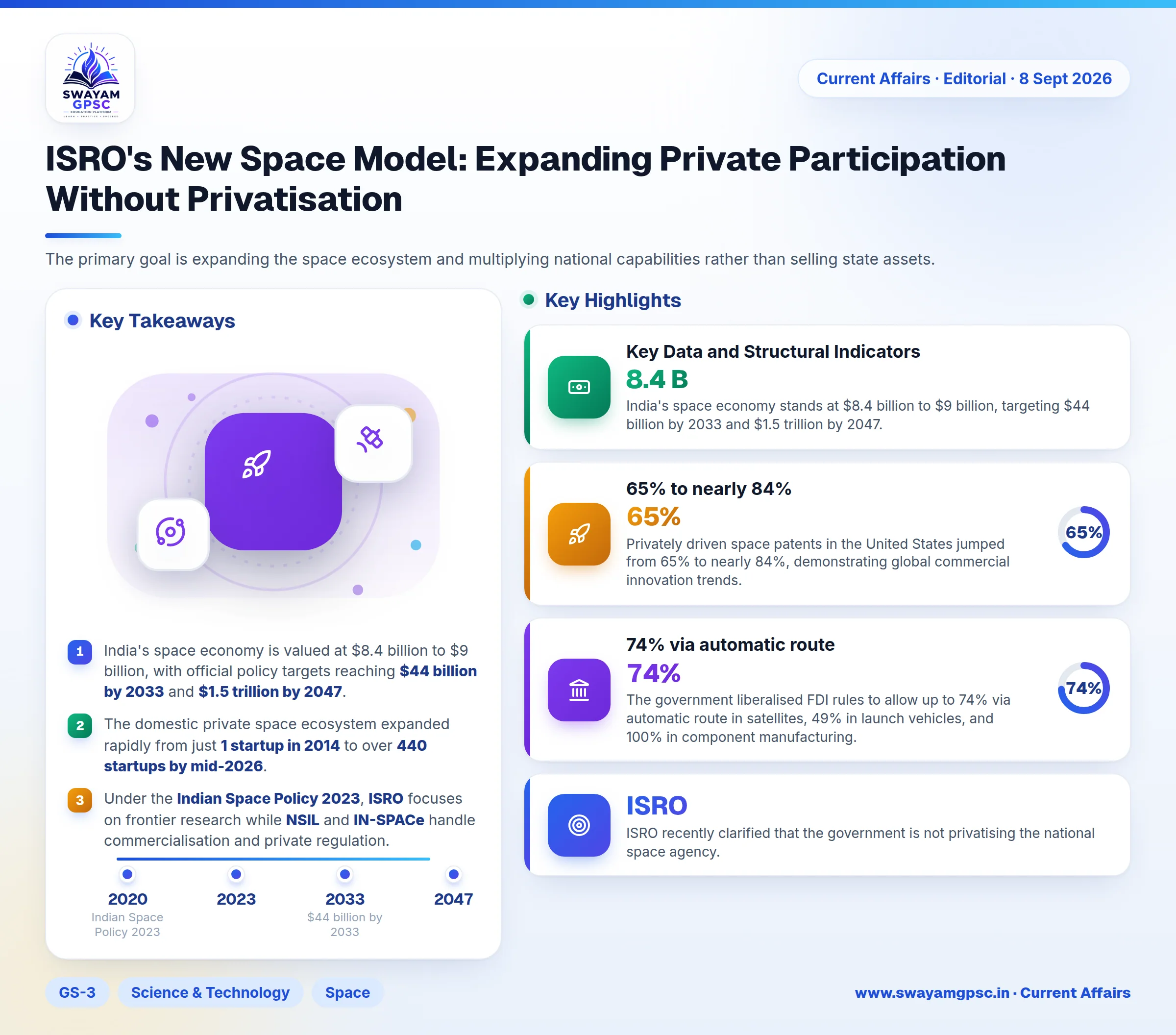
- India's space economy is valued at $8.4 billion to $9 billion, with official policy targets reaching $44 billion by 2033 and $1.5 trillion by 2047.
- The domestic private space ecosystem expanded rapidly from just 1 startup in 2014 to over 440 startups by mid-2026.
- Under the Indian Space Policy 2023, ISRO focuses on frontier research while NSIL and IN-SPACe handle commercialisation and private regulation.
- Liberalised space foreign investment rules allow up to 74% automatic FDI in satellite manufacturing and 100% in satellite components.
Why in News
- ISRO recently clarified that the government is not privatising the national space agency.
- This announcement comes as private companies and PSUs prepare to build operational launch vehicles and satellites.
- The reform allows private firms to handle routine space tasks while ISRO focuses on deep research and scientific missions.
ISRO's New Space Model Architecture
- India initiated major space reforms in 2020 and formalised them through the Indian Space Policy 2023.
- The primary goal is expanding the space ecosystem and multiplying national capabilities rather than selling state assets.
- Under this framework, ISRO concentrates exclusively on advanced research, human spaceflight, deep-space planetary exploration, and national security needs.
- An autonomous single-window regulator named IN-SPACe promotes, authorises, and supervises non-government entities using national space infrastructure.
- The commercial arm NSIL commercialises publicly developed technologies, pools market demand, and transfers mature rocket systems to private industry.
Key Data and Structural Indicators
- India's space economy stands at $8.4 billion to $9 billion, targeting $44 billion by 2033 and $1.5 trillion by 2047.
- The domestic space-tech ecosystem expanded dramatically from 1 startup in 2014 to more than 440 startups by mid-2026.
- Privately driven space patents in the United States jumped from 65% to nearly 84%, demonstrating global commercial innovation trends.
- The government liberalised FDI rules to allow up to 74% via automatic route in satellites, 49% in launch vehicles, and 100% in component manufacturing.
Comparing ISRO and NASA Commercial Approaches
- NASA functions mainly as an anchor customer and buyer of services through fixed-price commercial contracts.
- In contrast, ISRO maintains an integrated developer-operator role, licensing proven technology packages to domestic industry through NSIL.
- For orbital operations, NASA fully outsourced low Earth orbit launches to commercial firms like SpaceX while keeping the heavy Space Launch System (SLS).
- ISRO is transferring workhorse rockets like PSLV, SSLV, and LVM3 to industry while its own engineers develop the Next Generation Launch Vehicle (NGLV).
- While NASA contracts private landers for the Artemis programme, ISRO directly leads major exploration missions including Chandrayaan, Shukrayaan, and Aditya-L1.
- NASA relies on a century-old aerospace industrial base, whereas ISRO actively incubates young startups and upgrades MSME suppliers into full systems integrators.
Core Synergies and Shared Principles
- Both space agencies believe that routine factory manufacturing diverts valuable public scientists away from groundbreaking frontier research.
- Both models grant private companies direct access to state-owned launchpads, testing facilities, and tracking networks like Sriharikota.
- Both frameworks use public funding as catalytic seed capital to attract substantial private investment into the global space market.
Challenges
- Indian space startups face limited venture capital and fewer large government procurement contracts compared to American companies.
- Local suppliers must undergo rigorous quality upgrades to transform from simple parts manufacturers into full-scale orbital rocket integrators.
- India still needs clear legal rules for third-party financial liability, orbital debris management, and affordable space insurance coverage.
- The government must address internal workforce concerns regarding job security, research priorities, and intellectual property inside state facilities.
Way Forward
- NSIL and defence departments should act as guaranteed long-term buyers for private satellite constellations and commercial launch services.
- The Department of Space must build rapid, standardized technology transfer protocols for liquid propulsion, composite materials, and advanced avionics.
- Parliament should pass a dedicated statutory Space Activities Bill to provide legal permanence to IN-SPACe and secure private property rights.
- The government must channel domestic military procurement through the Defence Space Agency (DSA) and Mission DefSpace to guarantee steady market demand.
Conclusion
- While NASA acts as a buyer in a mature commercial market, India is actively building its industrial base through state support and shared infrastructure.
- By combining entrepreneurial private agility with ISRO's proven technical excellence, India is positioning itself as a major global space power.