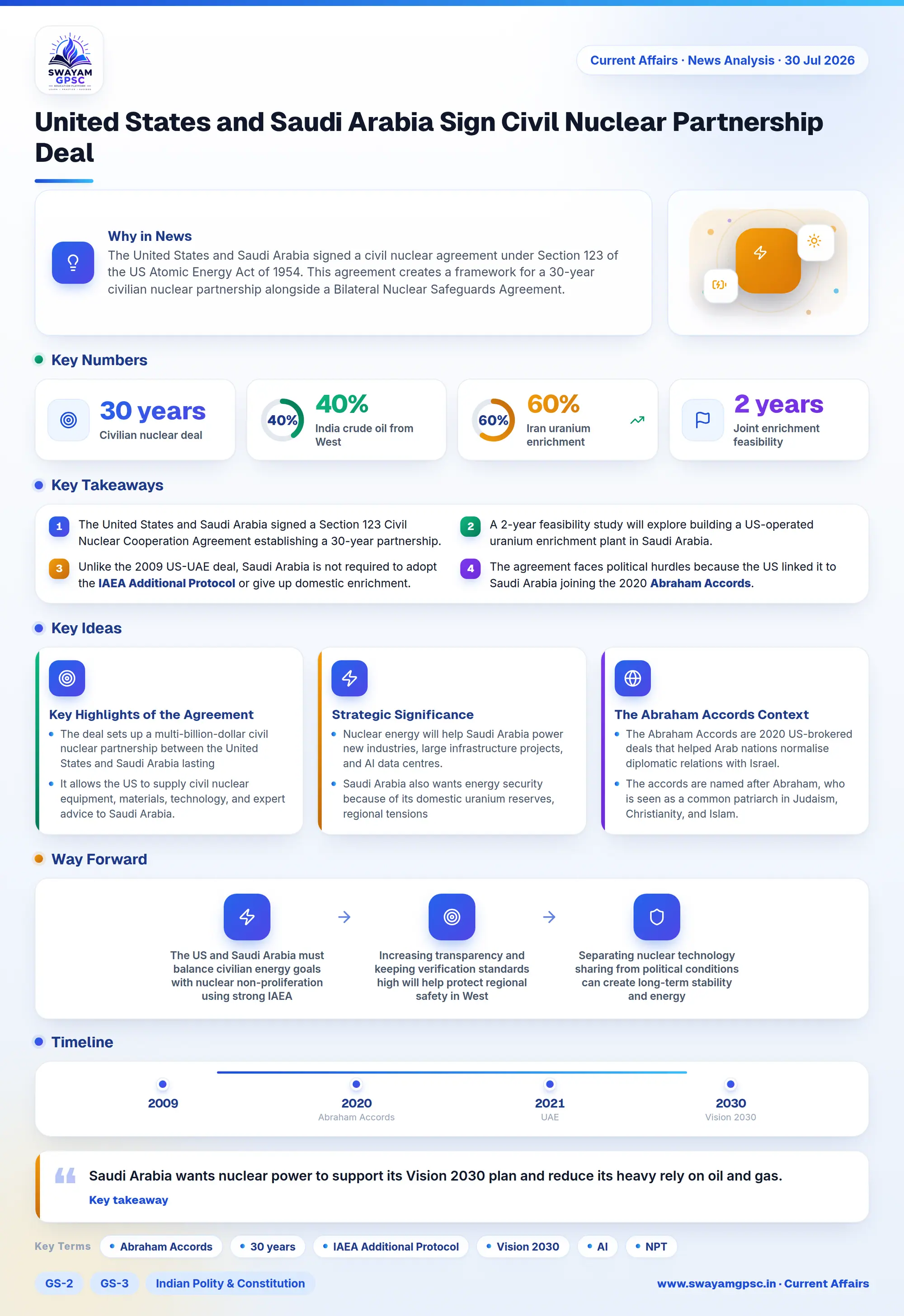
United States and Saudi Arabia Sign Civil Nuclear Partnership Deal
#GS-2 #GS-3 #Indian Polity & Constitution #Governance & Social Justice #Science & Technology #Nuclear Technology #Current Events #International #Groupings & Agreements
Key takeaways
- The United States and Saudi Arabia signed a Section 123 Civil Nuclear Cooperation Agreement establishing a 30-year partnership.
- A 2-year feasibility study will explore building a US-operated uranium enrichment plant in Saudi Arabia.
- Unlike the 2009 US-UAE deal, Saudi Arabia is not required to adopt the IAEA Additional Protocol or give up domestic enrichment.
- The agreement faces political hurdles because the US linked it to Saudi Arabia joining the 2020 Abraham Accords.
- Regional instability from Saudi-Iran competition could impact the 40% of crude oil that India imports from West Asia.
Why in News
- The United States and Saudi Arabia signed a civil nuclear agreement under Section 123 of the US Atomic Energy Act of 1954.
- This agreement creates a framework for a 30-year civilian nuclear partnership alongside a Bilateral Nuclear Safeguards Agreement.
- However, the US stated that the deal will move forward only if Saudi Arabia joins the Abraham Accords and normalises relations with Israel.
Key Highlights of the Agreement
- The deal sets up a multi-billion-dollar civil nuclear partnership between the United States and Saudi Arabia lasting 30 years.
- It allows the US to supply civil nuclear equipment, materials, technology, and expert advice to Saudi Arabia.
- American nuclear companies will get priority status when Saudi Arabia builds its nuclear energy infrastructure.
- Saudi Arabia will import nuclear fuel for its reactors during the initial phase of the agreement.
- Both countries will conduct a 2-year study to check if commercial uranium enrichment inside Saudi Arabia is feasible.
- This study will explore a black box arrangement where sensitive technology remains under complete US control.
- If the study succeeds, US firms will build and run enrichment plants in Saudi Arabia without transferring sensitive technology.
- Unlike the 2009 US-UAE agreement, Saudi Arabia did not permanently give up uranium enrichment or spent fuel reprocessing.
- The agreement does not require Saudi Arabia to sign the IAEA Additional Protocol, which limits intrusive international inspections.
- Critics warn that this arrangement could weaken global non-proliferation rules by allowing dual-use technologies to spread.
Strategic Significance
- Saudi Arabia wants nuclear power to support its Vision 2030 plan and reduce its heavy rely on oil and gas.
- Nuclear energy will help Saudi Arabia power new industries, large infrastructure projects, and AI data centres.
- Saudi Arabia also wants energy security because of its domestic uranium reserves, regional tensions, and concerns over Iran.
- For the US, this deal brings valuable contracts for domestic firms while checking Chinese and Russian influence in West Asia.
- Iran currently operates an advanced nuclear program with uranium enriched up to 60%, which is close to weapons grade.
- Iran claims its program is peaceful under the NPT, but it refuses US demands to stop enrichment.
- Allowing Saudi Arabia to enrich uranium may cause Iran to hold firmer on its own enrichment facilities.
The Abraham Accords Context
- The Abraham Accords are 2020 US-brokered deals that helped Arab nations normalise diplomatic relations with Israel.
- The accords are named after Abraham, who is seen as a common patriarch in Judaism, Christianity, and Islam.
- The initial signers were the UAE, Bahrain, and Morocco in 2020, with Sudan joining in 2021.
- These agreements shifted West Asian diplomacy by opening trade, security, and technology links between Israel and Arab states.
- Saudi Arabia insists it will not normalise relations with Israel without a pathway to an independent Palestinian state based on 1967 borders.
- The Accords helped India form the I2U2 Group with Israel, the UAE, and the US to collaborate on technology and food security.
Implications for India
- Increased rivalry between Saudi Arabia and Iran could destabilise the Strait of Hormuz and push up energy costs for India.
- India relies on West Asia for nearly 40% of its crude oil imports, making regional stability vital.
- The situation tests India's multi-alignment foreign policy because New Delhi maintains strong ties with Washington, Riyadh, Tehran, and Tel Aviv.
- Progress on the India-Middle East-Europe Economic Corridor (IMEC) depends on peace and normal ties between Saudi Arabia and Israel.
- Saudi Arabia's expanding civilian nuclear project could open up non-sensitive infrastructure opportunities for Indian engineering companies.
US-Saudi Deal versus Indo-US Nuclear Deal
- India is not an NPT signatory but received a special 2008 NSG waiver to conduct global nuclear trade.
- Saudi Arabia is an NPT signatory as a Non-Nuclear Weapon State and holds the right to peaceful nuclear energy.
- India received blanket consent for enrichment and reprocessing while separating its civilian and military facilities under IAEA safeguards.
- The Saudi deal allows a 2-year study for a US-run enrichment facility instead of enforcing the strict UAE gold standard.
- India signed an India-specific IAEA Safeguards Agreement and Additional Protocol covering its civilian nuclear sites.
- Saudi Arabia operates under a Comprehensive Safeguards Agreement but is not required to adopt the IAEA Additional Protocol.
- The 2008 Indo-US deal aimed to bring India into the global non-proliferation framework and balance China in the Indo-Pacific.
- The US-Saudi deal supports Vision 2030, limits Chinese and Russian influence, and links nuclear cooperation to the Abraham Accords.
Way Forward
- The US and Saudi Arabia must balance civilian energy goals with nuclear non-proliferation using strong IAEA safeguards.
- Increasing transparency and keeping verification standards high will help protect regional safety in West Asia.
- Separating nuclear technology sharing from political conditions can create long-term stability and energy security.