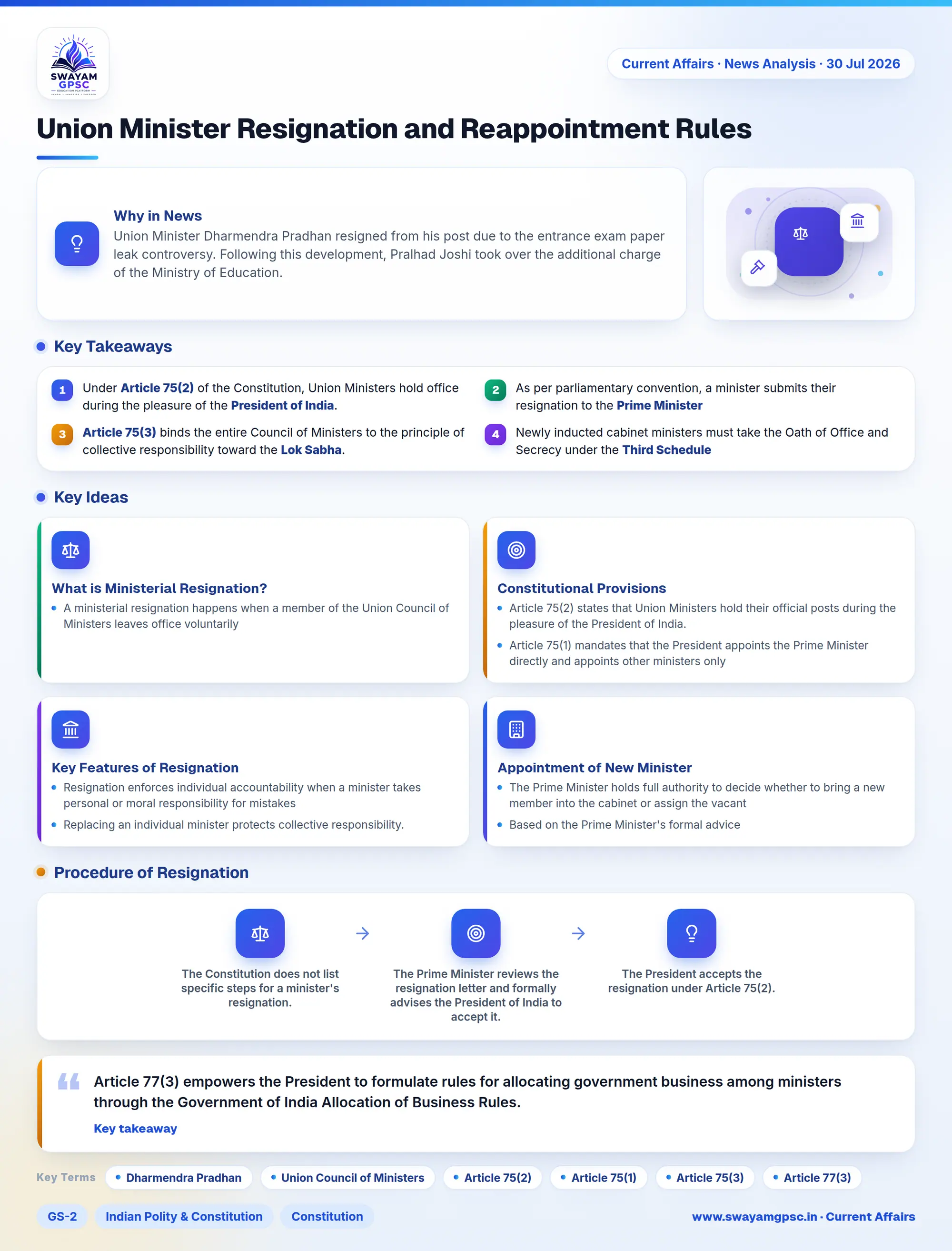
Union Minister Resignation and Reappointment Rules
#GS-2 #Indian Polity & Constitution #Constitution #Executive #Parliament #Governance & Social Justice #Good Governance #Union Minister Resignation #Council of Ministers
Key takeaways
- Under Article 75(2) of the Constitution, Union Ministers hold office during the pleasure of the President of India.
- As per parliamentary convention, a minister submits their resignation to the Prime Minister, who then recommends its acceptance to the President.
- Article 75(3) binds the entire Council of Ministers to the principle of collective responsibility toward the Lok Sabha.
- Newly inducted cabinet ministers must take the Oath of Office and Secrecy under the Third Schedule, whereas existing ministers receiving additional charge do not require a fresh oath.
Why in News
- Union Minister Dharmendra Pradhan resigned from his post due to the entrance exam paper leak controversy. Following this development, Pralhad Joshi took over the additional charge of the Ministry of Education.
What is Ministerial Resignation?
- A ministerial resignation happens when a member of the Union Council of Ministers leaves office voluntarily or on the Prime Minister's request. This action triggers a constitutional process to reassign that ministry to another leader.
Constitutional Provisions
- Article 75(2) states that Union Ministers hold their official posts during the pleasure of the President of India.
- Article 75(1) mandates that the President appoints the Prime Minister directly and appoints other ministers only on the Prime Minister's advice.
- Article 75(3) lays down the principle of collective responsibility, making the entire Council of Ministers answerable to the Lok Sabha.
- Article 77(3) empowers the President to formulate rules for allocating government business among ministers through the Government of India Allocation of Business Rules.
Procedure of Resignation
- The Constitution does not list specific steps for a minister's resignation. By parliamentary tradition, the minister sends the resignation letter directly to the Prime Minister.
- The Prime Minister reviews the resignation letter and formally advises the President of India to accept it.
- The President accepts the resignation under Article 75(2). After this step, Rashtrapati Bhavan releases an official notification.
Key Features of Resignation
- Resignation enforces individual accountability when a minister takes personal or moral responsibility for mistakes, policy failures, or bad administration in their department.
- Replacing an individual minister protects collective responsibility. This change allows the government to function normally without forcing the entire cabinet to resign.
- The resignation takes effect immediately after presidential approval. The outgoing minister gives up all executive powers and duties of that portfolio right away.
Appointment of New Minister and Procedure
- The Prime Minister holds full authority to decide whether to bring a new member into the cabinet or assign the vacant portfolio as an additional charge.
- Based on the Prime Minister's formal advice, the President of India issues an official order to allocate the portfolio.
- If the Prime Minister brings a new person into the cabinet, the President administers the Oath of Office and Secrecy under the Third Schedule of the Constitution.
- If an existing minister takes additional charge of the ministry, no new oath is needed because they have already taken the constitutional oath.